早稲田大学 基幹理工学研究科 電子物理システム学専攻 2023年8月実施 力学 (その1) [1]
Author
Miyake
Description
図1に示すような半径 (radius) a の質量 (mass) の無視できる円環 (circle ring) 上に固定された質量 m の質点 (point mass) の xy 平面内での運動 (motion) について考える。はじめに円環の中心は原点 (0,0) に、質点は (0,−a) にあり、円環は摩擦 (friction) を受けず滑らずに y=−a 上を回転して移動した。円環の中心と直線 y=−a と円環との接点を結んだ線、円環の中心と質点を結んだ線、この二つの線の間の角を θ とおき、重力 (gravity) の向きは −y 方向、重力加速度 (gravitational acceleration) の大きさを g として、以下の問いに答えよ。
(1) 質点の直交座標 (rectangular coordinates) (x,y) を θ を用いて表せ。
(2) θ を一般化座標 (generalized coordinate) として、質点のラグランジアン (Lagrangian) L(θ,θ˙) を示せ。
(3) θ に共役な (conjugate) 一般化運動量 (generalized momentum) pθ を示し、ハミルトニアン (Hamiltonian) H(θ,pθ) を求めよ。
(4) 質点に対するハミルトンの正準方程式 (Hamilton’s canonical equations) を具体的に書き下せ。
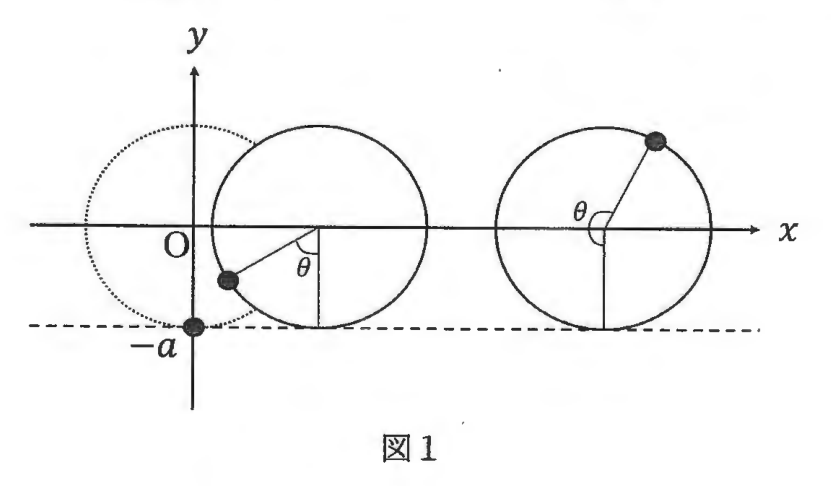
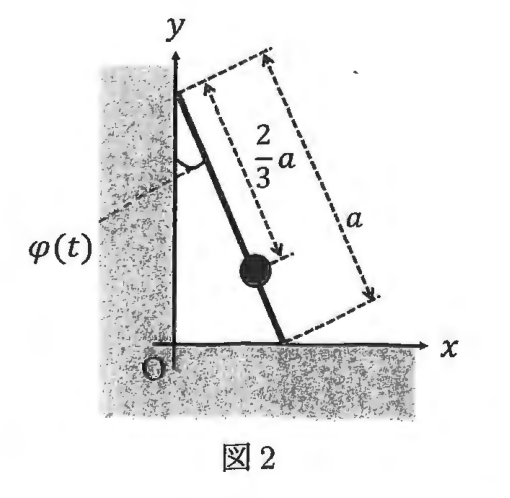
図2に示すような、上端から 2/3 の位置に質量 m の質点を付けた長さ a の棒 (rod) が壁と離れることなく、滑りながら倒れていく場合を考える。重力加速度を g とし、重力は −y 方向に働くものとする。棒の質量、太さおよび棒と壁の間の摩擦は無視できるものとして、以下の問いに答えよ。
(1) 図2に示す通り、時刻 t における棒と y 軸のなす角を φ(t) とするとき、質点の座標 (x(t),y(t)) を φ(t) を用いて表せ。
(2) 時刻 t における質点のラグランジアンを φ(t) を用いて表せ。
(3) 質点に対するラグランジュ方程式 (Lagrange’s equation) を使って、φ(t) の微分方程式 (differential equation) となる運動方程式 (equation of motion) を書き下せ。
题目描述
问1
考虑图1所示的半径为 a、质量可忽略的圆环,以及固定在圆环上、质量为 m 的质点在 xy 平面内的运动。最初圆环的中心位于原点 (0,0),质点位于 (0,−a),圆环不受摩擦且不发生滑动,沿 y=−a 旋转移动。将圆环中心与直线 y=−a 和圆环的接触点的连线,以及圆环中心与质点的连线之间的夹角记为 θ。重力方向为 −y 方向,重力加速度的大小为 g。回答以下问题。
(1) 用 θ 表示质点的直角坐标 (x,y)。
(2) 以 θ 为广义坐标,写出质点的拉格朗日量 L(θ,θ˙)。
(3) 写出与 θ 共轭的广义动量 pθ,并求哈密顿量 H(θ,pθ)。
(4) 具体写出质点的哈密顿正则方程。
问2
如图2所示,长为 a 的杆在距上端全长 2/3 的位置固定了一个质量为 m 的质点。考虑杆始终不离开墙面、边滑动边倒下的情况。设重力加速度为 g,重力沿 −y 方向作用。忽略杆的质量、粗细以及杆与墙面之间的摩擦,回答以下问题。
(1) 如图2所示,将时刻 t 杆与 y 轴的夹角记为 φ(t),用 φ(t) 表示质点坐标 (x(t),y(t))。
(2) 用 φ(t) 表示时刻 t 质点的拉格朗日量。
(3) 利用质点的拉格朗日方程,写出关于 φ(t) 的微分方程,即运动方程。
Kai
問 1
(1)
円環の中心の x 座標は
X=aθ
であり、質点の座標は
xy=X−asinθ=aθ−asinθ,=−acosθ
である。
(2)
x˙y˙=aθ˙−aθ˙cosθ,=aθ˙sinθ
なので、求めるラグランジアンは
L(θ,θ˙)=21m(x˙2 +y˙2)−mgy=ma2θ˙2(1−cosθ)+mgacosθ
である。
(3)
以下のルジャンドル変換と正準方程式は 1−cosθ>0 の範囲で成り立つ。θ=2kπ では速度の係数が零になり、この座標による変換は特異になる。
pθH(θ,pθ)=∂θ˙∂L=2ma2θ˙(1−cosθ),=θ˙pθ−L=2ma2θ˙2(1−cosθ)−ma2θ˙2(1−cosθ)−mgacosθ=ma2θ˙2(1−cosθ)−mgacosθ=4ma2(1−cosθ)pθ2−mgacosθ
(4)
θ˙p˙θ=∂pθ∂H=2ma2(1−cosθ)pθ,=−∂θ∂H=4ma2(1−cosθ)2pθ2sinθ−mgasinθ
問 2
(1)
時刻 t において、棒と床が接触している点の x 座標を X(t) とし、
棒と壁が接触している点の y 座標を Y(t) とすると、
X(t)=asinφ(t), Y(t)=acosφ(t)
なので、
x(t)y(t)=32X(t)=32asinφ(t),=31Y(t)=31acosφ(t)
である。
(2)
x˙(t)y˙(t)=32aφ˙(t)cosφ(t),=−31aφ˙(t)sinφ(t)
なので、求めるラグランジアンは
L(φ,φ˙)=21m(x˙2+y˙2)−mgy=181ma2φ˙2(4cos2φ+sin2φ)−31mgacosφ=181ma2φ˙2(3cos2φ+1)−31mgacosφ
である。
(3)
dtd∂φ˙∂L∂φ∂L=dtd91ma2φ˙(3cos2φ+1)=91ma2(φ¨(3cos2φ+1)−6φ˙2cosφsinφ),=−31ma2φ˙2cosφsinφ+31mgasinφ
なので、求める運動方程式は
φ¨(3cos2φ+1)−6φ˙2cosφsinφ=−3φ˙2cosφsinφ+3agsinφ
∴ φ¨(3cos2φ+1)−3φ˙2cosφsinφ−3agsinφ=0
である。
Reference