跳到主要内容

筑波大学 理工情報生命学術院 システム情報工学研究群 社会工学学位プログラム 2019年1月実施 微分積分

Author​

思齐塾, 祭音Myyura

Description​

実関数 f(x)f(x) を以下のように定める.

f(x)=1x(1−x)f(x) = \frac{1}{x(1-x)}

以下のA, Bに答えよ。

(A) xx を任意の実数としたとき、以下の小問に答えよ。

A-1. 以下をそれぞれ求めよ。

(i) xx が0に近づくときの f(x)f(x) の左側極限値

(ii) xx が0に近づくときの f(x)f(x) の右側極限値

(iii) xx が1に近づくときの f(x)f(x) の左側極限値

(iv) xx が1に近づくときの f(x)f(x) の右側極限値

( xx が aa に近づくときの左側極限値は lim⁡x→a−0f(x)\lim_{x \to a-0} f(x) , lim⁡x→a−f(x)\lim_{x \to a^{-}} f(x) 等と表記され、 xx が aa に近づくときの右側極限値は lim⁡x→a+0f(x)\lim_{x \to a+0} f(x) , lim⁡x→a+f(x)\lim_{x \to a^{+}} f(x) 等と表記される.)

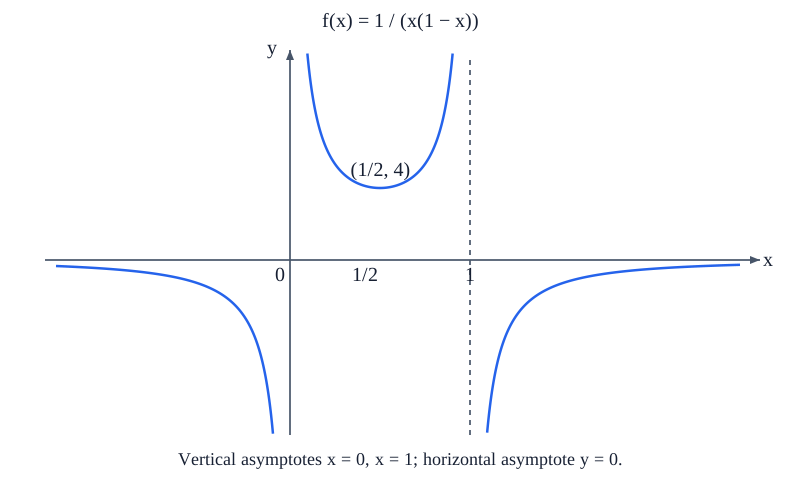
A-2. y=f(x)y = f(x) のグラフを描け.

A-3. ∫121f(x)dx\int_{\frac{1}{2}}^1 f(x)dx を求めよ。

(B) xx を 0<x<10 < x < 1 を満たす実数としたとき、以下の小問に答えよ。

B-1. ∫x12f(x)dx=t\int_x^{\frac{1}{2}} f(x)dx = t としたとき, x=g(t)x = g(t) を求めよ。ただし, g(0)=12g(0) = \frac{1}{2} とする.

B-2. lim⁡t→∞g(t)\lim_{t \to \infty} g(t) と lim⁡t→−∞g(t)\lim_{t \to -\infty} g(t) をそれぞれ求めよ.

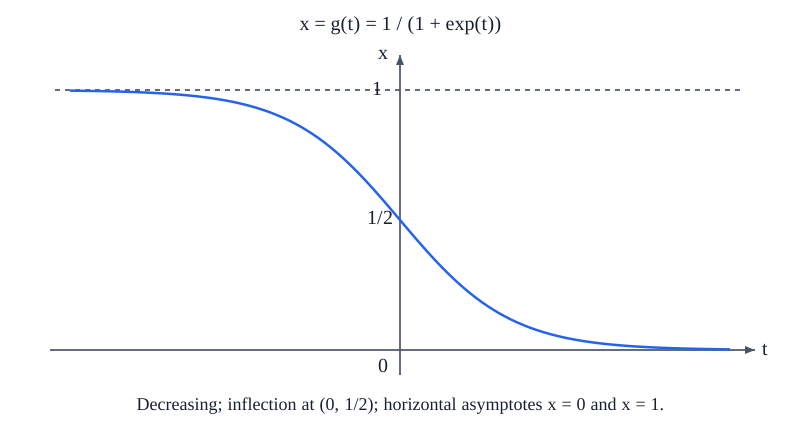
B-3. x=g(t)x = g(t) のグラフを描け。

题目描述​

定义实函数

f(x)=1x(1−x).f(x)=\frac{1}{x(1-x)}.

完成 A、B 两部分。

A. 令 xx 为任意实数。

  1. 分别求以下四个单侧极限:

    (i) lim⁡x→0−f(x),(ii) lim⁡x→0+f(x),\text{(i)}\ \lim_{x\to0^-}f(x),\qquad \text{(ii)}\ \lim_{x\to0^+}f(x),
    (iii) lim⁡x→1−f(x),(iv) lim⁡x→1+f(x).\text{(iii)}\ \lim_{x\to1^-}f(x),\qquad \text{(iv)}\ \lim_{x\to1^+}f(x).

    题面同时说明,左极限可记作 lim⁡x→a−0f(x)\lim_{x\to a-0}f(x) 或 lim⁡x→a−f(x)\lim_{x\to a^-}f(x),右极限可记作 lim⁡x→a+0f(x)\lim_{x\to a+0}f(x) 或 lim⁡x→a+f(x)\lim_{x\to a^+}f(x)。

  2. 画出 y=f(x)y=f(x) 的图像。

  3. 求广义积分

    ∫1/21f(x) dx.\int_{1/2}^{1}f(x)\,dx.

B. 以下令 0<x<10<x<1。

  1. 当

    ∫x1/2f(u) du=t\int_x^{1/2}f(u)\,du=t

    时,将 xx 反解为 x=g(t)x=g(t),并满足 g(0)=12g(0)=\frac12。

  2. 分别求

    lim⁡t→+∞g(t)与lim⁡t→−∞g(t).\lim_{t\to+\infty}g(t) \quad\text{与}\quad \lim_{t\to-\infty}g(t).
  3. 画出 x=g(t)x=g(t) 的图像。

Kai​

A-1.

(i) lim⁡x→0−f(x)=lim⁡x→0−1x(1−x)=lim⁡x→0−1x⋅lim⁡x→0−11−x=(−∞)(1)=−∞\lim_{x \to 0^-} f(x) = \lim_{x \to 0^-} \frac{1}{x(1-x)} = \lim_{x \to 0^-} \frac{1}{x} \cdot \lim_{x \to 0^-} \frac{1}{1-x} = (-\infty)(1) = -\infty

(ii) lim⁡x→0+f(x)=lim⁡x→0+1x(1−x)=lim⁡x→0+1x⋅lim⁡x→0+11−x=(+∞)(1)=+∞\lim_{x \to 0^+} f(x) = \lim_{x \to 0^+} \frac{1}{x(1-x)} = \lim_{x \to 0^+} \frac{1}{x} \cdot \lim_{x \to 0^+} \frac{1}{1-x} = (+\infty)(1) = +\infty

(iii) lim⁡x→1−f(x)=lim⁡x→1−1x(1−x)=lim⁡x→1−1x⋅lim⁡x→1−11−x=(1)(+∞)=+∞\lim_{x \to 1^-} f(x) = \lim_{x \to 1^-} \frac{1}{x(1-x)} = \lim_{x \to 1^-} \frac{1}{x} \cdot \lim_{x \to 1^-} \frac{1}{1-x} = (1)(+\infty) = +\infty

(iv) lim⁡x→1+f(x)=lim⁡x→1+1x(1−x)=lim⁡x→1+1x⋅lim⁡x→1+11−x=(1)(−∞)=−∞\lim_{x \to 1^+} f(x) = \lim_{x \to 1^+} \frac{1}{x(1-x)} = \lim_{x \to 1^+} \frac{1}{x} \cdot \lim_{x \to 1^+} \frac{1}{1-x} = (1)(-\infty) = -\infty

A-2.

The graph of y=f(x)=1x(1−x)=1x+11−xy = f(x) = \frac{1}{x(1-x)} = \frac{1}{x} + \frac{1}{1-x} has vertical asymptotes at x=0x=0 and x=1x=1 . The function is symmetric about x=12x = \frac{1}{2} .

Graph of f

A-3.

∫121f(x)dx=∫1211x(1−x)dx=∫121(1x+11−x)dx=[ln⁡∣x∣−ln⁡∣1−x∣]121=[ln⁡∣x1−x∣]121\int_{\frac{1}{2}}^1 f(x) dx = \int_{\frac{1}{2}}^1 \frac{1}{x(1-x)} dx = \int_{\frac{1}{2}}^1 (\frac{1}{x} + \frac{1}{1-x}) dx = [\ln|x| - \ln|1-x|]_{\frac{1}{2}}^1 = [\ln|\frac{x}{1-x}|]_{\frac{1}{2}}^1

Since lim⁡x→1−ln⁡∣x1−x∣=∞\lim_{x \to 1^-} \ln|\frac{x}{1-x}| = \infty , the integral diverges.

B-1.

∫x12f(u)du=∫x12(1u+11−u)du=[ln⁡∣u∣−ln⁡∣1−u∣]x12=[ln⁡∣u1−u∣]x12=ln⁡∣121−12∣−ln⁡∣x1−x∣=ln⁡(1)−ln⁡(x1−x)=−ln⁡(x1−x)=t\int_x^{\frac{1}{2}} f(u) du = \int_x^{\frac{1}{2}} (\frac{1}{u} + \frac{1}{1-u}) du = [\ln|u| - \ln|1-u|]_x^{\frac{1}{2}} = [\ln|\frac{u}{1-u}|]_x^{\frac{1}{2}} = \ln|\frac{\frac{1}{2}}{1-\frac{1}{2}}| - \ln|\frac{x}{1-x}| = \ln(1) - \ln(\frac{x}{1-x}) = -\ln(\frac{x}{1-x}) = t

ln⁡(x1−x)=−t\ln(\frac{x}{1-x}) = -t

x1−x=e−t\frac{x}{1-x} = e^{-t}

x=e−t−xe−tx = e^{-t} - xe^{-t}

x(1+e−t)=e−tx(1 + e^{-t}) = e^{-t}

x=e−t1+e−t=1et+1=g(t)x = \frac{e^{-t}}{1 + e^{-t}} = \frac{1}{e^t + 1} = g(t)

B-2.

lim⁡t→∞g(t)=lim⁡t→∞1et+1=0\lim_{t \to \infty} g(t) = \lim_{t \to \infty} \frac{1}{e^t + 1} = 0

lim⁡t→−∞g(t)=lim⁡t→−∞1et+1=1\lim_{t \to -\infty} g(t) = \lim_{t \to -\infty} \frac{1}{e^t + 1} = 1

B-3.

The graph of x=g(t)=1et+1x = g(t) = \frac{1}{e^t + 1} is a decreasing function from x=1x=1 to x=0x=0 as tt increases from −∞-\infty to ∞\infty . g(0)=1e0+1=12g(0) = \frac{1}{e^0 + 1} = \frac{1}{2} .

Graph of g