跳到主要内容

筑波大学 理工情報生命学術院 システム情報工学研究群 社会工学学位プログラム 2018年2月実施 微积分

Author

思齐塾, 祭音Myyura

Description

実関数 f:RRf: \mathbb{R} \to \mathbb{R}

f(x)=ex1+exf(x) = \frac{e^x}{1+e^x}

で定義する。以下の問いに答えよ。

(1) 極限 limxf(x)\lim_{x \to -\infty} f(x)limxf(x)\lim_{x \to \infty} f(x) を計算せよ。

(2) f(x)f(x) の導関数 f(x)f'(x) と 2階導関数 f(x)f''(x) を計算せよ。

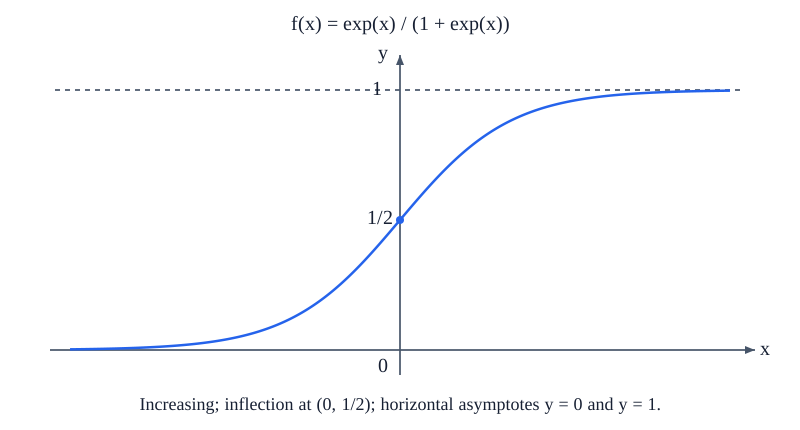
(3) (1), (2) の結果を用いて y=f(x)y = f(x) のグラフを描け。

(4) ttf(x)dx=10\int_{-t}^t f(x) dx = 10 となる実数 tt を求めよ。

(5) 実数 x,yx, y4ex+ey=74e^x + e^y = 7 を満たすとき, f(x)+f(y)f(x) + f(y) の最大値を求めよ。

题目描述

定义实函数

f:RR,f(x)=ex1+ex.f:\mathbb R\to\mathbb R,\qquad f(x)=\frac{e^x}{1+e^x}.

回答下列问题:

  1. 计算

    limxf(x)limx+f(x).\lim_{x\to-\infty}f(x) \quad\text{和}\quad \lim_{x\to+\infty}f(x).
  2. 求一阶导数 f(x)f'(x) 和二阶导数 f(x)f''(x)

  3. 利用前两问所得的无穷远极限、单调性和凹凸性,画出曲线 y=f(x)y=f(x) 的图像。

  4. 求满足

    ttf(x)dx=10\int_{-t}^{t}f(x)\,dx=10

    的实数 tt

  5. 当实数 x,yx,y 满足

    4ex+ey=74e^x+e^y=7

    时,求 f(x)+f(y)f(x)+f(y) 的最大值。

Kai

(1) limxf(x)=limxex1+ex=01+0=0\lim_{x \to -\infty} f(x) = \lim_{x \to -\infty} \frac{e^x}{1+e^x} = \frac{0}{1+0} = 0 limxf(x)=limxex1+ex=limx1ex+1=10+1=1\lim_{x \to \infty} f(x) = \lim_{x \to \infty} \frac{e^x}{1+e^x} = \lim_{x \to \infty} \frac{1}{e^{-x}+1} = \frac{1}{0+1} = 1

(2) f(x)=ex(1+ex)exex(1+ex)2=ex(1+ex)2f'(x) = \frac{e^x(1+e^x) - e^x e^x}{(1+e^x)^2} = \frac{e^x}{(1+e^x)^2} f(x)=ex(1+ex)2ex2(1+ex)ex(1+ex)4=ex(1+ex)2e2x(1+ex)3=exe2x(1+ex)3=ex(1ex)(1+ex)3f''(x) = \frac{e^x(1+e^x)^2 - e^x \cdot 2(1+e^x)e^x}{(1+e^x)^4} = \frac{e^x(1+e^x) - 2e^{2x}}{(1+e^x)^3} = \frac{e^x - e^{2x}}{(1+e^x)^3} = \frac{e^x(1-e^x)}{(1+e^x)^3}

(3) f(x)f(x) のグラフを描く。 limxf(x)=0\lim_{x \to -\infty} f(x) = 0 , limxf(x)=1\lim_{x \to \infty} f(x) = 1 f(x)>0f'(x) > 0 なので、単調増加。 f(x)=0f''(x) = 0 となるのは x=0x=0 のとき。 x<0x<0 では f(x)>0f''(x) > 0 , x>0x>0 では f(x)<0f''(x) < 0 なので、 x=0x=0 で変曲点を持つ。 変曲点は (0,12)(0, \frac{1}{2})

(4) ttf(x)dx=ttex1+exdx=tt(1+ex)1+exdx=[ln(1+ex)]tt=ln(1+et)ln(1+et)=ln(1+et1+et)=ln(1+et1+1et)=ln(1+etet+1et)=ln(et)=t\int_{-t}^t f(x) dx = \int_{-t}^t \frac{e^x}{1+e^x} dx = \int_{-t}^t \frac{(1+e^x)'}{1+e^x} dx = [\ln(1+e^x)]_{-t}^t = \ln(1+e^t) - \ln(1+e^{-t}) = \ln(\frac{1+e^t}{1+e^{-t}}) = \ln(\frac{1+e^t}{1+\frac{1}{e^t}}) = \ln(\frac{1+e^t}{\frac{e^t+1}{e^t}}) = \ln(e^t) = t ttf(x)dx=t=10\int_{-t}^t f(x) dx = t = 10

(5) u=exu=e^x とおく。 ex>0e^x>0 かつ ey=74ex>0e^y=7-4e^x>0 であるから、 uu の範囲は

0<u<740<u<\frac{7}{4}

である。このとき

F(u)=f(x)+f(y)=u1+u+74u84uF(u)=f(x)+f(y) =\frac{u}{1+u}+\frac{7-4u}{8-4u}

であり、

F(u)=1(1+u)24(84u)2.F'(u) =\frac{1}{(1+u)^2}-\frac{4}{(8-4u)^2}.

0<u<7/40<u<7/4 では 1+u>0, 84u>01+u>0,\ 8-4u>0 なので、

sgnF(u)=sgn(11+u284u)=sgn(1u).\operatorname{sgn}F'(u) =\operatorname{sgn}\left( \frac{1}{1+u}-\frac{2}{8-4u} \right) =\operatorname{sgn}(1-u).

したがって FF(0,1)(0,1) で増加し、 (1,7/4)(1,7/4) で減少する。よって最大値は u=1u=1 、すなわち

x=0,ey=3(y=ln3)x=0,\qquad e^y=3\quad (y=\ln 3)

のときに取り、

max{f(x)+f(y)}=f(0)+f(ln3)=12+34=54\max\{f(x)+f(y)\} =f(0)+f(\ln 3) =\frac12+\frac34 =\frac54

である。