東京大学 新領域創成科学研究科 海洋技術環境学専攻 2021年8月実施 第1問~第4問 Author Miyake
Description 第1問
以下の定積分の値を求めよ。
∫ 0 π e x sin ( x ) cos ( x ) d x \int_0^{\pi} e^x \sin(x) \cos(x) dx ∫ 0 π e x sin ( x ) cos ( x ) d x 第2問
O − x y z \text{O} - xyz O − x yz A A A B B B C C C ( 4 , 5 , 7 ) (4, 5, 7) ( 4 , 5 , 7 ) ( 2 , 1 , 3 ) (2, 1, 3) ( 2 , 1 , 3 ) ( 9 , 7 , 6 ) (9, 7, 6) ( 9 , 7 , 6 )
(1) 三角形 O A B OAB O A B
(2) 四面体 O A B C OABC O A BC
第3問
観測点 O O O 200 200 200 P P P 25 25 25 B B B ∠ B O P \angle BOP ∠ BOP P P P 100 100 100 ∠ B O P \angle BOP ∠ BOP
第4問
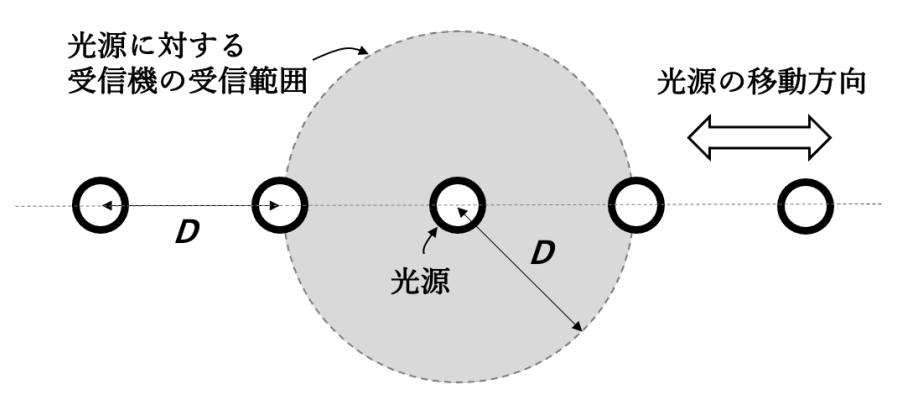
図のように直線上を無数の光源が一定の間隔 D D D D D D L L L D / 2 D/2 D /2
(1) 1 1 1 1 1 1 L L L
(2) 1 1 1 2 2 2 L L L
题目描述
回答以下四题:
计算
∫ 0 π e x sin x cos x d x . \int_0^\pi e^x\sin x\cos x\,dx. ∫ 0 π e x sin x cos x d x .
在三维坐标系中给定
A = ( 4 , 5 , 7 ) , B = ( 2 , 1 , 3 ) , C = ( 9 , 7 , 6 ) . A=(4,5,7),\quad B=(2,1,3),\quad C=(9,7,6). A = ( 4 , 5 , 7 ) , B = ( 2 , 1 , 3 ) , C = ( 9 , 7 , 6 ) .
求三角形 O A B OAB O A B
求四面体 O A B C OABC O A BC
地点 P P P O O O P P P B B B ∠ B O P \angle BOP ∠ BOP P P P
如上图,无限多个光源沿一直线运动且相邻间距恒为 D D D D D D L L L D / 2 D/2 D /2
求使任一光源在任意位置始终至少被 1 台接收机接收到时 L L L
求始终至少被 2 台接收机接收到时 L L L
Kai 第1問
I = ∫ 0 π e x sin ( x ) cos ( x ) d x = 1 2 ∫ 0 π e x sin ( 2 x ) d x = 1 2 [ e x sin ( 2 x ) ] 0 π − ∫ 0 π e x cos ( 2 x ) d x = − [ e x cos ( 2 x ) ] 0 π − 2 ∫ 0 π e x sin ( 2 x ) d x = − e π + 1 − 4 I ∴ 5 I = 1 − e π ∴ I = 1 − e π 5 \begin{aligned}
I
&= \int_0^\pi e^x \sin(x) \cos(x) dx
\\
&= \frac{1}{2} \int_0^\pi e^x \sin(2x) dx
\\
&= \frac{1}{2} \left[ e^x \sin(2x) \right]_0^\pi - \int_0^\pi e^x \cos(2x) dx
\\
&= - \left[ e^x \cos(2x) \right]_0^\pi - 2 \int_0^\pi e^x \sin(2x) dx
\\
&= - e^\pi + 1 - 4I
\\
\therefore \ \
5 I &= 1 - e^\pi
\\
\therefore \ \
I &= \frac{1 - e^\pi}{5}
\end{aligned} I ∴ 5 I ∴ I = ∫ 0 π e x sin ( x ) cos ( x ) d x = 2 1 ∫ 0 π e x sin ( 2 x ) d x = 2 1 [ e x sin ( 2 x ) ] 0 π − ∫ 0 π e x cos ( 2 x ) d x = − [ e x cos ( 2 x ) ] 0 π − 2 ∫ 0 π e x sin ( 2 x ) d x = − e π + 1 − 4 I = 1 − e π = 5 1 − e π 第2問
(1)
1 2 ∣ O A → × O B → ∣ = 1 2 ∣ ( 8 , 2 , − 6 ) ∣ = 1 2 ⋅ 2 26 = 26 \begin{aligned}
\frac{1}{2}
\left|
\overrightarrow{\mathrm{OA}} \times \overrightarrow{\mathrm{OB}}
\right|
&= \frac{1}{2} \left| (8, 2, -6) \right|
\\
&= \frac{1}{2} \cdot 2 \sqrt{26}
\\
&= \sqrt{26}
\end{aligned} 2 1 OA × OB = 2 1 ∣ ( 8 , 2 , − 6 ) ∣ = 2 1 ⋅ 2 26 = 26 (2)
1 6 ∣ ( O A → × O B → ) ⋅ O C → ∣ = 1 6 ⋅ 50 = 25 3 \begin{aligned}
\frac{1}{6}
\left|
\left( \overrightarrow{\mathrm{OA}} \times \overrightarrow{\mathrm{OB}} \right)
\cdot \overrightarrow{\mathrm{OC}}
\right|
&= \frac{1}{6} \cdot 50
\\
&= \frac{25}{3}
\end{aligned} 6 1 ( OA × OB ) ⋅ OC = 6 1 ⋅ 50 = 3 25 第3問
θ = ∠ B O P \theta = \angle \mathrm{BOP} θ = ∠ BOP
B \mathrm{B} B P \mathrm{P} P h h h
また、それぞれの時間変化率 (毎分) を θ ˙ , h ˙ = 25 \dot{\theta}, \dot{h} = 25 θ ˙ , h ˙ = 25
tan θ = h 200 \begin{aligned}
\tan \theta = \frac{h}{200}
\end{aligned} tan θ = 200 h であり、
θ ˙ cos 2 θ = h ˙ 200 \begin{aligned}
\frac{\dot{\theta}}{\cos^2 \theta} = \frac{\dot{h}}{200}
\end{aligned} cos 2 θ θ ˙ = 200 h ˙ が成り立つ。
よって、 h = 100 h=100 h = 100 tan θ = 1 / 2 \tan \theta = 1/2 tan θ = 1/2 cos 2 θ = 4 / 5 \cos^2 \theta = 4/5 cos 2 θ = 4/5
θ ˙ = 4 5 ⋅ 25 200 = 1 10 \begin{aligned}
\dot{\theta}
&= \frac{4}{5} \cdot \frac{25}{200}
\\
&= \frac{1}{10}
\end{aligned} θ ˙ = 5 4 ⋅ 200 25 = 10 1 である。
第4問
(1)
1つの光源を中心とする半径 D D D
1つの受信機がこの円から出る瞬間に、その隣の受信機がこの円に入るとすると、
L 2 = D 2 − ( D 4 ) 2 = 15 16 D 2 ∴ L = 15 4 D \begin{aligned}
L^2
&= D^2 - \left( \frac{D}{4} \right)^2
\\
&= \frac{15}{16} D^2
\\
\therefore \ \
L &= \frac{\sqrt{15}}{4} D
\end{aligned} L 2 ∴ L = D 2 − ( 4 D ) 2 = 16 15 D 2 = 4 15 D であり、これが求める L L L
(2)
1つの光源を中心とする半径 D D D
1つの受信機がこの円から出る瞬間に、その隣の隣の受信機がこの円に入るとすると、
L 2 = D 2 − ( D 2 ) 2 = 3 4 D 2 ∴ L = 3 2 D \begin{aligned}
L^2
&= D^2 - \left( \frac{D}{2} \right)^2
\\
&= \frac{3}{4} D^2
\\
\therefore \ \
L &= \frac{\sqrt{3}}{2} D
\end{aligned} L 2 ∴ L = D 2 − ( 2 D ) 2 = 4 3 D 2 = 2 3 D であり、これが求める L L L