跳到主要内容

東京大学 新領域創成科学研究科 海洋技術環境学専攻 2019年8月実施 第1問~第5問

Author

Miyake

Description

第1問

次の定積分を求めよ。

I=03dxx2+1I = \int_0^{\sqrt{3}} \frac{dx}{\sqrt{x^2 + 1}}

第2問

整数 mm、任意の実数 θ\theta について、変数 xxyy を以下のように定義する。

{x(θ)=m=0θ2m(2m)!y(θ)=m=0θ2m+1(2m+1)!\left\{ \begin{aligned} x(\theta) &= \sum_{m=0}^{\infty} \frac{\theta^{2m}}{(2m)!} \\ y(\theta) &= \sum_{m=0}^{\infty} \frac{\theta^{2m+1}}{(2m+1)!} \end{aligned} \right.

ただし、m!m×(m1)×(m2)××2×1m! \equiv m \times (m-1) \times (m-2) \times \cdots \times 2 \times 10!=10! = 100=10^0 = 1 である。

この時、以下の問いを答えよ。

1) dxdy\frac{dx}{dy}xxyy で表せ。

2) xxyy の満たす関係を求めよ。

第3問

A=(121256134)A=\begin{pmatrix} 1 & 2 & 1 \\ 2 & 5 & 6 \\ 1 & 3 & 4\\ \end{pmatrix}

について以下の問いに答えよ。

1) A1A^{-1} を求めよ。

2) A1=1A|A^{-1}|= \frac{1}{|A|} となることを示せ。

第4問

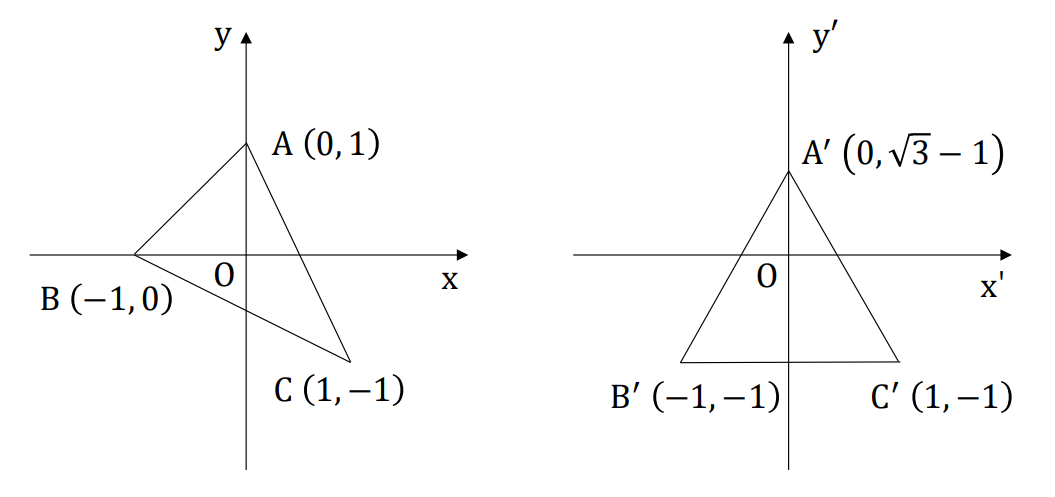
座標系 Oxy\text{O}xy 上の三角形 ABCABC が、座標系 Oxy\text{O}x'y' 上の三角形 ABCA'B'C' に変換された。 この時、座標系 Oxy\text{O}xy 上の任意の点 x\vec{x} から座標系 Oxy\text{O}x'y' 上の点 x\vec{x'} への変換を求めよ。

第5問

行列 A=(a1a1aa)A=\begin{pmatrix} a & 1-a \\ 1-a & a \end{pmatrix} について、以下の問いに答えよ。ただし aa は実数で、0<a<10<a<1 とする。

1) 固有値、固有ベクトルを求めよ。

2) AnA^n を求めよ。ただし、nn は自然数である。

3) limnAn\lim_{n \rightarrow \infty} A^n を求めよ。

Kai

第1問

I=03dxx2+1=[logx+x2+1]03=log(2+3)\begin{aligned} I &= \int_0^{\sqrt{3}} \frac{dx}{\sqrt{x^2 + 1}} \\ &= \left[ \log \left| x + \sqrt{x^2 + 1} \right|\right]_0^{\sqrt{3}} \\ &= \log \left( 2 + \sqrt{3} \right) \end{aligned}

第2問

1)

dx(θ)dθ=m=1θ2m1(2m1)!=y(θ)dy(θ)dθ=m=0θ2m(2m)!=x(θ)\begin{aligned} \frac{dx(\theta)}{d \theta} &= \sum_{m=1}^\infty \frac{\theta^{2m-1}}{(2m-1)!} \\ &= y(\theta) \\ \frac{dy(\theta)}{d \theta} &= \sum_{m=0}^\infty \frac{\theta^{2m}}{(2m)!} \\ &= x(\theta) \end{aligned}

なので、dxdy=dxdθdydθ=yx\frac{dx}{dy} = \frac{\frac{dx}{d \theta}}{\frac{dy}{d \theta}} = \frac{y}{x} を得る。

2)

xdx=ydy\begin{aligned} x dx = y dy \end{aligned}

であり、これを積分すると、積分定数を CC として、

x2=y2+C\begin{aligned} x^2 = y^2 + C \end{aligned}

である。 θ=0\theta = 0 のとき x=1,y=0x=1, y=0 なので、 C=1C=1 がわかり、

x2y2=1\begin{aligned} x^2 - y^2 = 1 \end{aligned}

を得る。

第3問

1)

掃き出し法により、次のように求められる:

(121100256010134001)(121100014210013101)(107520014210001111)(100257010234001111)\begin{aligned} & \begin{pmatrix} 1 & 2 & 1 & 1 & 0 & 0 \\ 2 & 5 & 6 & 0 & 1 & 0 \\ 1 & 3 & 4 & 0 & 0 & 1 \end{pmatrix} \\ & \begin{pmatrix} 1 & 2 & 1 & 1 & 0 & 0 \\ 0 & 1 & 4 & -2 & 1 & 0 \\ 0 & 1 & 3 & -1 & 0 & 1 \end{pmatrix} \\ & \begin{pmatrix} 1 & 0 & -7 & 5 & -2 & 0 \\ 0 & 1 & 4 & -2 & 1 & 0 \\ 0 & 0 & -1 & 1 & -1 & 1 \end{pmatrix} \\ & \begin{pmatrix} 1 & 0 & 0 & -2 & 5 & -7 \\ 0 & 1 & 0 & 2 & -3 & 4 \\ 0 & 0 & 1 & -1 & 1 & -1 \end{pmatrix} \end{aligned}
  A1=(257234111)\begin{aligned} \therefore \ \ A^{-1} = \begin{pmatrix} -2 & 5 & -7 \\ 2 & -3 & 4 \\ -1 & 1 & -1 \end{pmatrix} \end{aligned}

2)

サラスの方法より、

A=(20+12+6)(5+18+16)=1A1=(62014)(21810)=1\begin{aligned} |A| &= (20+12+6)-(5+18+16) \\ &= -1 \\ |A^{-1}| &= (-6-20-14)-(-21-8-10) \\ &= -1 \end{aligned}

なので、 A1=1/A|A^{-1}| = 1 / |A| が成り立っていることがわかる。

第4問

x=(x,y)\vec{x}=(x,y) から x=(x,y)\vec{x'}=(x',y') への変換は次のように表される:

(xy)=(abcd)(xy)+(ef)\begin{aligned} \begin{pmatrix} x \\ y \end{pmatrix} = \begin{pmatrix} a & b \\ c & d \end{pmatrix} \begin{pmatrix} x' \\ y' \end{pmatrix} + \begin{pmatrix} e \\ f \end{pmatrix} \end{aligned}

点 A, B, C がそれぞれ 点 A', B', C' に変換されることから、

a=1,b=0,e=0,c=13,d=23,f=131\begin{aligned} a = 1, b = 0, e = 0, c = \frac{1}{\sqrt{3}}, d = \frac{2}{\sqrt{3}}, f = \frac{1}{\sqrt{3}} - 1 \end{aligned}

がわかる。 つまり、

x=xy=x+2y+133\begin{aligned} x' &= x \\ y' &= \frac{x+2y+1-\sqrt{3}}{\sqrt{3}} \end{aligned}

である。

第5問

1)

AA の固有値を λ\lambda とすると、

0=det(aλ1a1aaλ)=(λ1)(λ2a+1)  λ=1,2a1\begin{aligned} 0 &= \det \begin{pmatrix} a-\lambda & 1-a \\ 1-a & a-\lambda \end{pmatrix} \\ &= (\lambda - 1)(\lambda - 2a + 1) \\ \therefore \ \ \lambda &= 1, 2a-1 \end{aligned}

を得る。 a1a \ne 1 なので、これらは相異なる固有値である。

固有値 11 に属する固有ベクトルを求めるために

(00)=(a11a1aa1)(xy)\begin{aligned} \begin{pmatrix} 0 \\ 0 \end{pmatrix} &= \begin{pmatrix} a-1 & 1-a \\ 1-a & a-1 \end{pmatrix} \begin{pmatrix} x \\ y \end{pmatrix} \end{aligned}

とおくと x=yx=y であり、 固有値 2a12a-1 に属する固有ベクトルを求めるために

(00)=(1a1a1a1a)(xy)\begin{aligned} \begin{pmatrix} 0 \\ 0 \end{pmatrix} &= \begin{pmatrix} 1-a & 1-a \\ 1-a & 1-a \end{pmatrix} \begin{pmatrix} x \\ y \end{pmatrix} \end{aligned}

とおくと x+y=0x+y=0 であるから、それぞれに属する固有ベクトルは例えば

(11),(11)\begin{aligned} \begin{pmatrix} 1 \\ 1 \end{pmatrix} , \begin{pmatrix} 1 \\ -1 \end{pmatrix} \end{aligned}

である。

2)

1) で求めた固有ベクトルを使って、

P=12(1111)\begin{aligned} P &= \frac{1}{\sqrt{2}} \begin{pmatrix} 1 & 1 \\ 1 & -1 \end{pmatrix} \end{aligned}

とおくと、

P2=(1001)PAP=(1002a1)\begin{aligned} P^2 &= \begin{pmatrix} 1 & 0 \\ 0 & 1 \end{pmatrix} \\ PAP &= \begin{pmatrix} 1 & 0 \\ 0 & 2a-1 \end{pmatrix} \end{aligned}

が成り立つので、

An=P(1002a1)nP=P(100(2a1)n)P=12(1+(2a1)n1(2a1)n1(2a1)n1+(2a1)n)\begin{aligned} A^n &= P \begin{pmatrix} 1 & 0 \\ 0 & 2a-1 \end{pmatrix}^n P \\ &= P \begin{pmatrix} 1 & 0 \\ 0 & (2a-1)^n \end{pmatrix} P \\ &= \frac{1}{2} \begin{pmatrix} 1+(2a-1)^n & 1-(2a-1)^n \\ 1-(2a-1)^n & 1+(2a-1)^n \end{pmatrix} \end{aligned}

を得る。

3)

0<a<10 \lt a \lt 1 より 1<2a1<1-1 \lt 2a-1 \lt 1 なので、

limn(2a1)n=0\lim_{n \to \infty} (2a-1)^n = 0 であり、

limnAn=12(1111)\begin{aligned} \lim_{n \to \infty} A^n &= \frac{1}{2} \begin{pmatrix} 1 & 1 \\ 1 & 1 \end{pmatrix} \end{aligned}

を得る。