東京大学 新領域創成科学研究科 複雑理工学専攻 2024年8月実施 専門基礎科目
Problem No. 1 (Calculus)
Answer the following questions. e is the base of the natural logarithm and i is the imaginary unit.
Omit the derivations and write only the answers.
(Q.1) Define the real function f(x) as follows:
- (1) Obtain the derivative of f(x).
- (2) Obtain the Taylor expansion of f(x) around x = 0 up to the third order.
- (Q.2) Two real functions x(t) and y(t) satisfy the following coupled differential equations:
where A, a, and ( ) are real constants.
-
(1) Let z(t) = x(t) + iy(t). Obtain the differential equation for z(t).
-
(2) Let A = 0. Obtain the general solution x(t) and y(t) of the coupled differential equations.
-
(3) Let A > 0. x(t) asymptotically approaches as regardless of the initial condition. Here, B (B > 0), b, and are real constants. Obtain B, b, and .
-
(Q.3) Define the real function f(x) as follows:
- (1) Obtain all the extrema of f(x) and the corresponding values of x.
- (2) In an xy Cartesian coordinate system, obtain the area of the region defined by and x > 0.
- (3) In an xyz Cartesian coordinate system, obtain the volume of the solid formed by rotating the xy-plane region defined in (2) around the x-axis.
- (4) The surface of the solid defined in (3) can be expressed in terms of the real function
as g(x, y, z) = 0. Obtain the gradient vector of g(x, y, z).
(5) Obtain the coordinates (x, y, z) where h(x, y, z) = xyz is maximized on the surface of the solid defined in (3) in the x > 0 region. In addition, obtain the maximum.
Problem No. 2.1 (Linear algebra)
The transpose of a matrix or a vector is denoted by the superscript . The exponential of a square matrix J is defined as
Answer the following questions.
(Q.1) Consider the following real matrix A and real vectors and :
where is a constant.
Omit the derivations and write only the answers.
- (1) Obtain the eigenvalues of A.
- (2) Obtain the matrix P that satisfies
-
(3) Suppose that the equation for the variable has a solution. Obtain the value of . In addition, obtain all the solutions of the equation.
-
(4) Obtain , where t is a real number.
-
(Q.2) Let B be an real asymmetric matrix.
- (1) Show that the eigenvalues of B and are the same. You may use the fact that the determinants of a square matrix and its transposed matrix are the same.
- (2) Let (i = 1, ..., n) be the eigenvalues of B. Let and be the eigenvectors of B and corresponding to the eigenvalue , respectively. Namely,
hold true. Show that for .
Problem No. 2.2 (Probability and Statistics)
Answer the following questions. e is the base of the natural logarithm, and i is the imaginary unit.
Omit the derivations and write only the answers.
- (Q.1) Let X and Y be random variables with the means , , the variances , , respectively, and the covariance . Random variables U and V are defined by U = X + 3 and V = X + Y.
- (1) Obtain the means , of U, V.
- (2) Obtain the variances , of U, V.
- (3) Obtain the covariance between U and V.
- (Q.2) Let X be a random variable obeying the standard Cauchy distribution:
Answer the following questions.
-
(1) Obtain the cumulative distribution function F(x) of the standard Cauchy distribution.
-
(2) Let U be a random variable obeying the uniform distribution on the interval [0,1]. Obtain the probability , where F(x) is the cumulative distribution function in (1).
-
(3) For U defined in (2), obtain the real function g(U) that satisfies X = g(U).
-
(4) Obtain the characteristic function of the standard Cauchy distribution: , where t is a real number.
-
(5) Let be n random variables that are independent and identically distributed and obey the standard Cauchy distribution. A random variable Z is defined by . Obtain the probability density function of Z.
-
(Q.3) Let be N sample pairs of random variables X and Y. Define the following statistics on the sample pairs:
The regression line is obtained by minimizing the following function l:
which is assumed to be minimum at and . Express and in terms of , , , and . In addition, show the condition under which both and are uniquely determined.
Problem No. 2.3 (Mechanics)
Answer the following questions. Let the gravitational acceleration be (constant). Write only the answers.
- (Q.1) A linear molecule ABA is composed of Atoms A and B. Atom B is located between two Atoms A. Consider Molecule ABA as a system composed of three point masses connected by two massless springs of spring constant k. The masses of Atoms A and B are m and M, respectively. The atoms move along a common line. Ignore the gravity.
- (1) Write the equations of motion for the three atoms. The displacements of Atoms A, B, A from the natural lengths are defined as x, y, and z, respectively, with the positive direction from one Atom A to the other Atom A.
- (2) Introduce and . Answer the angular frequencies and of their oscillation. Let the center of the gravity of Molecule ABA do not move.
- (Q.2) Consider a point mass thrown at an elevation angle with initial velocity . x axis is taken in the positive direction of the horizontal component of the initial velocity. y axis is taken in the
vertical upward direction. The origin is the initial position of the point mass.
- (1) Answer the vertical position y of the point mass at x = X (> 0), using X, g, , and v.
- (2) Answer the range of the vertical position y where the point mass cannot reach at x = X (> 0) for any angles , using X, g, and v.
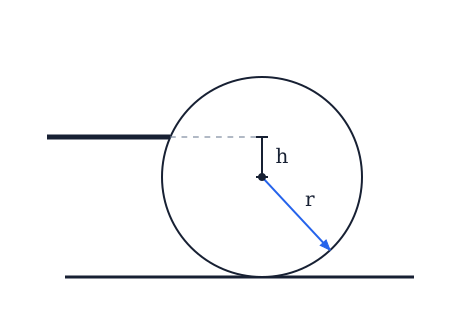
- (Q.3) A uniform-density rigid sphere of mass m and radius r is at rest on a frictionless horizonal plate. We want to roll the sphere without slipping by hitting horizontally with a stick as shown in the figure below. Answer the vertical distance h from the center of the sphere to hit using m, r, and the moment of inertia I of the rigid sphere.
(Q.4) Suppose the Earth is a rigid sphere that rotates eastward around the axis passing through the south pole and the north pole at a constant angular velocity . Let (x, y, z) be the coordinate system fixed to the Earth's surface with the origin at Point P on the northern hemisphere at latitude ( ). Positive direction of z axis is defined in the direction from the Earth's center to Point P, and positive directions of x axis and y axis are defined towards the south and east, respectively, on the tangential plane at Point P. A point mass of mass m is thrown from Point P to the positive direction of z axis at initial velocity v.
- (1) Answer the x, y, and z components of the Earth's angular velocity vector in the coordinate system (x, y, z).
- (2) The equation of motion for the point mass in the coordinate system (x, y, z) is expressed as follows using position vector , its first derivative with respect to time , and its second derivative :
Write the acceleration for the point mass in the y direction at the time t elapsed after throwing the point mass, using, g, t, v, , . Ignore the terms of order or higher.
Problem No. 2.4 (Electromagnetism)
Answer the following questions, assuming vacuum environment. Except for Q.5(2), write only the answers.
-
(Q.1) In the below, and are dielectric constant and permeability, respectively, in vacuum.
- (1) Write the light speed, using and .
- (2) Two conducting wires are placed in parallel at a distance r. The length of the wires is infinite. Current I is flowing in the same direction in each wire. Write the magnitude and direction of the force acting on the wire per unit length.
-
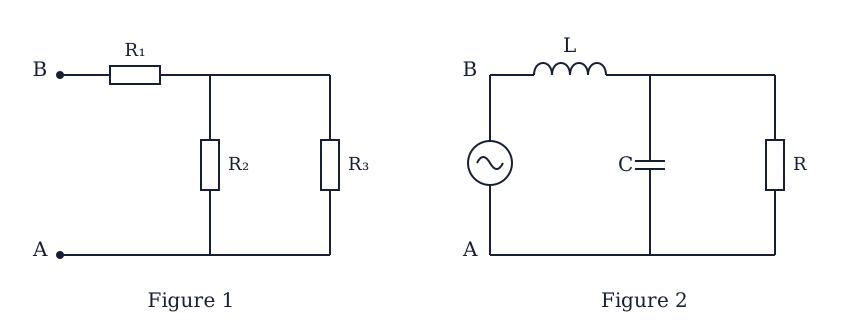
(Q.2) Answer the questions on the electric circuit shown in Figure 1. The , , and represent electric resistors, whose resistance values are , , and , respectively.
- (1) Write the combined resistance value between A and B, using .
- (2) A constant voltage V is applied between A and B. Write the current flowing in , and write the electric power consumed in . The answers should use V, , , .
-
(Q.3) Answer the questions on the electric circuit shown in Figure 2. An AC voltage is applied with an amplitude and an angular frequency . Here, L is the inductance of the coil, C is the capacitance of the capacitor, R is the resistance value of the resistor. Use j as the imaginary unit.
-
(1) Write the combined impedance between A and B, using , L, C, R.
-
(2) Write the ratio , where is the amplitude of the current flowing in the capacitor and is the amplitude of the current flowing in the resistor.
-
(3) We remove the capacitor from the circuit, namely we handle a circuit without the capacitor. We express the voltage variation between A and B as . Write the current flowing in the coil, using , L, R, V. Write also the effective electric power consumed in the resistor, using , L, R, . (The effective electric power is the time-averaged electric power.)
-
(Q.4) There is a closed circuit shown in Figure 3. The circuit is formed by one turn loop of a conducting wire and its surface area is S.
Using an equation
from Maxwell's equations, derive the expression on a voltage V in the circuit induced by the magnetic field crossing the circuit (Note: write only the expression on V). Here, is a magnetic field externally given, and is an electric field induced by the magnetic field. The magnetic field is uniform in space. The circuit is placed on a flat surface whose normal unit vector is expressed by . Ignore the thickness of the conducting wire.
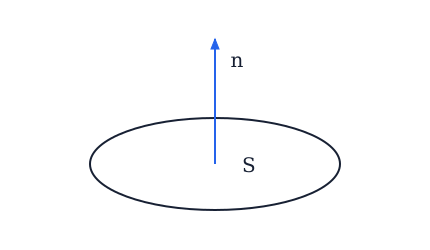
Figure 3
(Q.5) There is a square, whose side length is L, on an xy plane in a Cartesian coordinate system as depicted by broken lines in Figure 4(a). We made a closed circuit by winding a conducting wire twice in the same direction along the sides of this square. This wire has a resistance value R per the length L. Here, a magnetic field is applied uniformly in space in the z direction. The magnitude of the magnetic field B varies with time t as shown in Figure 4(b). The value of B is for , for and varies at a constant rate for . Answer the following questions for .
Ignore the self-inductance of the circuit and the thickness of the conducting wire.
- (1) Write the electric voltage V induced in the circuit by using the variables used in the above.
- (2) Describe the force on the wire, using V, R, L in about 5 lines.
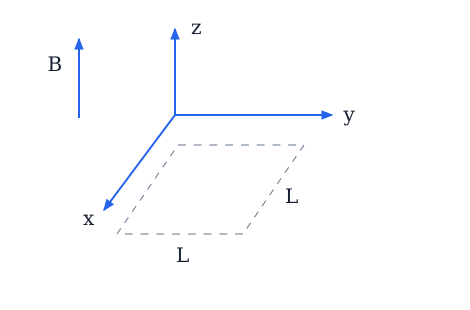
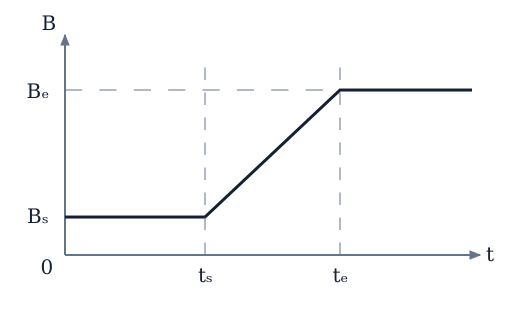
Figure 4