跳到主要内容

東京大学 工学系研究科 機械工学専攻 機械工学第1部 2026年9月実施 問題 2

Author​

AnonTokyo #83056

Description​

全問に解答すること。日本語または英語で解答すること。

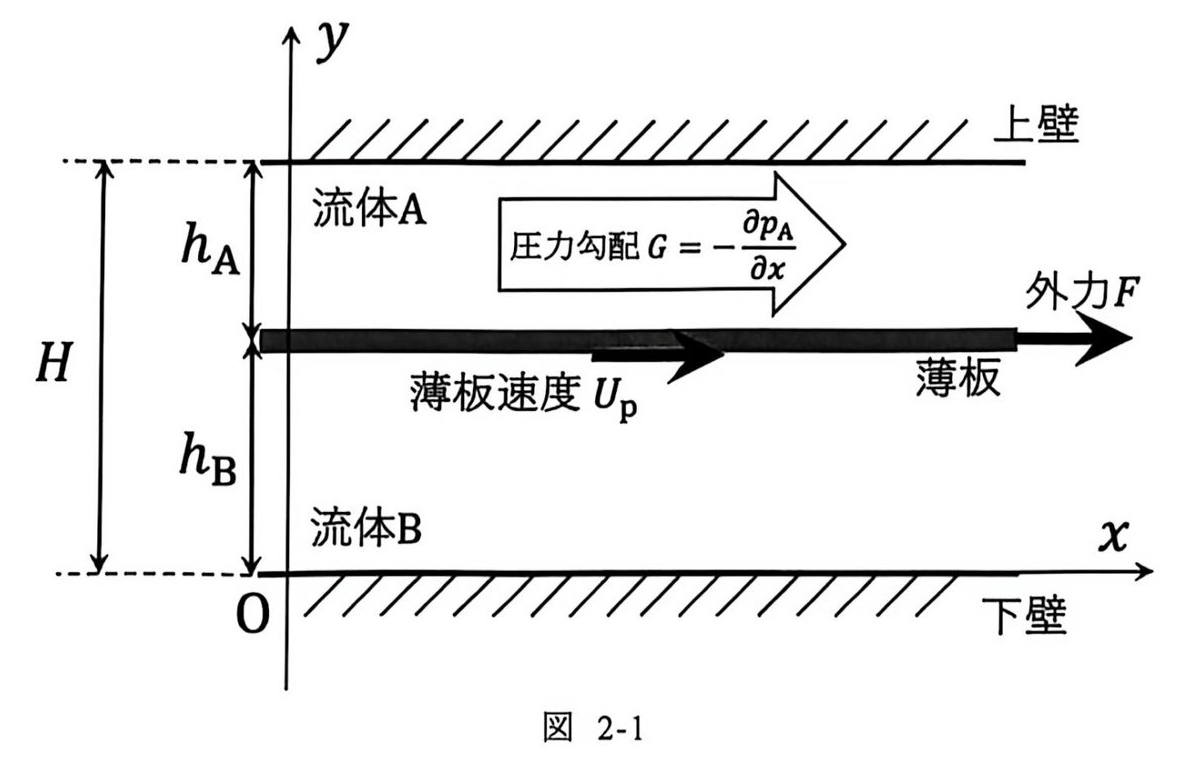
図2-1に示すように,無限に広い静止平行壁面の間に,これらと平行に無限に広い薄板があり,薄板と上壁の間は流体A,薄板と下壁の間は流体Bで満たされている。それぞれの流体は,粘度が μA,μB\mu_{\mathrm A},\mu_{\mathrm B} の非圧縮性ニュートン流体とする。薄板の厚さは無視してよい。薄板は,面内の一方向のみ変位が許されており,その方向を xx 方向とし,薄板垂直方向を yy 方向とする。薄板には単位面積あたり外力 FF が xx 方向に作用しているものとし,薄板の速度を UpU_{\mathrm p} とする。座標系の原点は下壁の位置にとる。薄板と上壁,および薄板と下壁の間隔は,それぞれ hA,hBh_{\mathrm A},h_{\mathrm B} とし,上下壁の間隔 HH は一定であり,H=hA+hBH=h_{\mathrm A}+h_{\mathrm B} である。流体Aのみ一定の圧力勾配 G=−∂pA/∂xG=-\partial p_{\mathrm A}/\partial x により,xx 方向に流れが駆動されている。なお,pAp_{\mathrm A} は流体Aの静圧である。流体Aと流体Bの流れは xx 方向の定常流れであり,xx–yy 平面に垂直な方向には一様とみなしてよい。以下の問いに答えよ。

図 2-1:平行壁間の薄板と二層流体

(1) 流体Aの xx 方向速度成分 uAu_{\mathrm A} を求めるための微分方程式を記述せよ。ただし,ゼロになる項は全て消去すること。

(2) Up=0U_{\mathrm p}=0 となるときの外力 FF を F1F_1 とする。F1F_1 を G,hAG,h_{\mathrm A} を用いて表せ。

(3) G=0G=0 において,薄板を速度 UpU_{\mathrm p} で動かすために必要となる外力 FF を F2F_2 とする。F2F_2 を hA,hB,Up,μA,μBh_{\mathrm A},h_{\mathrm B},U_{\mathrm p},\mu_{\mathrm A},\mu_{\mathrm B} を用いて表せ。

(4) G=0G=0 において,薄板を一定の速度 Up≠0U_{\mathrm p}\ne0 で動かすとき,流体Aと流体Bのエネルギー散逸の和が最小となる hAh_{\mathrm A} を H,μA,μBH,\mu_{\mathrm A},\mu_{\mathrm B} を用いて表せ。

(5) G≠0G\ne0,かつ F=0F=0 のとき,薄板の速度 UpU_{\mathrm p} を G,hA,hB,μA,μBG,h_{\mathrm A},h_{\mathrm B},\mu_{\mathrm A},\mu_{\mathrm B} を用いて表せ。

English

Problem 2

As shown in Figure 2-1, an infinitely-large thin plate is placed parallel between two infinitely-large parallel solid walls, and the space between the top solid wall and the thin plate is filled with Fluid A, while that between the bottom solid wall and the thin plate is filled with Fluid B. The two fluids are incompressible Newtonian fluids with viscosities of μA\mu_{\mathrm A} and μB\mu_{\mathrm B}, respectively. The thickness of the thin plate is negligible. The thin plate is allowed to displace only in one direction of the plane, which is defined as the xx direction, while the yy direction is taken perpendicular to the thin plate. An external force FF per unit area is applied to the thin plate in the xx direction, and the velocity of the thin plate is UpU_{\mathrm p}. The origin of the coordinate system is located on the bottom wall. The spacings from the thin plate to the top and bottom walls are hAh_{\mathrm A} and hBh_{\mathrm B}, respectively, yielding the total constant spacing of H=hA+hBH=h_{\mathrm A}+h_{\mathrm B} between the two solid walls. Only the flow of Fluid A is driven in the xx direction by a constant pressure gradient G=−∂pA/∂xG=-\partial p_{\mathrm A}/\partial x. Here, pAp_{\mathrm A} is the static pressure of Fluid A. The flows of Fluid A and Fluid B are steady flows in the xx direction and are uniform in the direction normal to the xx-yy plane. Answer the following questions.

(1) Derive the differential equation for obtaining the velocity component uAu_{\mathrm A} of Fluid A in the xx direction. Eliminate all terms that become zero.

(2) Let F1F_1 be the external force FF acting on the thin plate when Up=0U_{\mathrm p}=0. Express F1F_1 with GG and hAh_{\mathrm A}.

(3) Let F2F_2 be the external force FF acting on the thin plate required to move the thin plate with the velocity UpU_{\mathrm p} when G=0G=0. Express F2F_2 with hAh_{\mathrm A}, hBh_{\mathrm B}, UpU_{\mathrm p}, μA\mu_{\mathrm A} and μB\mu_{\mathrm B}.

(4) Express hAh_{\mathrm A} with HH, μA\mu_{\mathrm A} and μB\mu_{\mathrm B}, when the sum of the energy dissipation in Fluid A and Fluid B is minimized under the conditions where G=0G=0 and the thin plate is moved at a constant velocity Up(≠0)U_{\mathrm p}(\ne0).

(5) Express the velocity UpU_{\mathrm p} of the thin plate in terms of GG, hAh_{\mathrm A}, hBh_{\mathrm B}, μA\mu_{\mathrm A} and μB\mu_{\mathrm B}, when G≠0G\ne0 and F=0F=0.

题目描述​

全问均须作答,使用日语或英语作答。

如图 2-1 所示,两无限宽的静止平行壁面之间有一块与壁面平行、同样无限宽的薄板。薄板与上壁之间充满流体 A,薄板与下壁之间充满流体 B。两种流体均为不可压缩牛顿流体,其黏度分别为 μA\mu_{\mathrm A}、μB\mu_{\mathrm B}。薄板厚度可以忽略。薄板只允许沿板面内的一个方向移动,将该方向定义为 xx 方向,将垂直于薄板的方向定义为 yy 方向。薄板受到沿 xx 方向作用的单位面积外力 FF,薄板速度记为 UpU_{\mathrm p}。坐标原点位于下壁。薄板与上壁、薄板与下壁的间距分别为 hAh_{\mathrm A}、hBh_{\mathrm B},上下壁间距 HH 为常数,且 H=hA+hBH=h_{\mathrm A}+h_{\mathrm B}。只有流体 A 受到恒定压力梯度 G=−∂pA/∂xG=-\partial p_{\mathrm A}/\partial x 的驱动而沿 xx 方向流动,其中 pAp_{\mathrm A} 为流体 A 的静压。流体 A 和流体 B 的流动均为沿 xx 方向的定常流动,并且可以认为沿垂直于 xx–yy 平面的方向均匀。回答下列问题。

(1) 写出用于求取流体 A 的 xx 方向速度分量 uAu_{\mathrm A} 的微分方程。应消去所有为零的项。

(2) 将使 Up=0U_{\mathrm p}=0 的外力 FF 记为 F1F_1。用 GG、hAh_{\mathrm A} 表示 F1F_1。

(3) 在 G=0G=0 时,将使薄板以速度 UpU_{\mathrm p} 运动所需的外力 FF 记为 F2F_2。用 hAh_{\mathrm A}、hBh_{\mathrm B}、UpU_{\mathrm p}、μA\mu_{\mathrm A}、μB\mu_{\mathrm B} 表示 F2F_2。

(4) 在 G=0G=0,薄板以恒定速度 Up≠0U_{\mathrm p}\ne0 运动时,用 HH、μA\mu_{\mathrm A}、μB\mu_{\mathrm B} 表示使流体 A 与流体 B 的能量耗散之和最小的 hAh_{\mathrm A}。

(5) 当 G≠0G\ne0 且 F=0F=0 时,用 GG、hAh_{\mathrm A}、hBh_{\mathrm B}、μA\mu_{\mathrm A}、μB\mu_{\mathrm B} 表示薄板速度 UpU_{\mathrm p}。

Kai​

(1)​

流速は xx 成分のみであり,非圧縮性の連続の式から ∂uA/∂x=0\partial u_{\mathrm A}/\partial x=0 となる。定常性と紙面に垂直な方向の一様性を用いると,xx 方向の Navier–Stokes 方程式は

μAd2uAdy2+G=0\boxed{\mu_{\mathrm A}\frac{\mathrm d^2u_{\mathrm A}}{\mathrm dy^2}+G=0}

となる。以下では壁面および薄板上で滑りなし条件を用いる。z=y−hBz=y-h_{\mathrm B} とおけば,流体 A の境界条件は uA(0)=Upu_{\mathrm A}(0)=U_{\mathrm p},uA(hA)=0u_{\mathrm A}(h_{\mathrm A})=0 である。積分して

uA(z)=Up(1−zhA)+G2μAz(hA−z).u_{\mathrm A}(z) =U_{\mathrm p}\left(1-\frac{z}{h_{\mathrm A}}\right) +\frac{G}{2\mu_{\mathrm A}}z(h_{\mathrm A}-z).

流体 B では圧力勾配がないため μBuB′′=0\mu_{\mathrm B}u_{\mathrm B}''=0 であり,uB(0)=0u_{\mathrm B}(0)=0,uB(hB)=Upu_{\mathrm B}(h_{\mathrm B})=U_{\mathrm p} より

uB(y)=UphBy.u_{\mathrm B}(y)=\frac{U_{\mathrm p}}{h_{\mathrm B}}y.

(2)​

xx 正方向の力を正とする。流体 A,B が薄板に及ぼす単位面積当たりのせん断力は,それぞれ

tA=μAduAdz∣z=0=−μAUphA+GhA2,tB=−μBduBdy∣y=hB=−μBUphB.\begin{aligned} t_{\mathrm A} &=\left.\mu_{\mathrm A}\frac{\mathrm du_{\mathrm A}}{\mathrm dz}\right|_{z=0} =-\frac{\mu_{\mathrm A}U_{\mathrm p}}{h_{\mathrm A}}+\frac{Gh_{\mathrm A}}{2},\\ t_{\mathrm B} &=-\left.\mu_{\mathrm B}\frac{\mathrm du_{\mathrm B}}{\mathrm dy}\right|_{y=h_{\mathrm B}} =-\frac{\mu_{\mathrm B}U_{\mathrm p}}{h_{\mathrm B}}. \end{aligned}

薄板の両面で法線の向きが逆になることに注意する。薄板の力のつり合い F+tA+tB=0F+t_{\mathrm A}+t_{\mathrm B}=0 より

F=(μAhA+μBhB)Up−GhA2.(1)F=\left(\frac{\mu_{\mathrm A}}{h_{\mathrm A}}+\frac{\mu_{\mathrm B}}{h_{\mathrm B}}\right)U_{\mathrm p} -\frac{Gh_{\mathrm A}}{2}. \tag{1}

したがって Up=0U_{\mathrm p}=0 のとき

F1=−GhA2.\boxed{F_1=-\frac{Gh_{\mathrm A}}{2}}.

G>0G>0 なら流体 A は薄板を +x+x 方向に引くため,薄板を静止させる外力は −x-x 方向となる。

(3)​

式 (1) に G=0G=0 を代入して

F2=(μAhA+μBhB)Up.\boxed{F_2=\left(\frac{\mu_{\mathrm A}}{h_{\mathrm A}}+\frac{\mu_{\mathrm B}}{h_{\mathrm B}}\right)U_{\mathrm p}}.

(4)​

G=0G=0 のとき両流体の速度分布は直線である。単位薄板面積当たりのエネルギー散逸率は

D=∫0hAμA(UphA)2 dz+∫0hBμB(UphB)2 dy=Up2(μAhA+μBH−hA).\begin{aligned} \mathcal D &=\int_0^{h_{\mathrm A}}\mu_{\mathrm A} \left(\frac{U_{\mathrm p}}{h_{\mathrm A}}\right)^2\,\mathrm dz +\int_0^{h_{\mathrm B}}\mu_{\mathrm B} \left(\frac{U_{\mathrm p}}{h_{\mathrm B}}\right)^2\,\mathrm dy\\ &=U_{\mathrm p}^2\left(\frac{\mu_{\mathrm A}}{h_{\mathrm A}} +\frac{\mu_{\mathrm B}}{H-h_{\mathrm A}}\right). \end{aligned}

UpU_{\mathrm p} は非零の定数なので,0<hA<H0<h_{\mathrm A}<H における停留条件は

−μAhA2+μB(H−hA)2=0.-\frac{\mu_{\mathrm A}}{h_{\mathrm A}^2} +\frac{\mu_{\mathrm B}}{(H-h_{\mathrm A})^2}=0.

よって

hA=HμAμA+μB.\boxed{h_{\mathrm A} =\frac{H\sqrt{\mu_{\mathrm A}}}{\sqrt{\mu_{\mathrm A}}+\sqrt{\mu_{\mathrm B}}}}.

また,

d2DdhA2=2Up2(μAhA3+μB(H−hA)3)>0\frac{\mathrm d^2\mathcal D}{\mathrm dh_{\mathrm A}^2} =2U_{\mathrm p}^2\left( \frac{\mu_{\mathrm A}}{h_{\mathrm A}^3} +\frac{\mu_{\mathrm B}}{(H-h_{\mathrm A})^3} \right)>0

であり,両端では D→∞\mathcal D\to\infty となるため,これが唯一の最小点である。

(5)​

式 (1) に F=0F=0 を代入して

Up=GhA2(μA/hA+μB/hB)=GhA2hB2(μAhB+μBhA).\boxed{ U_{\mathrm p} =\frac{Gh_{\mathrm A}}{2(\mu_{\mathrm A}/h_{\mathrm A}+\mu_{\mathrm B}/h_{\mathrm B})} =\frac{Gh_{\mathrm A}^2h_{\mathrm B}}{2(\mu_{\mathrm A}h_{\mathrm B}+\mu_{\mathrm B}h_{\mathrm A})} }.

分母は正であるから,薄板の運動方向は GG の符号と一致する。

Reference​

原題・原図の著作権は東京大学に帰属する。