東京大学 工学系研究科 機械工学専攻 機械工学第1部 2026年9月実施 問題 1-I
Author
Description
全問に解答すること。日本語または英語で解答すること。
下記の I,II の両方について解答せよ。なお,I の解答に答案用紙1枚を,II の解答に答案用紙1枚を,それぞれ用いること。
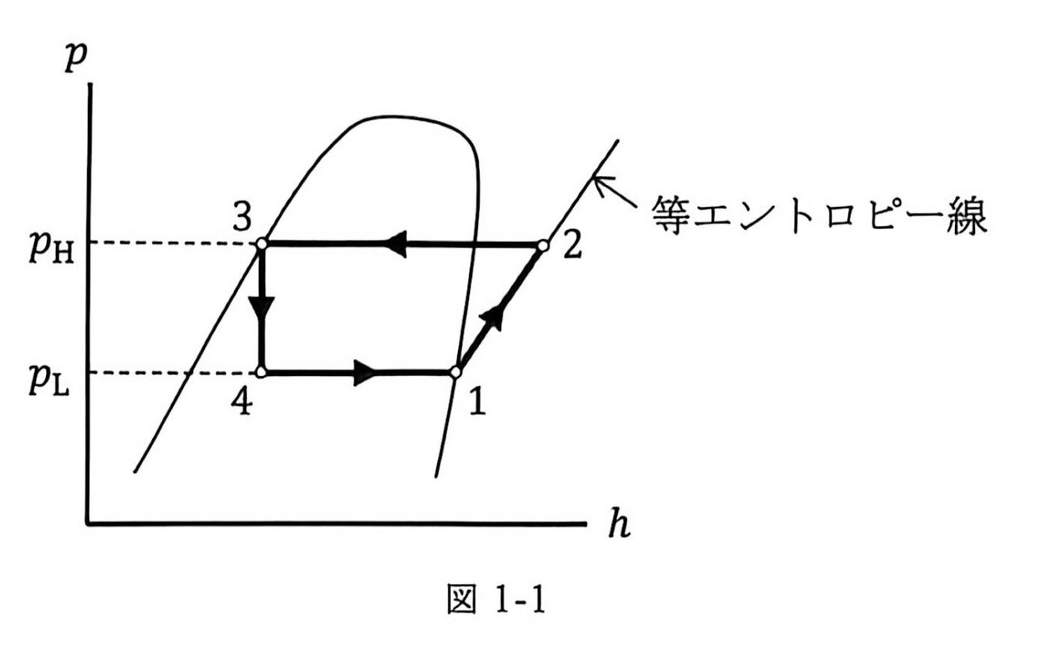
I.冷凍サイクルは,低温熱源から熱を受け取り,高温熱源へ熱を放出する機械における,一連の連続した熱力学過程を表す。冷媒(冷凍サイクルの作動物質)が,図1-1に示す圧力–エンタルピー(–)線図のように と状態変化しながら,定常的に流れる冷凍サイクルについて考える。状態 は圧縮機での可逆断熱圧縮過程,状態 は凝縮器における等圧冷却過程(圧力 ),状態 は膨張弁を通過するときの等エンタルピー膨張過程,状態 は蒸発器における等圧加熱過程(圧力 )を示す。冷媒は純物質とし,図1-1中の曲線はその飽和液線と飽和蒸気線を表す。以下の設問に答えよ。
(1) 比エントロピーの微小変化量 について,式(1-1)が成り立つことを示せ。
ただし, は温度, は定圧比熱, は比体積である。以下のマクスウェルの熱力学的関係式を用いてよい。
(2) 冷凍サイクルにおいては,状態 の過程で冷媒の温度が下がる。等エンタルピー膨張によって温度が下がる条件を示せ。式(1-1)を用いてよい。
(3) この冷凍サイクルの加熱目的の動作係数(COP)(=高温熱源への放熱量/入力仕事)を求めよ。ただし,状態 においては,冷媒を理想気体と仮定せよ。また,圧力 における冷媒の凝縮熱を とし, は温度,圧力によらずに一定とせよ。状態1,2,3の温度 を用いてよい。
English
Problem 1
Answer both the following Questions I and II. Use one answer sheet for Question I and use another answer sheet for Question II.
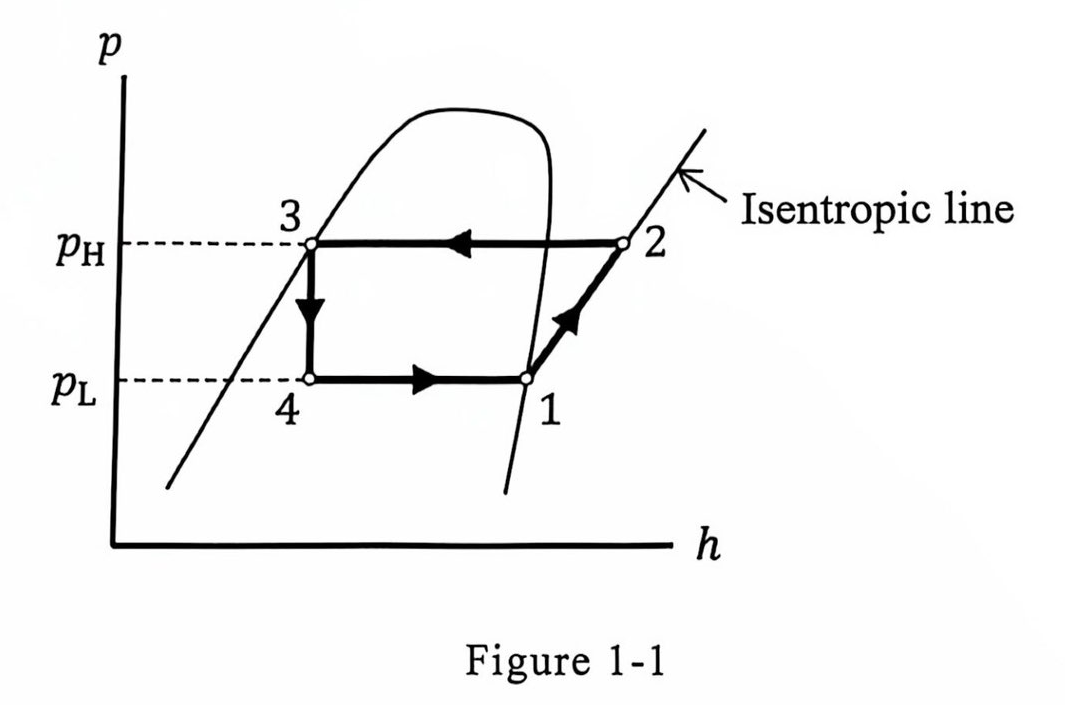
I. A refrigeration cycle describes a series of consecutive thermodynamic processes in a machine that absorbs heat from a low-temperature heat source and releases it to a high-temperature heat source. Consider a refrigeration cycle in which a refrigerant (working substance used in the refrigeration cycle) flows steadily, while changing the states from as shown in the pressure–enthalpy () diagram shown in Figure 1-1. The process from state represents a reversible adiabatic compression process in the compressor, the process from state represents an isobaric cooling process in the condenser (at ), the process from state represents an isenthalpic expansion process as the refrigerant passes through the expansion valve, while the process from state represents an isobaric heating process in the evaporator (at ). The refrigerant is assumed to be a pure substance, and the curves in Figure 1-1 represent its saturated liquid line and saturated vapor line. Answer the following questions.
(1) Show that Equation (1-1) holds for the infinitesimal change in specific entropy .
where is the temperature, is the specific heat at constant pressure, and is the specific volume. The following Maxwell thermodynamic relation may be used.
(2) In the refrigeration cycle, the temperature of the refrigerant decreases during the process from state . Indicate the conditions under which the temperature of the refrigerant decreases during isenthalpic expansion. You may use Equation (1-1).
(3) Determine the coefficient of performance (COP) for the heating operation (= the amount of heat released to the high-temperature heat source / work input) of this refrigeration cycle. Assume that the refrigerant is an ideal gas during the process from state . Furthermore, let be the heat of condensation of the refrigerant at pressure , and be constant regardless of temperature and pressure. You may use the temperatures for states 1, 2 and 3, , and .
题目描述
所有题目均须作答,使用日语或英语作答。请回答以下 I、II 两题,I、II 各使用一张答题纸。
I.制冷循环描述从低温热源吸收热量、向高温热源放出热量的机械中一系列连续的热力学过程。考虑一个制冷剂(制冷循环的工质)按照图 1-1 所示的压力—焓(–)图,以 的顺序改变状态并稳定流动的制冷循环。状态 表示压缩机中的可逆绝热压缩过程,状态 表示冷凝器中的等压冷却过程(压力为 ),状态 表示通过膨胀阀时的等焓膨胀过程,状态 表示蒸发器中的等压加热过程(压力为 )。假设制冷剂是纯物质,图 1-1 中的曲线表示其饱和液线和饱和蒸气线。回答下列问题。
(1) 证明比熵的微小变化量 满足式 (1-1)。
其中, 为温度, 为定压比热容, 为比体积。可以使用以下 Maxwell 热力学关系式。
(2) 在制冷循环中,制冷剂的温度在状态 的过程中下降。给出等焓膨胀使温度下降的条件。可以使用式 (1-1)。
(3) 求这个制冷循环用于供热时的性能系数(COP)(=向高温热源放出的热量/输入功)。在状态 的过程中,假设制冷剂为理想气体。另外,设压力 下制冷剂的凝结热为 , 不随温度和压力变化,为常数。可以使用状态 1、2、3 的温度 。
Reference
- 東京大学大学院 2027 年度入学試験・機械工学第1部(2026年9月1日実施)、投稿者提供の原題スキャン: