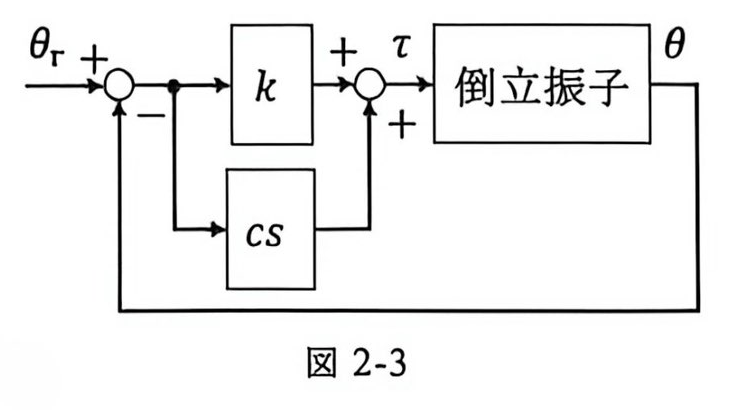
(4) 回転角 θ を制御するために,図 2-3 に示す閉ループ系を構成する.この系において,トルクを τ(t)=k(θr(t)−θ(t))+c(θ˙r(t)−θ˙(t)) で与える.k と c は定数である.θr(t) から θ(t) への閉ループ系の伝達関数を求めよ.また,閉ループ系が臨界減衰となる k と c の関係を求めよ.
English
Answer all questions in Japanese or English.
Problem 2
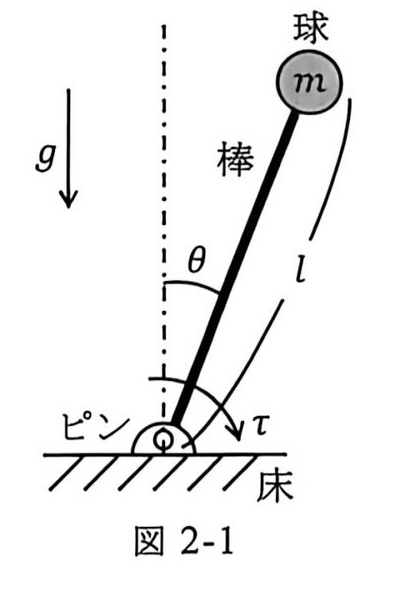
Consider an inverted pendulum in which a ball is attached to a bar connected to a pin, as shown in Figure 2-1. Here, there is no friction between the pin and the bar, and the bar rotates around the pin in the plane. The ball is assumed to be a point mass with mass m. l is the length of the bar. θ is the rotation angle with respect to the vertical axis to the horizontal floor. The rotation angle θ is controlled by a torque τ as input. g is the gravitational acceleration. The mass and deformation of the bar are negligible. Answer the following questions.
(1) Find the potential energy P and kinetic energy T of the inverted pendulum. In addition, obtain the equation of motion for the inverted pendulum using Lagrange’s equation.
In the following questions, assume that θ is small, and consider the linearized equation of motion. θ˙r(t) and θ˙(t) express the time derivatives of θr(t) and θ(t), respectively. Here, θr(t) is the reference value of the rotation angle θ(t).
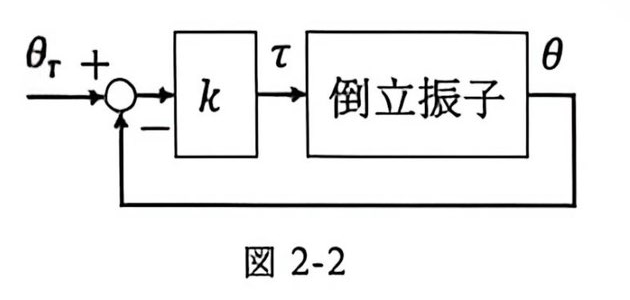
(2) To control the rotation angle θ, the closed-loop system shown in Figure 2-2 is constructed. In this system, the torque is given by τ(t)=k(θr(t)−θ(t)). Here, k is a constant. Derive the transfer function of the closed-loop system from θr(t) to θ(t). In addition, show the condition on k for the response to be bounded.
(3) Consider when θr(t) is set to 0. Obtain the response θ(t) under the condition of Question (2) with the initial conditions θ(t=0)=θ0 and θ˙(t=0)=0.
(4) To control the rotation angle θ, the closed-loop system shown in Figure 2-3 is constructed. In this system, the torque is given by τ(t)=k(θr(t)−θ(t))+c(θ˙r(t)−θ˙(t)). Here, k and c are constants. Derive the transfer function of the closed-loop system from θr(t) to θ(t). In addition, show the relationship between k and c so that the closed-loop system has critical damping.