跳到主要内容

東京大学 工学系研究科 2016年8月実施 数学 第4問

Author

Description

0θ<2π,0απ0 \leq \theta < 2\pi ,0 \leq \alpha \leq \pi 範囲にある実数 θ\theta, α\alpha に対して, 3 次元直交座標系 xyzxyz における点 P(cosθ,sinθ,1)P(\cos\theta,\sin\theta,1) と点 Q(cos(θ+α),sin(θ+α),1)Q(\cos(\theta + \alpha),\sin(\theta + \alpha),-1) の 2 点を通る直線 LL を考える。

I.

直線 LL を, 媒介変数 tt の一次式として表せ。ただし, t=0t = 0 の時に点 QQ を, t=1t = 1 の時に点 PP を表すように定めよ。

II.

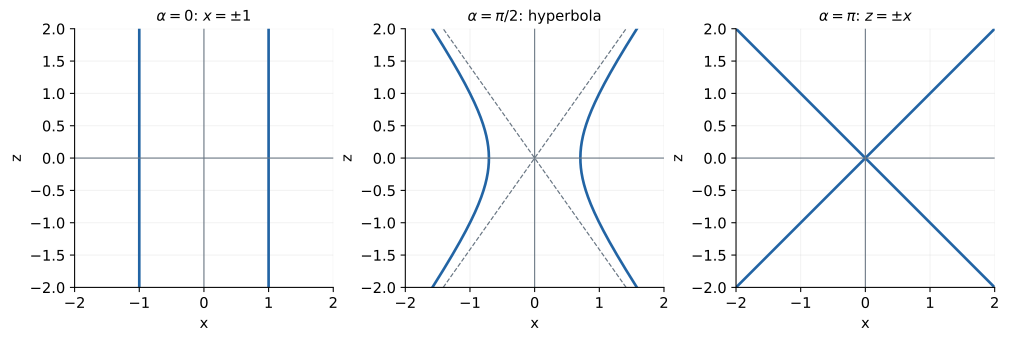
θ\theta0θ<2π0 \leq \theta < 2\pi の範囲で変化させたときに直線 LL が描く曲面 SSx,y,zx,y,z の方程式として求めよ。また, 曲面 SSと平面 y=0y=0 の交線を CC とする。CCx,zx,z の方程式として求め, その概形を図示せよ。

次に, 曲面 SS のガウス曲率を考える。一般に曲面上の点 RR の位置ベクトル rr が媒介変数 u,vu,v を用いて,

r(u,v)=(x(u,v),y(u,v),z(u,v))\begin{align} r(u,v) = (x(u,v),y(u,v),z(u,v)) \end{align}

で与えられるとき, ガウス曲率 KK は次式のように表される。

K=(ruue)(rvve)(ruve)2(ruru)(rvrv)(rurv)2\begin{align} K = \frac{(r_{uu}\cdot e)(r_{vv}\cdot e) - (r_{uv} \cdot e)^2}{(r_{u}\cdot r_{u})(r_{v}\cdot r_{v})- (r_{u} \cdot r_{v})^2} \end{align}

ここで, ru,rvr_{u},r_{v}ruu,ruv,rvvr_{uu},r_{uv},r_{vv} は媒介変数 u,vu,v に関する r(u,v)r(u,v) の一階偏微分, 二階偏微分を表している。また, (ab)\big( a \cdot b \big) は 3 次元ベクトル a,ba,b の内積, ee は点 RR における法線方向の単位ベクトルを表している。

III.

曲面 SSxx 軸の交点のうち領域 x>0x>0 にあるものを点 WW とする。0α<π0 \leq \alpha < \pi を満たす α\alpha に対し, 点 WW における曲面 SS のガウス曲率を計算せよ。

IV.

0α<π0 \leq \alpha < \pi を満たす α\alpha に対し, 曲面 SS の任意の点においてガウス曲率が 00 以下であることを示せ。

Kai

I.

直線 LL 上の点 MM は,

OM=OQ+tQP\overrightarrow{OM} = \overrightarrow{OQ} + t\overrightarrow{QP}

と表せる。このとき, t=0t = 0OQ\overrightarrow{OQ}, t=1t = 1OQ+QP=OP\overrightarrow{OQ} + \overrightarrow{QP} = \overrightarrow{OP} となり, 題意た満たす。

QP=(cosθcos(θ+α),sinθsin(θ+α),2)\overrightarrow{QP} = (\cos\theta - \cos(\theta + \alpha),\sin\theta - \sin(\theta + \alpha), 2)

であるから, 求める直線 LL の媒介変数表示は,

L:{x=cos(θ+α)+t(cosθcos(θ+α))y=sin(θ+α)+t(sinθsin(θ+α))z=1+2tL: \left\{ \begin{aligned} x &= \cos(\theta + \alpha) + t(\cos\theta - \cos(\theta + \alpha)) \\ y &= \sin(\theta + \alpha) + t(\sin\theta - \sin(\theta + \alpha)) \\ z &= -1 + 2t \\ \end{aligned} \right.

II.

和積の公式より,

x=cos(θ+α)2tsin(θ+(θ+α)2)sin(θ(θ+α)2)=cos(θ+α)+2tsin(θ+α2)sinα2y=sin(θ+α)+2tcos(θ+(θ+α)2)sin(θ(θ+α)2)=sin(θ+α)2tcos(θ+α2)sinα2\begin{aligned} x &= \cos(\theta + \alpha) - 2t\sin\bigg(\frac{\theta + (\theta + \alpha)}{2}\bigg) \sin\bigg(\frac{\theta - (\theta + \alpha)}{2}\bigg) \\ &= \cos(\theta + \alpha) + 2t\sin(\theta + \frac{\alpha}{2})\sin\frac{\alpha}{2} \\ y &= \sin(\theta + \alpha) + 2t\cos\bigg(\frac{\theta + (\theta + \alpha)}{2}\bigg)\sin\bigg(\frac{\theta - (\theta + \alpha)}{2}\bigg) \\ &= \sin(\theta + \alpha) - 2t\cos(\theta + \frac{\alpha}{2})\sin\frac{\alpha}{2} \end{aligned}

x2+y2x^2 + y^2 を計算してを消去する。

x2+y2=cos2(θ+α)+4tcos(θ+α)sin(θ+α2)sinα2+4t2sin2(θ+α2)sin2α2+sin2(θ+α)4tsin(θ+α)cos(θ+α2)sinα2+4t2cos2(θ+α2)sin2α2=1+4t2sin2α2+4tsinα2(cos(θ+α)sin(θ+α2)sin(θ+α)cos(θ+α2))=1+4t2sin2α2+4tsinα2sin(θ+α2(θ+α))(加法定理)=1+4t2sin2α24tsin2α2\begin{aligned} &\quad x^2 + y^2 \\ &= \cos^2(\theta + \alpha) + 4t\cos(\theta + \alpha)\sin\big(\theta + \frac{\alpha}{2}\big)\sin\frac{\alpha}{2} \\ &\quad + 4t^2\sin^2\big(\theta + \frac{\alpha}{2}\big)\sin^2\frac{\alpha}{2} + \sin^2(\theta + \alpha) \\ &\qquad - 4t\sin(\theta + \alpha)\cos\big(\theta + \frac{\alpha}{2}\big)\sin\frac{\alpha}{2} \\ &\quad \qquad + 4t^2\cos^2\big(\theta + \frac{\alpha}{2}\big)\sin^2\frac{\alpha}{2} \\ &= 1 + 4t^2\sin^2 \frac{\alpha}{2} + 4t\sin\frac{\alpha}{2} \\ &\qquad\cdot \big(\cos(\theta + \alpha)\sin\big(\theta + \frac{\alpha}{2}\big) - \sin(\theta + \alpha)\cos\big(\theta + \frac{\alpha}{2}\big) \big) \\ &= 1 + 4t^2\sin^2\frac{\alpha}{2} + 4t\sin\frac{\alpha}{2}\sin\big(\theta + \frac{\alpha}{2} - (\theta + \alpha)\big) \quad (\because \text{加法定理}) \\ &= 1 + 4t^2\sin^2\frac{\alpha}{2} - 4t\sin^2\frac{\alpha}{2} \end{aligned}

さらに, t=(z+1)/2t = (z + 1)/2 を代入して tt を消去すると,

x2+y2=1+(z+1)2sin2α22(z+1)sin2α2=sin2α2z2+1sin2α2=sin2α2z2+cos2α2\begin{aligned} x^2 + y^2 &= 1 + (z + 1)^2 \sin^2\frac{\alpha}{2} - 2(z + 1)\sin^2\frac{\alpha}{2} \\ &= \sin^2\frac{\alpha}{2} \cdot z^2 + 1 - \sin^2\frac{\alpha}{2} \\ &= \sin^2\frac{\alpha}{2} \cdot z^2 + \cos^2\frac{\alpha}{2} \end{aligned}

よって, 求める曲面 SS の方程式は

x2+y2sin2α2z2=cos2α2x^2 + y^2 - \sin^2\frac{\alpha}{2} \cdot z^2 = \cos^2\frac{\alpha}{2}

また y=0y = 0 とすると, 交線 CC の方程式を得る。

x2sin2α2z2=cos2α2x^2 - \sin^2\frac{\alpha}{2} \cdot z^2 = \cos^2\frac{\alpha}{2}

a=0a = 0 のとき, x=±1x = \pm 1 である。

a0a \neq 0 のとき, この曲線は双曲線であり, その漸近線の方程式は, 

z=±cosα2sinα21cosα2x=±xsinα2z = \pm \frac{\cos\frac{\alpha}{2}}{\sin\frac{\alpha}{2}} \cdot \frac{1}{\cos\frac{\alpha}{2}} x = \pm \frac{x}{\sin\frac{\alpha}{2}}

である。概形は次のようになる。

今, 曲面 SS 上の点 RR の位置ベクトルは媒介変数 θ,t\theta ,t を用いて以下のように表されでおり,

r(θ,t)=(cos(θ+α)+t(cosθcos(θα))sin(θ+α)+t(sinθsin(θ+α))1+2t)r(\theta ,t) = \begin{pmatrix} \cos(\theta + \alpha) + t(\cos\theta - \cos(\theta - \alpha)) \\ \sin(\theta + \alpha) + t(\sin\theta - \sin(\theta + \alpha)) \\ -1 + 2t \end{pmatrix}

ガウス曲率 KK は,

K=(rθθe)(rtte)(rθte)2(rθrθ)(rtrt)(rθrt)2K = \frac{(r_{\theta\theta}\cdot e)(r_{tt}\cdot e) - (r_{\theta t}\cdot e)^2}{(r_{\theta}\cdot r_{\theta})(r_{t} \cdot r_{t}) - (r_{\theta} \cdot r_{t})^2}

で表される。

rθ=((1t)sin(θ+α)tsinθ(1t)cos(θ+α)+tcosθ0)rt=(cosθcos(θ+α)sinθsin(θ+α)2)rθθ=((1t)cos(θ+α)tcosθ(1t)sin(θ+α)tsinθ0)rtt=(000)rθt=(sinθ+sin(θ+α)cosθcos(θ+α)0)\begin{aligned} r_{\theta} &= \begin{pmatrix} -(1 - t)\sin(\theta + \alpha) - t\sin \theta \\ (1 - t)\cos(\theta + \alpha) + t\cos \theta \\ 0 \end{pmatrix} \\ r_{t} &= \begin{pmatrix} \cos \theta - \cos(\theta + \alpha) \\ \sin \theta - \sin(\theta + \alpha) \\ 2 \end{pmatrix} \\ r_{\theta\theta} &= \begin{pmatrix} -(1 - t)\cos(\theta + \alpha) - t\cos\theta \\ -(1 - t)\sin(\theta + \alpha) -t\sin\theta \\ 0 \end{pmatrix} \\ r_{tt} &= \begin{pmatrix} 0 \\ 0 \\ 0 \end{pmatrix} \\ r_{\theta t} &= \begin{pmatrix} -\sin\theta + \sin(\theta + \alpha) \\ \cos\theta - \cos(\theta + \alpha) \\ 0 \end{pmatrix} \end{aligned}

計算の都合上, 設問 IV から先に解答する。

III.

設問 II の図を利用して, 点 WW における曲面 SS の法線ベクトル nn を求める。 平面 y=0y = 0 での断面が下図左であり, これが双曲線であることから nn は実数 kk を用いて (1,k,0)(1,k,0) の形で表すことができる。

一方で, 平面 z=0z = 0 で断面は SS の方程式に z=0z = 0 を代入することで, 原点を中心とする半径 cosα2\cos\frac{\alpha}{2} の円 (下図右) であることが容易に分かる。したがって, nn は実数 ll を用いて (1,0,l)(1,0,l) の形で表すことができる。

これらをともに満たす nn は, n=(1,0,0)n=(1,0,0) であり, これは単位ベクトルだから点 WW における単位法線ベクトル eee=(1,0,0)e=(1,0,0) となる。

WW において, θ,t\theta,t は以下の関係を満たす。

{cos(θ+α)+t(cosθcos(θ+α))=cosα2sin(θ+α)+t(sinθsin(θ+α))=01+2t=0\left\{ \begin{aligned} \cos(\theta + \alpha) + t(\cos\theta - \cos(\theta + \alpha)) &= \cos\frac{\alpha}{2 } \\ \sin(\theta + \alpha) + t(\sin\theta - \sin(\theta + \alpha)) &= 0 \\ -1 + 2t &= 0 \end{aligned} \right.

3つ目の式より t=1/2t = 1/2 であり, 2つ目の式に代入して,

sinθ+sin(θ+α)=0\sin\theta + \sin(\theta + \alpha) = 0
sin((θ+α2)α2)+sin((θ+α2+α2))=0\sin \big((\theta + \frac{\alpha}{2}) - \frac{\alpha}{2}\big) + \sin \big((\theta + \frac{\alpha}{2} + \frac{\alpha}{2})\big) = 0
2cosα2sin(θ+α2)=0(和積の公式)2\cos\frac{\alpha}{2}\sin\big(\theta + \frac{\alpha}{2}\big) = 0 (\because\text{和積の公式})

cosα20\cos\frac{\alpha}{2} \neq 0より, sin(θ+α2)=0\sin(\theta + \frac{\alpha}{2}) = 0

θ+α2=nπ(n=1,±1,±2,)\therefore \theta + \frac{\alpha}{2} =n\pi \quad (n=1,\pm1,\pm2,\cdots)

0α<π0 \leq \alpha < \pi, 0θ<2π0 \leq \theta < 2\pi より,

θ=α2+π,α2+2π\theta = -\frac{\alpha}{2} + \pi ,-\frac{\alpha}{2} + 2\pi
sinθ=±sinα2sin2θ=sin2α2\therefore \sin\theta = \pm\sin\frac{\alpha}{2} \Leftrightarrow \sin^2\theta =\sin^2\frac{\alpha}{2}

KK の分子は,

(rθte)2=(sin(θ+α)sinθ)2=(sin(θ+α)+sinθ)2+4sinθsin(θ+α)=02+4sinθ(sinθ)=4sin2θ=4sin2α2\begin{aligned} &\quad -(r_{\theta t}\cdot e)^2 \\ &= -(\sin(\theta + \alpha) - \sin\theta)^2 \\ &= -(\sin(\theta + \alpha) + \sin\theta)^2 + 4\sin\theta\sin(\theta + \alpha) \\ &= -0^2 + 4\sin\theta \cdot (-\sin\theta) \\ &= -4\sin^2\theta = -4\sin^2\frac{\alpha}{2} \end{aligned}

KK の分母は,

(rθrθ)(rtrt)(rθrt)2=(62cosα)(22cosα)(t12)2+2(1+cosα)=0+22cos2α2=4cos2α2\begin{aligned} &\quad (r_{\theta} \cdot r_{\theta})(r_{t} \cdot r_{t}) - (r_{\theta} \cdot r_{t})^2 \\ &= (6 - 2\cos\alpha)(2 - 2\cos\alpha)(t - \frac{1}{2})^2 + 2(1 + \cos\alpha) \\ &= 0 + 2 \cdot 2\cos^2\frac{\alpha}{2} = 4\cos^2\frac{\alpha}{2} \end{aligned}

したがって求めるガウス曲率 KK は,

K=4sin2α24cos2α2=tan2α2K = \frac{-4\sin^2\frac{\alpha}{2}}{4\cos^2\frac{\alpha}{2}} = -\tan^2\frac{\alpha}{2}

IV.

rtt=or_{tt} = o であることから, KK の分子は (rθte)2-(r_{\theta t} \cdot e)^2 であり, これは明らかに 00 以下である。従って, KK の分母が正であることを示せば良い。

rθrθ={(1t)sin(θ+α)+tsinθ}2+{(1t)cos(θ+α)+tcosθ}2=(1t)2+t2+2t(1t){sin(θ+α)sinθ+cos(θ+α)cosθ}=12t+2t2+2t(1t)cos((θ+α)θ)=12t+2t2+2t(1t)cosα\begin{aligned} &\quad r_{\theta} \cdot r_{\theta} \\ &= \{(1 - t)\sin(\theta + \alpha) + t\sin\theta\}^2 + \{(1 - t)\cos(\theta + \alpha) + t\cos\theta\}^2 \\ &= (1 - t)^2 + t^2 + 2t(1 - t)\{\sin(\theta + \alpha)\sin\theta + \cos(\theta + \alpha)\cos\theta\} \\ &= 1 - 2t + 2t^2 + 2t(1 - t)\cos\big((\theta + \alpha) - \theta\big) \\ &= 1 - 2t + 2t^2 + 2t(1 - t)\cos\alpha \end{aligned}
rtrt=(cosθcos(θ+α))2+(sinθsin(θ+α))2+22=1+1+42{cos(θ+α)cosθ +sinθsin(θ+α)}=62cosα\begin{aligned} &\quad r_{t} \cdot r_{t} \\ &= (\cos\theta - \cos(\theta + \alpha))^2 + (\sin\theta - \sin(\theta + \alpha))^2 + 2^2 \\ &= 1 + 1 + 4 - 2\{\cos(\theta + \alpha)\cos\theta\ + \sin\theta\sin(\theta + \alpha)\} \\ &= 6 - 2\cos\alpha \end{aligned}
rθrt={(1t)sin(θ+α)tsinθ}(cosθcos(θ+α))+{(1t)cos(θ+α)+tcosθ}(sinθsin(θ+α))=(1t)sin(θ+α)cosθ+(1t)sin(θ+α)cos(θ+α)tsinθcosθ+tsinθcos(θ+α)+(1t)cos(θ+α)sinθ(1t)cos(θ+α)sin(θ+α)+tsinθcosθtcosθsin(θ+α)=sin(θ+α)cosθ+cos(θ+α)sinθ=sin(θ(θ+α))=sinα\begin{aligned} &\quad r_{\theta} \cdot r_{t}\\ &= \{-(1 - t)\sin(\theta + \alpha) - t\sin\theta\}(\cos\theta - \cos(\theta + \alpha)) \\ &\qquad +\{(1 - t)\cos(\theta + \alpha)+ t\cos\theta\}(\sin\theta - \sin(\theta + \alpha)) \\ &= -(1 - t)\sin(\theta + \alpha)\cos\theta + (1 - t)\sin(\theta + \alpha)\cos(\theta + \alpha)\\ &\qquad - t\sin\theta\cos\theta + t\sin\theta\cos(\theta + \alpha) + (1 - t)\cos(\theta + \alpha)\sin\theta \\ &\quad \qquad - (1 - t)\cos(\theta + \alpha)\sin(\theta + \alpha) \\ &\qquad \qquad + t\sin\theta\cos\theta - t\cos\theta\sin(\theta + \alpha) \\ &= -\sin(\theta + \alpha)\cos\theta + \cos(\theta + \alpha)\sin\theta \\ &= \sin(\theta - (\theta + \alpha))\\ &= -\sin\alpha \end{aligned}

であるから, KK の分母は,

(rθrθ)(rtrt)(rθrt)2={12t+2t2+2t(1t)cosα}(62cosα)sin2α=(62cosα){(22cosα)t2+(2cosα2)t+1}(1cos2α)=(62cosα)(22cosα)(t12)214(62cosα)(22cosα)+(52cosα+cos2α)=(62cosα)(22cosα)(t12)2+2(1+cosα)\begin{aligned} &\quad (r_{\theta} \cdot r_{\theta})(r_{t} \cdot r_{t}) - (r_{\theta} \cdot r_{t})^2 \\ &= \{1 - 2t + 2t^2 + 2t(1 - t)\cos\alpha\}(6 - 2\cos\alpha) - \sin^2\alpha \\ &= (6 - 2\cos\alpha)\{(2 - 2\cos\alpha)t^2 + (2\cos\alpha - 2)t + 1\} - (1 - \cos^2\alpha) \\ &= (6 - 2\cos\alpha)(2 - 2\cos\alpha)\big(t - \frac{1}{2}\big)^2 \\ &\qquad \qquad - \frac{1}{4}(6 - 2\cos\alpha)(2 - 2\cos\alpha) + (5 - 2\cos\alpha + \cos^2\alpha) \\ &= (6 - 2\cos\alpha)(2 - 2\cos\alpha)\big(t - \frac{1}{2}\big)^2 + 2(1 + \cos\alpha) \end{aligned}

ここで, 0α<π0 \leq \alpha < \pi より, cosα0\cos\alpha \ge 0 であるから,

(rθrθ)(rtrt)(rθrt)2>0(r_{\theta} \cdot r_{\theta})(r_{t} \cdot r_{t}) - (r_{\theta} \cdot r_{t})^2 > 0

である。したがって, K0K \leq 0 が示された。