東京大学 情報理工学系研究科 電子情報学専攻 2024年8月実施 専門 第3問
Author
祭音Myyura
Description
最小全域木(Minimum Spanning Tree, MST)問題とは, を頂点集合, をエッジ集合とし,各エッジに重みが与えられている無向グラフ が与えられたとき,以下の条件を満たす部分グラフを 1 つ見つける問題である.
- グラフ のすべての頂点 を含む.
- サイクル(閉路)が存在しない,木の構造である.
- エッジの重みの総和が最小である.
解答にあたっては,以下の仮定を前提とすること.
- ソート関数を使う場合には,長さ の配列に対して の計算量を仮定すること.
- 各頂点がどの集合に属しているかの判定や,2 つの異なる集合の統合操作は,例えば互いに素な集合データ構造(Union–Find)を用いることで定数時間で行えること.
- 優先度付きキューを使用する場合には,ヒープによって実装されたものを使うこと.
以下の問いに答えよ.
(1) 最小全域木問題を解くアルゴリズムの方針とその擬似コードを簡潔に示せ.なお,アルゴリズムは決定的かつ時間計算量が となるようにせよ. は集合 の要素数, は集合 の要素数を示す.
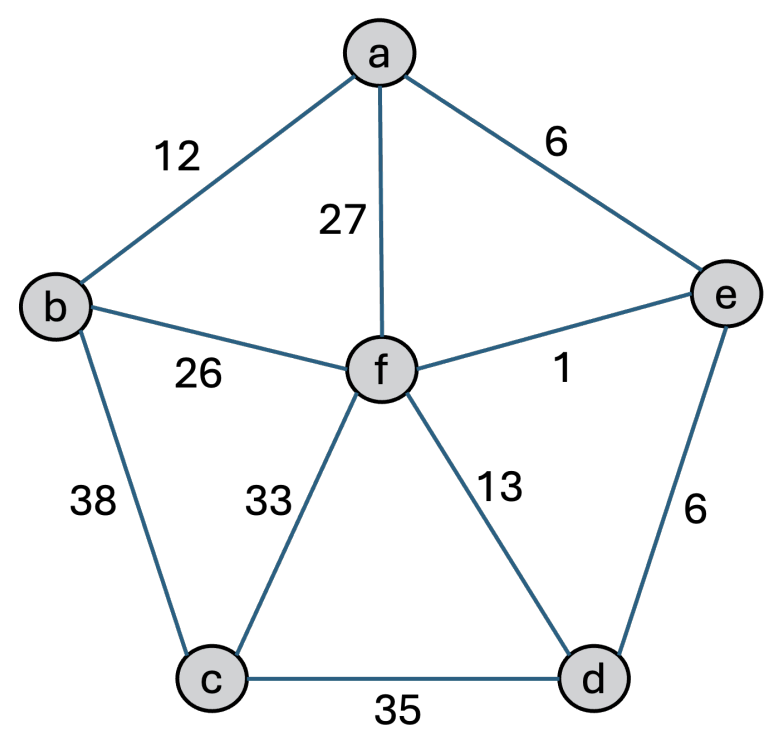
(2) (1) で示したアルゴリズムを用いて 図 のグラフの最小全域木とエッジの重みの総和を示せ.
(3) 全域木の中でエッジの重みの和が 2 番目に小さい全域木(以下,Second MST と呼ぶ)を求めるアルゴリズムの方針とその擬似コードを簡潔に示せ.また,時間計算量を示せ.
(4) (3) で示したアルゴリズムを用いて 図 のグラフの Second MST とエッジの重みの総和を示せ.
题目描述
最小生成树(Minimum Spanning Tree,MST)问题给定一个带权无向图 ,其中 为顶点集、 为边集,要求找到一个同时满足以下条件的子图:
- 包含 的全部顶点;
- 无环,构成一棵树;
- 所有边的权重之和最小。
作答时采用以下假设:
- 对长度为 的数组,排序函数耗时 ;
- 判断顶点所属集合及合并两个不同集合可借助并查集等结构在常数时间内完成;
- 若使用优先队列,则采用堆实现。
(1) 简要说明一种求 MST 的确定性算法,并写出伪代码,使其时间复杂度为 ;、 分别表示边数和顶点数。
(2) 用 (1) 的算法求上图所示图的 MST,并给出所选边及其权重总和。
(3) 在所有生成树中,把边权总和第二小的生成树称为 Second MST。简要说明求 Second MST 的算法,写出伪代码,并给出时间复杂度。
(4) 用 (3) 的算法求上图所示图的 Second MST,并给出所选边及其权重总和。
Kai
(1)
KruskalMST(G=(V,E), w):
    sort edges E by (weight, fixed edge ID) ascending # O(|E| log |E|)
    UF = UnionFind(|V|)
    T = ∅ ; WT = 0
    for each (u,v) in E (in ascending weight):
        if UF.find(u) != UF.find(v):                  # O(1)
            UF.union(u,v)
            T.add((u,v))
            WT += w(u,v)
            if |T| == |V|-1: break
    return T, WT
For a connected simple graph, . Total complexity:
(2)
The selected edges are , and their total weight is .
(3)
A lightest spanning tree distinct from a chosen MST omits at least one edge of . Hence it is enough to find the best spanning tree after excluding each edge of in turn.
Using Kruskal's algorithm
We can use Kruskal's algorithm to find the MST first, then exclude each of its edges in turn and recompute a spanning tree.
- Sort all edges of the graph in non-decreasing order of their weights, which requires .
- Apply Kruskal’s algorithm to the sorted edge list to obtain an initial minimum spanning tree , Since edge sorting has already been performed, this step requires time.
- For each edge (there are such edges), temporarily remove it from the edge set so that it cannot be selected. Using the remaining edges, apply Kruskal’s algorithm again to construct a new spanning tree (if possible). Each such computation can be performed in time.
- Among all feasible spanning trees obtained above, select one with minimum total weight. Every spanning tree different from omits some edge of , so this minimum is the second spanning tree (and may have the same weight as when the MST is not unique).
The overall time complexity will be .
A complete implementation, retaining the initial edge order, is:
SecondTree(V, sortedEdges):
    (T, W) = KruskalUsingSortedEdges(V, sortedEdges)
    if |T| != |V|-1: return NONE
    bestTree = NONE; bestWeight = infinity
    for excludedEdge in T:
        UF = UnionFind(|V|)
        candidate = ∅; weight = 0
        for (u, v, w, id) in sortedEdges:
            if id == excludedEdge.id: continue
            if UF.find(u) != UF.find(v):
                UF.union(u, v)
                candidate.add(id)
                weight += w
        if |candidate| == |V|-1 and weight < bestWeight:
            bestTree = candidate; bestWeight = weight
    return bestTree, bestWeight
If “second” requires a strictly larger total weight, equal-weight MSTs must be skipped. In that convention, examine every exchange of a non-tree edge with an edge on its fundamental cycle:
StrictSecondTree(G):
    (T, W) = KruskalMST(G)
    bestTree = NONE; bestWeight = infinity
    for edge e=(u,v) in E minus T:
        P = the unique u-to-v path in T       # DFS, O(|V|)
        for edge f in P:
            delta = w(e) - w(f)
            if 0 < delta and W+delta < bestWeight:
                bestTree = T minus {f} plus {e}
                bestWeight = W+delta
    return bestTree, bestWeight
The minimum positive exchange produces a tree with the next distinct weight. To see this, compare with a tree of that weight and pair their differing edges by the spanning-tree exchange property. Each admissible exchange from an MST has nonnegative cost; at least one is positive, and its cost is at most the total weight difference. Minimality of the next distinct weight then forces equality. The path searches and scans take time.
(4)
The selected edges are , and their total weight is .