東京大学 情報理工学系研究科 電子情報学専攻 2023年8月実施 専門 第2問
Author
Description
Consider designing a binary digital synchronous sequential circuit as follows.
- The circuit has inputs and output .
- The inputs represent a character from to encoded as , and .
- The output is when the last two consecutive inputs are or ; otherwise is .
Answer the following questions.
(1) Explain in words or less what a synchronous sequential circuit is.
(2) Draw a state transition diagram of the circuit in the form of a Mealy graph. Use states corresponding to each character. Each state represents that the corresponding character is the last input.
(3) The output must be until the first two characters are given as inputs to the circuit. Answer which state in the state transition diagram in (2) should be the initial state to achieve this.
(4) Simplify the state transition diagram in (2) so that it has states.
(5) Create a state transition table from the state transition diagram in (4).
(6) Draw Karnaugh maps from the state transition table in (5).
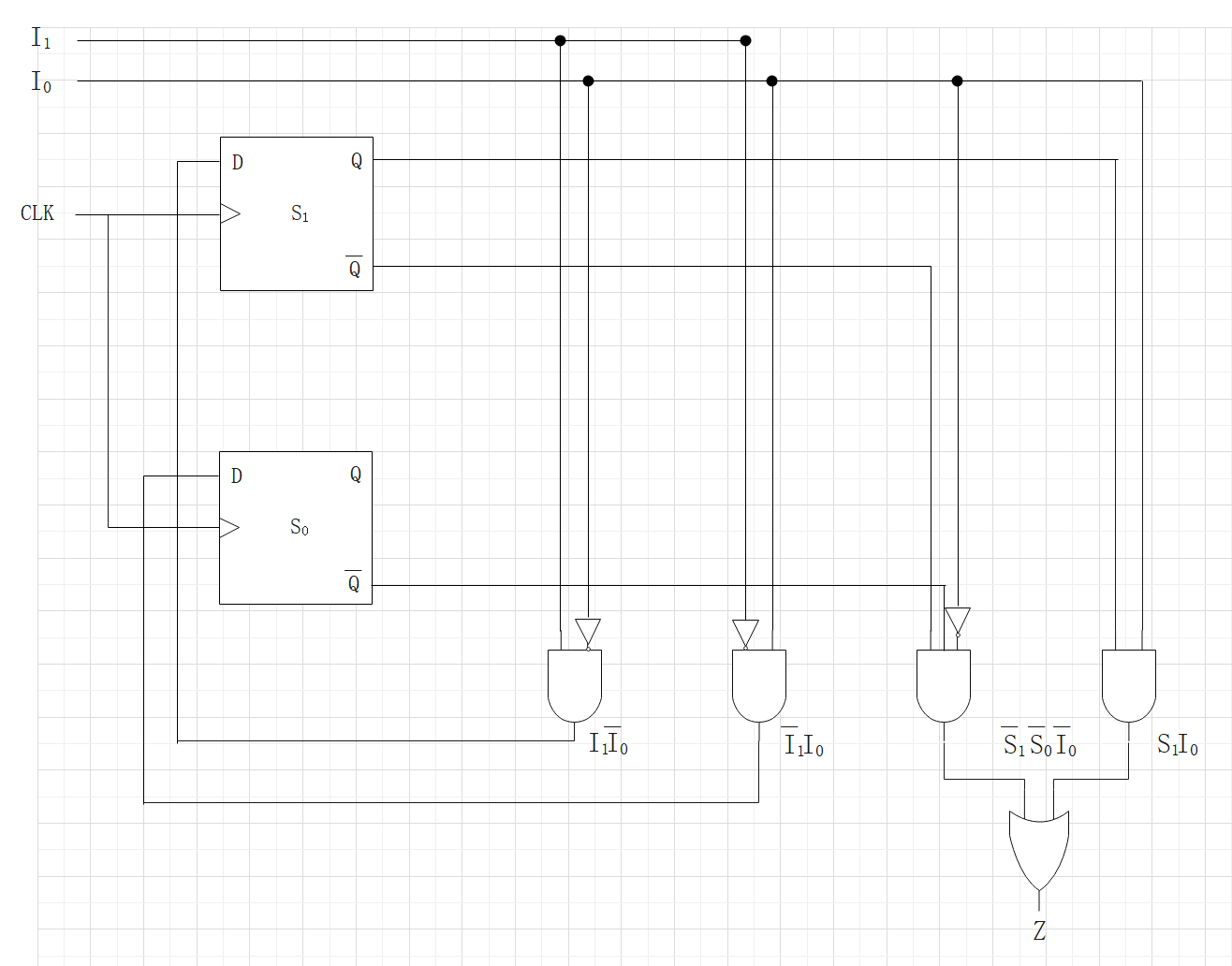
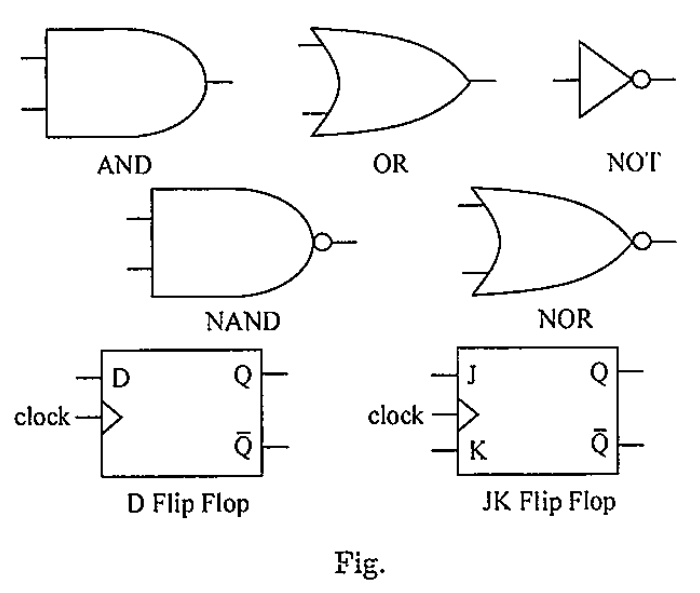
(7) Simplify the logic as much as possible using the Karnaugh maps in (6), and draw the circuit using MIL simbols shown in the Fig.
题目描述
设计如下二进制数字同步时序电路:
- 电路有两个输入 和一个输出 ;
- 输入编码字符 至 :、、、;
- 最近连续输入的两个字符为 之一时,,否则 。
回答下列问题,所用 MIL 符号见上图。
(1) 用不超过 个词解释什么是同步时序电路。
(2) 以 Mealy 图形式画出状态转移图。使用分别对应字符 的 个状态,每个状态表示该字符是最近一次输入。
(3) 在最初两个字符输入完成之前,输出必须保持 。为满足这一条件,说明 (2) 的状态转移图应以哪个状态为初始状态。
(4) 化简 (2) 的状态转移图,使其只含 个状态。
(5) 根据 (4) 的状态转移图写出状态转移表。
(6) 根据 (5) 的状态转移表画卡诺图。
(7) 利用 (6) 的卡诺图尽可能化简逻辑,并用上图所示 MIL 符号画出电路。
Kai
(1)
A synchronous sequential circuit stores a state that changes at specified clock edges. Its next state depends on the present state and inputs; its outputs depend on the state and, for a Mealy circuit, the current inputs.
(2)
(3)
State should be the initial state. Since any two consecutive input only inputs .
(4)
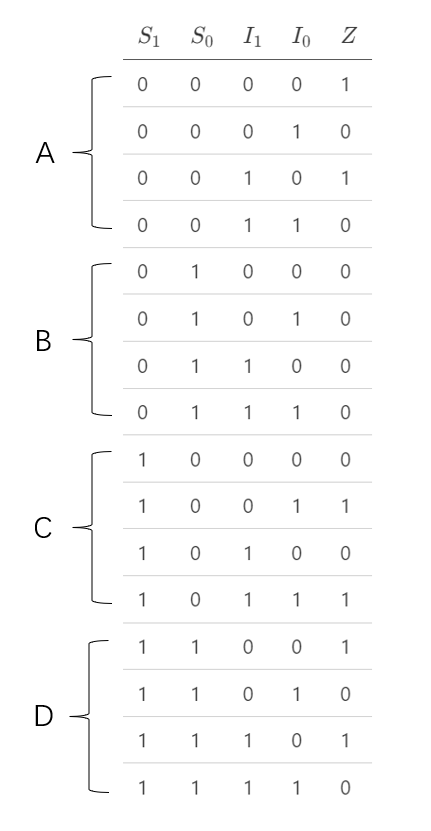
States and are equivalent: their outputs agree for every input, and their next states are identical. Encode , , .
(5)
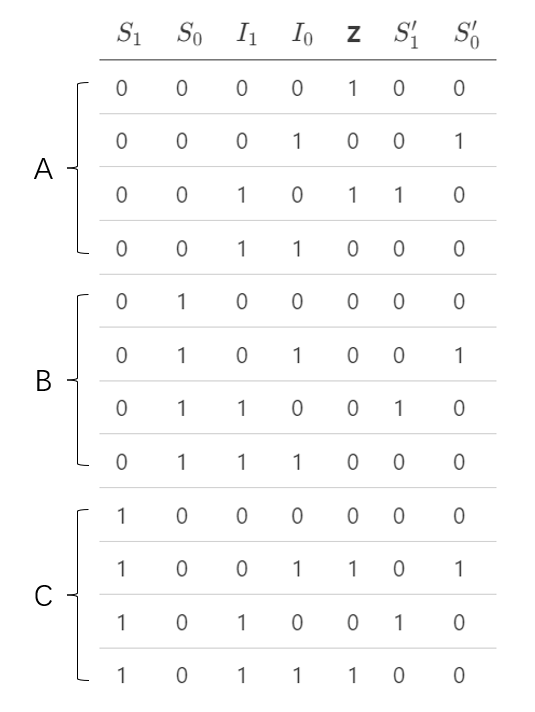
(6)
| / | 00 | 01 | 11 | 10 |
|---|---|---|---|---|
| 00 | 0 | 0 | 0 | 1 |
| 01 | 0 | 0 | 0 | 1 |
| 11 | d | d | d | d |
| 10 | 0 | 0 | 0 | 1 |
| / | 00 | 01 | 11 | 10 |
|---|---|---|---|---|
| 00 | 0 | 1 | 0 | 0 |
| 01 | 0 | 1 | 0 | 0 |
| 11 | d | d | d | d |
| 10 | 0 | 1 | 0 | 0 |
| / | 00 | 01 | 11 | 10 |
|---|---|---|---|---|
| 00 | 1 | 0 | 0 | 1 |
| 01 | 0 | 0 | 0 | 0 |
| 11 | d | d | d | d |
| 10 | 0 | 1 | 1 | 0 |
Here , , and denotes the unused state. Initialize .
(7)