跳到主要内容

東京大学 情報理工学系研究科 電子情報学専攻 2022年8月実施 専門 第5問

Author

Josuke

Description

Answer the following questions about discrete signal processing.

(1) Show the definition of the Z\mathcal{Z}-transform X(z)X(z) of a discrete signal sequence xn(n=0,1,2,)x_n(n=0,1,2,\dots) defined for n0n \ge 0 where zz is a complex number.

(2) By using the definition, find the Z\mathcal{Z}-transform of a geometric sequence xn=pnx_n = p^n where pp is a real number.

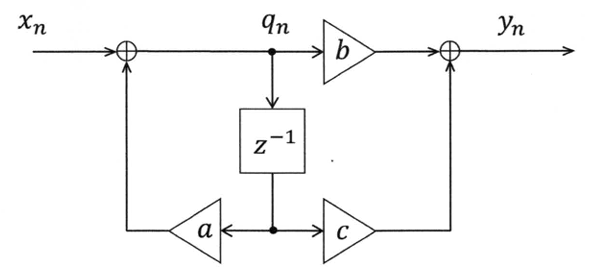
(3) We consider the zero state response of the discrete time system shown in the figure below ,where a,ba,b and cc are real numbers. Give X(z)X(z) and Y(z)Y(z) by using the Z\mathcal{Z}-tranform Q(z)Q(z) of the system's internal state qnq_n. Here, X(z)X(z) and Y(z)Y(z) are the Z\mathcal{Z}-tranforms of the system's input xnx_n and output yny_n, respectively.

(4) Give the transfer function H(z)H(z) of the system.

(5) Next, we find the system's frequency response by using the transfer function H(z)H(z). Consider the input sequnence xn=ejnωTx_n = e^{jn\omega T} sampled at the interval TT from a complex exponential function x(t)=ejωt(t0)x(t) = e^{j\omega t}(t \ge 0). Derive Y(z)Y(z) and then find the output sequence yny_n.

Kai

(1)

X(z)=n=0+x(n)znX(z) = \sum_{n=0}^{+\infty}x(n)z^{-n}

(2)

X(z)=n=0+pnzn=n=0+(pz1)n=11pz1X(z) = \sum_{n=0}^{+\infty}p^nz^{-n} = \sum_{n=0}^{+\infty}(pz^{-1})^n = \frac{1}{1 - pz^{-1}}

(3)

X(z)+az1Q(z)=Q(z)X(z)=(1az1)Q(z)Y(z)=bQ(z)+cz1Q(z)=(b+cz1)Q(z)\begin{aligned} X(z) &+ az^{-1}Q(z) = Q(z) \\ X(z) &= (1 - az^{-1})Q(z) \\ Y(z) &= bQ(z) + cz^{-1}Q(z) \\ &= (b + cz^{-1})Q(z) \end{aligned}

(4)

H(z)=Y(z)X(z)=b+cz11az1=b1az1+cz11az1H(z) = \frac{Y(z)}{X(z)} = \frac{b + cz^{-1}}{1 - az^{-1}} = \frac{b}{1 - az^{-1}} + \frac{cz^{-1}}{1 - az^{-1}}

(5)

X(z)=11ejωTz1h[n]=ban+can1Y(z)=b+cz1(1az1)(1ejωTz1)y[n]=k=0+ejωkT(bank+cank1)=bank=0+(ejωTa1)k+can1k=0+(ejωTa1)k=ban1a1ejωT+can11a1ejωT=(ba+c)an11a1ejωT\begin{aligned} X(z) &= \frac{1}{1 - e^{j\omega T}z^{-1}} \qquad h[n] = ba^n + ca^{n-1} \\ Y(z) &= \frac{b + cz^{-1}}{(1 - az^{-1})(1 - e^{j\omega T}z^{-1})} \\ y[n] &= \sum_{k=0}^{+\infty}e^{j\omega kT}(ba^{n-k} + ca^{n-k-1}) \\ &= ba^{n} \sum_{k=0}^{+\infty}(e^{j\omega T}a^{-1})^k + ca^{n-1} \sum_{k=0}^{+\infty}(e^{j\omega T}a^{-1})^k \\ &= \frac{ba^n}{1 - a^{-1}e^{j\omega T}} + \frac{ca^{n-1}}{1 - a^{-1}e^{j\omega T}} \\ &=\frac{(ba + c)a^{n-1}}{1 - a^{-1}e^{j\omega T}} \end{aligned}