跳到主要内容

東京大学 情報理工学系研究科 電子情報学専攻 2017年8月実施 専門 第5問

Author

Josuke

Description

Answer the following questions about discrete signal processing. Here, TT is the sampling interval.

(1) Show the definition of the ZZ-transform X(z)X(z) for the discrete signal series xn(n=0,1,2,)x_n(n = 0,1,2,\cdots), which is defined for n0n \ge 0. Here, zz is a complex variable.

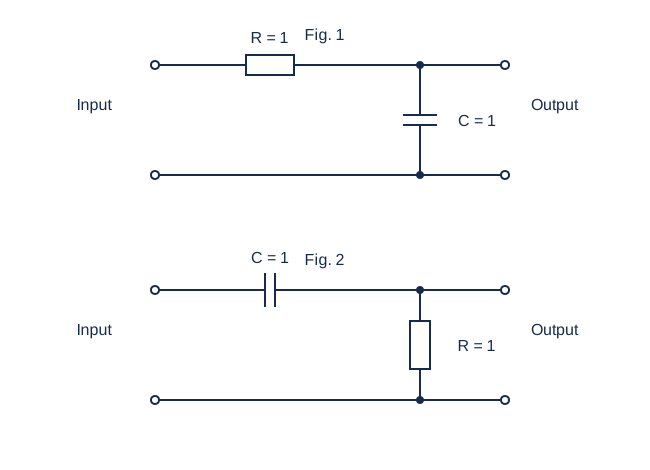
(2) Derive the transfer function H(s)H(s) in the ss-domain(the Laplace transform domain) of the circuit in Fig.1.

(3) The relationship between the Laplace transform and the ZZ-transform is described as z=esTz = e^{sT}. Derive the following approximation.

s2T1z11+z1.s \simeq \frac{2}{T}\frac{1 - z^{-1}}{1 + z^{-1}}.

You can use the following equation if necessary.

ex1+x.e^{x} \simeq 1 + x.

(4) Convert H(s)H(s) to the transfer function H(z)H(z) in the zz-domain by using the approximation derived in (3). Here, we assume T=1T = 1.

(5) Show a schematic of a discrete signal circuit that corresponds to H(z)H(z) in (4).

(6) By taking the same procedure, show a schematic of a discrete signal circuit for the circuit shown in Fig.2.

Kai

(1)

X(z)=n=0x(n)znX(z) = \sum_{n = 0}^{\infty}x(n)z^{-n}

(2)

H(s)=Vout(s)Vin(s)=1sCR+1sC=11+sH(s) = \frac{V_{out}(s)}{V_{in}(s)} = \frac{\frac{1}{sC}}{R + \frac{1}{sC}} = \frac{1}{1 + s}

(3)

z1=esT=e12sTe12sT=112sT1+12sTz^{-1} = e^{sT} = \frac{e^{-\frac{1}{2}sT}}{e^{\frac{1}{2}sT}} = \frac{1 - \frac{1}{2}sT}{1 + \frac{1}{2}sT}
z1(1+12sT)=112sTz1=112sT(1+z1)1z1=12sT(1+z1)s=2T1z11+z1\begin{aligned} z^{-1}(1 + \frac{1}{2}sT) &= 1 - \frac{1}{2}sT \\ z^{-1} &= 1 - \frac{1}{2}sT(1 + z^{-1}) \\ 1 - z^{-1} &= \frac{1}{2}sT(1 + z^{-1}) \\ s &= \frac{2}{T} \cdot \frac{1 - z^{-1}}{1 + z^{-1}} \end{aligned}

(4)

H(s)=11+s=11+21z11+z1=1+z13z1=13113z1+13z1113z1\begin{aligned} H(s) &= \frac{1}{1 + s} = \frac{1}{1 + 2 \cdot \frac{1 - z^{-1}}{1 + z^{-1}}} = \frac{1 + z^{-1}}{3 - z^{-1}} \\ &= \frac{\frac{1}{3}}{1 - \frac{1}{3}z^{-1}} + \frac{\frac{1}{3}z^{-1}}{1 - \frac{1}{3}z^{-1}} \end{aligned}

(5)

H(z)=Y(z)X(z)=1+z13z1H(z) = \frac{Y(z)}{X(z)} = \frac{1 + z^{-1}}{3 - z^{-1}}
(3z1)Y(z)=(1+z1)X(z)(3 - z^{-1})Y(z) = (1 + z^{-1})X(z)
Y(z)=13[X(z)+z1(X(z)+Y(z))]Y(z) = \frac{1}{3}[X(z) + z^{-1}(X(z) + Y(z))]

(6)

H(s)=s1+sH(s) = \frac{s}{1 + s}
H(z)=21z11+z11+21z11+z1=22z13z1H(z) = \frac{2 \cdot \frac{1 - z^{-1}}{1 + z^{-1}}}{1 + 2 \cdot \frac{1 - z^{-1}}{1 + z^{-1}}} = \frac{2 - 2z^{-1}}{3 - z^{-1}}
Y(z)X(z)=22z13z1\frac{Y(z)}{X(z)} = \frac{2 - 2z^{-1}}{3 - z^{-1}}
Y(z)=13[2X(z)+z1(Y(z)2X(z))]Y(z) = \frac{1}{3}[2X(z) + z^{-1}(Y(z) - 2X(z))]