東京大学 情報理工学系研究科 コンピュータ科学専攻 2019年8月実施 専門科目II 問題3
Author
祭音Myyura (co-authored with GPT 5.6 SOL)
Description
Let us consider representing an orientation of an object in a three-dimensional space as a rotation from a canonical orientation. In the following, we consider the orientation of the object consisting of four cubes as shown in Figures 1 and 2 (note that each pair of cubes placed side by side shares a surface). We also define the canonical orientation as the one illustrated in Figure 1. Note that the center of the cube at the lower left in Figure 1 is placed at the origin, and the center of each cube lies on the , , or axis. Figure 2 shows another orientation of this object, in which the center of the cube at the lower right is placed at the origin, and the center of each cube lies on the , , or axis. When you draw another orientation of this object, you need to draw it with the axes from the same point of view as Figures 1 and 2. Angles must be represented in radian.
Answer the following questions.
Figures 1 and 2 are specified geometrically below, with the cube side length taken as one unit.
| Figure | Centers of the four cubes |
|---|---|
| Figure 1 | |
| Figure 2 |
Let us represent an orientation of the object using a triplet (called, Euler angles) of the angles of rotations from the canonical orientation given in Figure 1. Namely, the object is rotated around the axis by the angle , around the axis by the angle , and around the axis by the angle in this order, and the angle of a rotation around each axis is positive if the rotation is in the clockwise direction when viewed from the negative-to-positive direction of the axis.
(1) Draw the object with the orientation represented by Euler angles .
(2) Answer Euler angles given as the elementwise arithmetic mean of the two triplets of Euler angles, (corresponding to the canonical orientation) and . Also, draw the object with the orientation represented by the mean Euler angles.
Let us represent an orientation of the object using a transformation matrix that corresponds to a rotation from the canonical orientation given in Figure 1. Note that a point on the object at a three-dimensional coordinate moves to another three-dimensional coordinate through the rotation by a transformation matrix .
(3) Answer the transformation matrix that represents the orientation shown in Figure 2.
(4) Answer the transformation matrix given as the elementwise arithmetic mean of the two transformation matrices corresponding to the orientations shown in Figures 1 and 2. Also, draw and describe the shape of the object obtained by applying the mean transformation matrix to the object shown in Figure 1.
Let us represent an orientation of the object using a quaternion that expresses a rotation from the canonical orientation given in Figure 1. A quaternion is a four-dimensional unit vector, and a quaternion that expresses the three-dimensional rotation centered at the origin around a three-dimensional unit vector with an angle is represented as .
Note that the angle of a rotation around the three-dimensional unit vector is positive if the rotation is in the clockwise direction when the unit vector is viewed from its start point.
(5) Answer the quaternion that corresponds to the orientation shown in Figure 2. There are two answers for this question; give both of the two answers.
(6) Answer the quaternion given as the spherical linear average of the two quaternions corresponding to the orientations shown in Figures 1 and 2. There are two answers for this question; give both of the two answers. Also, draw the object with the orientation represented by the averaged quaternions. Note that the spherical linear average of two quaternions and is given as where ; the spherical linear average is undefined when .
题目描述
物体由四个相邻处共面的同样大小的立方体组成,姿态视作从标准姿态绕原点旋转所得。为描述图形,取立方体边长为单位长度。图1的四个立方体中心为
图2的中心为
绘图时沿用图1、图2的视点并标出 轴;角度使用弧度。
欧拉角 表示依次绕固定 轴旋转。沿轴从负向正看去,顺时针为正。
(1)画出欧拉角 对应的姿态。
(2)求 与 的逐分量算术平均欧拉角,并画出对应姿态。
用 矩阵 表示旋转,点 变为 。
(3)求图2对应的旋转矩阵。
(4)求图1、图2的旋转矩阵的逐元素算术平均。画出它作用于图1后得到的形状,并说明。
用单位四元数表示旋转:绕单位向量 旋转 对应
从向量起点朝其方向看,顺时针为正。
(5)求图2对应的两个四元数。
(6)求图1、图2对应四元数的球面线性平均,并画出相应姿态。给出两种答案。题中平均定义为
时未定义。
Kai
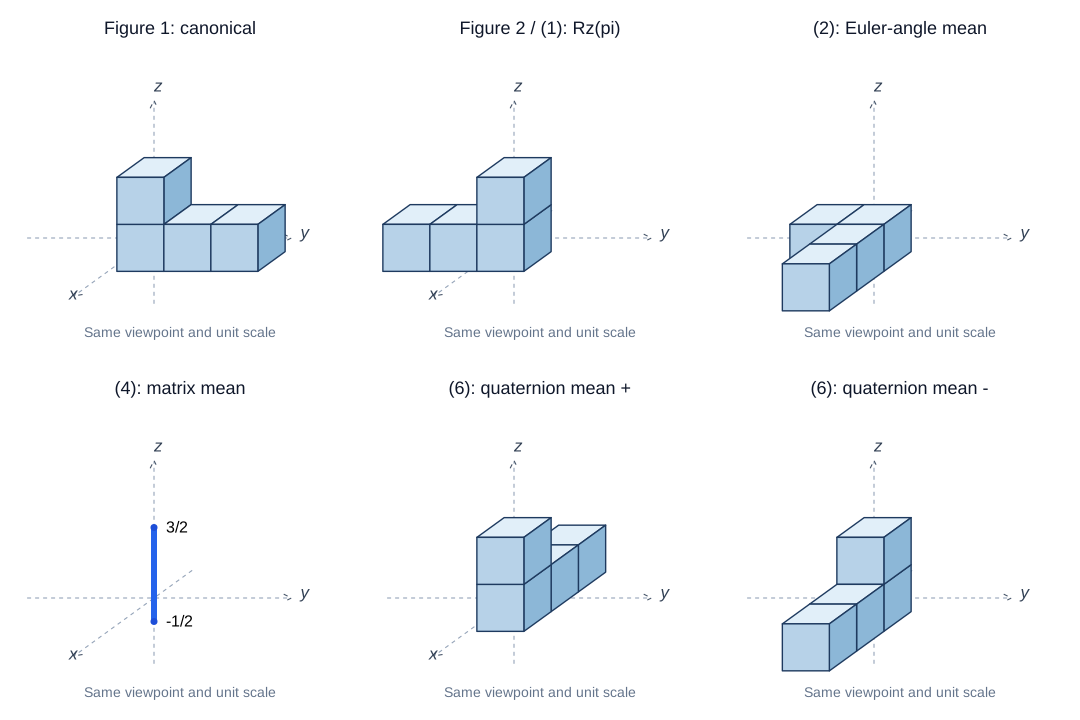
(1)
按题设先后次序,
故姿态就是图2:三块沿负 方向排列,原点上方另有一块。见上图上排中间对应标注 (1) 的面板。
(2)
平均欧拉角为
对应矩阵为
所以四个中心为 :三块沿正 方向排列,原点处向负 方向伸出一块。
(3)
图2保持正 轴不变,将正 轴变成负 轴,因此是绕 轴旋转 :
(4)
它将 映为 ,因此物体被压到 轴上。以立方体边长为 ,完整形状为线段
该矩阵秩为 ,不是旋转矩阵;它没有保持物体形状。
(5)
取转轴 、角度 ,以及其整体反号,得
(6)
固定图1的表示 。对图2的两个表示均有 ,故
两者分别表示绕 轴旋转 与 :
- :中心为 。
- :中心为 。
图中下排中、右两幅给出这两种姿态。整体同时取负不改变四元数表示的姿态。