東京大学 情報理工学系研究科 創造情報学専攻 2023年8月実施 筆記試験 第2問
Author
itsuitsuki, 祭音Myyura
Description
Let us consider a dataset that consists of data where each datum is represented in the form which is a bit string of length . Each datum is assigned a unique data ID (identifier) which is a distinct integer. Let's build a system that searches for data close in distance to an arbitrary input datum (query datum). During a search, the system needs to enumerate the data IDs of all data that satisfy the condition. The distance between two data is defined by the Hamming distance between bit strings. The Hamming distance between two bit strings and is defined as follows.
Answer the following questions.
(1) The table below shows an example of the dataset in the case of and .
| Data ID | ||||
|---|---|---|---|---|
| 1 | 0 | 1 | 1 | 1 |
| 2 | 1 | 0 | 0 | 1 |
| 3 | 0 | 0 | 1 | 0 |
Assume that a query datum is given. Find the Hamming distance between the query datum and each datum.
Next, we consider a search algorithm using a lookup table. Assume that is an even number and that the bit strings of data are uniformly distributed. In the following questions, it is not necessary to consider the time complexity of building a lookup table.
(2) We want to search for data whose bit strings are identical to a given query datum. Here, let us consider a lookup table that takes a bit string as an input and outputs a list containing the data IDs of all data that have the bit string. Answer the average time complexity and the space complexity of a search using this lookup table.
(3) We consider an algorithm as follows. We divide a bit string into two bit strings of length . We search for candidates by using the lookup table in the same manner as Question (2) for each divided bit string and then return the data IDs of all data matching the query datum. Answer the average time complexity and the space complexity of a search by this algorithm.
(4) By using the same data structure as Question (3), we consider an algorithm to search for data with a Hamming distance of 1 or less from a given query datum. Answer the average time complexity of a search by this algorithm.
Next, we consider the case where . In this case, it is sometimes effective to perform a linear search by actually calculating the Hamming distance between the query datum and each datum. Therefore, let us consider designing a specialized digital circuit to compute the Hamming distance.
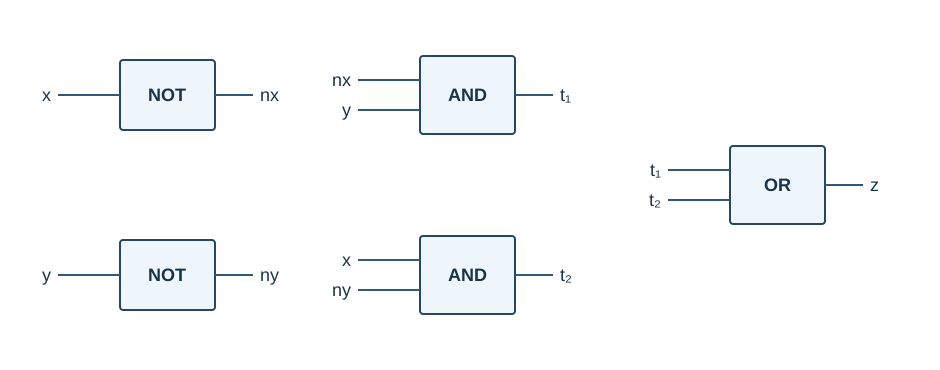
(5) Let us consider a 2-input 1-output digital circuit whose inputs are two 1-bit bit strings , and output is which is the Hamming distance between and . Draw a table representing the relation of , and . Also, draw by using necessary components among AND, OR, and NOT gates.
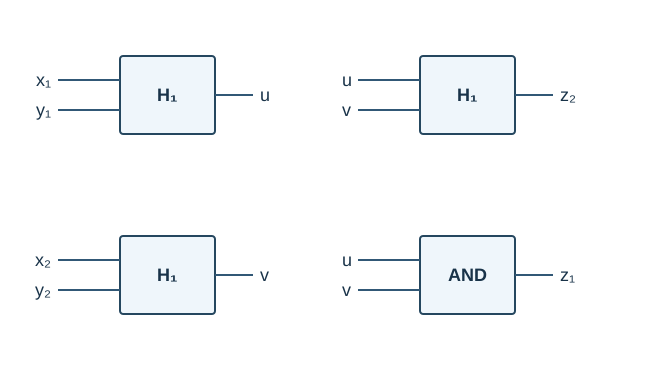
(6) Draw a 4-input 2-output digital circuit that outputs a binary representation of the Hamming distance between two 2-bit bit strings by using necessary components among AND, OR, NOT gates, and .
(7) Draw an 8-input 3-output digital circuit that outputs a binary representation of the Hamming distance between two 4-bit bit strings by using necessary components among , half adder , and OR gate.
题目描述
数据集含 条数据,每条是长度 的位串
并有唯一整数数据 ID。系统须对任意查询数据枚举所有满足距离条件的数据 ID。距离定义为汉明距离
-
当 时数据为:
数据 ID 1 0 1 1 1 2 1 0 0 1 3 0 0 1 0 对查询 ,分别求它与三条数据的汉明距离。
下面考虑查找表算法,假设 为偶数、数据位串均匀分布,无须计建表时间。
- 建立“完整位串 具有该位串的全部数据 ID 列表”的查找表,用它搜索与查询完全相同的数据。给出平均搜索时间复杂度和空间复杂度。
- 把位串分为两个长度 的子串,分别用类似第 2 问的查找表找候选,再返回完整匹配查询的数据 ID。给出平均时间复杂度和空间复杂度。
- 使用第 3 问同一数据结构,搜索与查询汉明距离不超过 1 的数据,给出平均搜索时间复杂度。
当 时,直接逐条计算距离的线性搜索有时更有效,因此设计专用数字电路。
- 电路 输入两个 1 位串 、,输出其汉明距离 。列输入输出表,并只用 AND、OR、NOT 门画出 。
- 使用 及必要的 AND、OR、NOT 门,画 4 输入、2 输出电路 ,以二进制输出两个 2 位串的汉明距离。
- 使用 、半加器 HA 和 OR 门中的必要元件,画 8 输入、3 输出电路 ,以二进制输出两个 4 位串的汉明距离。
Kai
(1)
(2)
Given we have data points, for every data point, the probability it is the same as the query is . Expected data ID list length is
where is the indicator RV that the -th data is the same as the query.
Enumerating the output costs its list length. Including the table access, the expected search time is when an index and a data ID each fit in a constant-time machine word. If reading or assembling the query index requires processing all bits, the bound is .
The space complexity is for a direct-address table with list headers (including empty lists) and stored data IDs.
(3)
The space complexity becomes since there are 2 tables, each with indices and IDs.
Store each list sorted by data ID when building the tables. Retrieve the two matching lists and intersect them using two advancing pointers. Their expected total length is , so the expected search time is with machine-word indexing, or including the bitwise query-index construction.
(4)
First we find a list from for finding a match for the first bits with expected length by executing (3), and verify by computing Hamming distance for every datum with time. We find the sequences with Hamming distance and the first- bits same as the query.
Then retrieve from . At most one bit mismatch leaves at least one half unchanged, so every valid datum lies in . Merge the two sorted ID lists as a union before verification, emitting an ID present in both only once. Compute the full -bit Hamming distance for each candidate and retain those with distance at most 1.
Finding 2 lists takes time and verifying takes . So the average time complexity is .
(5)
| (Distance) | ||
|---|---|---|
| 0 | 0 | 0 |
| 0 | 1 | 1 |
| 1 | 0 | 1 |
| 1 | 1 | 0 |
z=OR(AND(NOT(x), y), AND(x, NOT(y)))
(6)
In (5), we have constructed . Let the XOR operation be , we find .
Since
the lower bit is the sum mod :
the higher bit is the carry:
So the circuit is
z2=H1(H1(x1,y1),H1(x2,y2))
z1=AND(H1(x1,y1),H1(x2,y2))
(7)
A half adder is a module taking input and output as the sum mod 2 and the carry.
| A | B | S | C |
|---|---|---|---|
| 0 | 0 | 0 | 0 |
| 0 | 1 | 1 | 0 |
| 1 | 0 | 1 | 0 |
| 1 | 1 | 0 | 1 |
and can be 00,01,10.
is the sum-mod-2 from a half adder adding .
is the S from a half adder wrapping the carry of HA(A2,B2) and the S of HA(A1,B1)
is the final carry of A1+B1+HA(A2,B2)[C], namely the OR of the two carries below. For valid outputs, only 10+10 produces ; the OR wiring is the standard two-bit-adder construction.
A1,A2=H2((x1,x2),(y1,y2))
B1,B2=H2((x3,x4),(y3,y4))
z3,c3=HA(A2,B2) (sum,carry)
s2,c2=HA(A1,B1)
z2,c1=HA(c3,s2)
z1=OR(c1,c2)
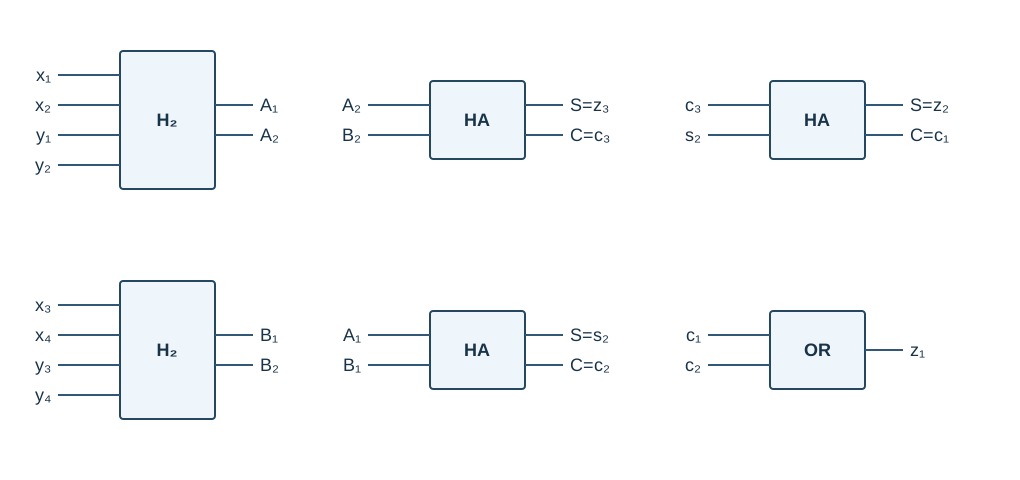
In these diagrams, identically named wires are connected. A half adder outputs S (sum) and C (carry); the final output bits are ordered from most significant to least significant.