東京大学 情報理工学系研究科 創造情報学専攻 2022年8月実施 筆記試験 第1問
Author
Description
We are constructing a deterministic finite automaton (DFA) that judges whether the sum of two binary integers is a multiple of three or not.
(1) A DFA is represented by a directed graph called a state diagram. Figure 1 is an example of a state diagram. The states of a DFA are represented by the nodes of the graph. When a DFA in state reads a symbol , it changes its state according to the outgoing edge labeled of the node corresponding to . The set of allowed input symbols is a finite set, which is called its input alphabet. In the state graph of a DFA, each node has exactly one outgoing edge for each symbol in its input alphabet.
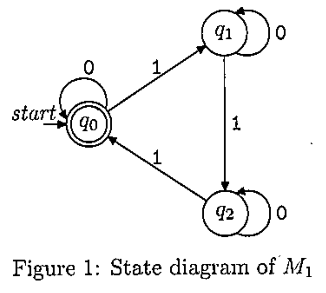
One of the states is the start state, which is indicated by the arrow labeled start. Some states are designated as final states, which are indicated by double circles. When a DFA in its start state will be in one of the final states after reading all symbols of a symbol string one-by-one from left to right, we say accepts .
(1-1) Let be the DFA represented by Figure 1. The input alphabet of is . Answer the state that will be in after reading the symbol string 0101110 starting in the start state.
(1-2) Answer the shortest symbol string starting with 0101110 that the DFA accepts.
(1-3) Construct a DFA that accepts a symbol string if and only if the length of is an even number, and draw its state diagram. must satisfy the following conditions.
- (Condition 1) The number of states of is two.
- (Condition 2) The input alphabet of is .
(2) Consider a string of symbols in to be a binary number. Let denote the -digit binary number whose -th digit from the least significant digit is . Let denote its value. When the string starts with a sequence of 0s, let denote the value of the string without the sequence of 0s. The string whose length is zero is called an empty string, denoted by . Let . For example, is 46 in decimal. For every binary number with an even number of digits , show
Here, "" denotes the remainders of and are the same when they are divided by three. In what follows, we will omit " " and simply denote "."
(3) Consider , a string of symbols in , to be a binary number . Construct a DFA that accepts , the string in reverse order, if and only if its length is an even number and
holds, and draw its state diagram. must satisfy the following conditions.
- (Condition 1) The number of states of is six.
- (Condition 2) The input alphabet of is .
(4) Consider , a string of symbols in , to be a binary number . Construct a DFA that accepts if and only if
holds regardless of the length of , and draw its state diagram. must satisfy the following conditions.
- (Condition 1) The number of states of is three.
- (Condition 2) The input alphabet of is .
(5) Let
For , a string of symbols in with length , construct a DFA that accepts if and only if
holds, and draw its state diagram. must satisfy the following conditions.
- (Condition 1) The number of states of is three.
- (Condition 2) The input alphabet of is .
题目描述
构造确定性有限自动机(DFA),判断两个二进制整数之和是否为 3 的倍数。
-
DFA 用称为状态图的有向图表示:结点为状态;处于 时读入符号 ,沿 的标号为 的唯一出边转移。允许输入符号的有限集合称为输入字母表,每个状态对字母表中每个符号恰有一条出边。一个状态是以
start箭头标出的初态,双圈表示终态。DFA 从初态自左向右逐符号读完串 后若位于终态,就接受 。- 对图 1 的 DFA ,字母表为 。从初态读完
0101110后处于哪个状态? - 求以
0101110开头且被 接受的最短符号串。 - 构造 DFA ,当且仅当串长为偶数时接受,并画状态图。要求恰有 2 个状态,字母表为 。
- 对图 1 的 DFA ,字母表为 。从初态读完
-
把 串视为二进制数。记 的从最低位起第 位为 ,其数值为 。开头的连续 0 不影响数值;空串记为 ,令 。例如 。证明对任意偶数位二进制数
后文省略“”,直接写 。
-
把串 视为二进制数 , 表示逆序串。构造并画 DFA ,当且仅当 长度为偶数且 时接受 。要求恰有 6 个状态,字母表 。
-
构造并画 DFA ,不论 长度为何,当且仅当 时接受 。要求恰有 3 个状态,字母表 。
-
令
对长度 的串
构造并画 DFA ,当且仅当
时接受 。要求恰有 3 个状态,输入字母表为 。
Kai
(1-1)
A 0 leaves the state unchanged, and a 1 advances . The input 0101110 contains four 1s, so the final state is .
(1-2)
From , two additional 1s are necessary and sufficient to reach . Thus the shortest accepted extension is
(1-3)
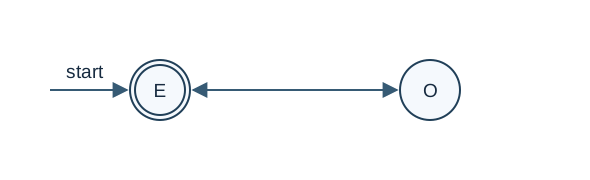
Let and mean that an even or odd number of symbols has been read. The start state is the only final state, and either input switches between and .
(2)
Since , and . Therefore
(3)
For any input read so far, use the remainder . Appending a bit updates it to . Reversal preserves divisibility by three: for ,
because . The factor is nonzero modulo three, so either value has remainder zero exactly when the other does. The empty string also has value zero.
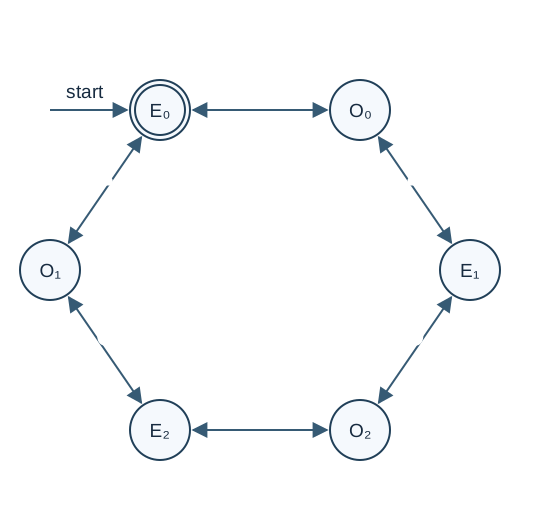
Combine this remainder with length parity. The six states are , with transitions
Start in and accept only . Each double-headed edge below represents the two directed transitions with the same label.
(4)
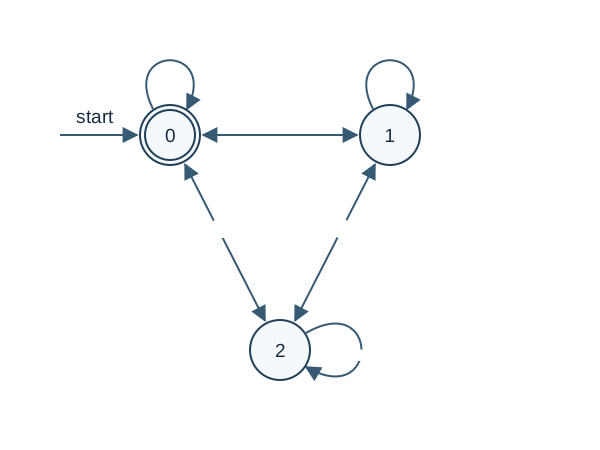
Remove the parity component and retain only , with . Start in state 0 and accept only state 0. The reversal identity in (3) proves the required condition for every length, including zero.
| State | Input 0 | Input 1 |
|---|---|---|
| 0 | 0 | 1 |
| 1 | 2 | 0 |
| 2 | 1 | 2 |
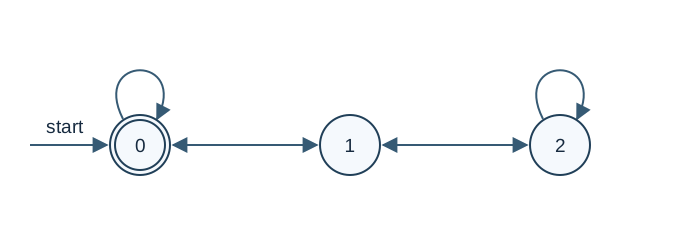
(5)
After reading a prefix of the paired-bit input, let be the sum of the two prefix values modulo three. Appending replaces this by
The two components have the same length, so the reversal identity multiplies their sum by the same nonzero factor . Hence the sum before reversal is divisible by three exactly when the sum after reversal is. Use three states 0, 1, 2, with 0 the start and sole final state.
| State | |||
|---|---|---|---|
| 0 | 0 | 1 | 2 |
| 1 | 2 | 0 | 1 |
| 2 | 1 | 2 | 0 |
In the diagram, ab denotes the column .