東京大学 情報理工学系研究科 創造情報学専攻 2022年8月実施 プログラミング 第1問
Author
Description
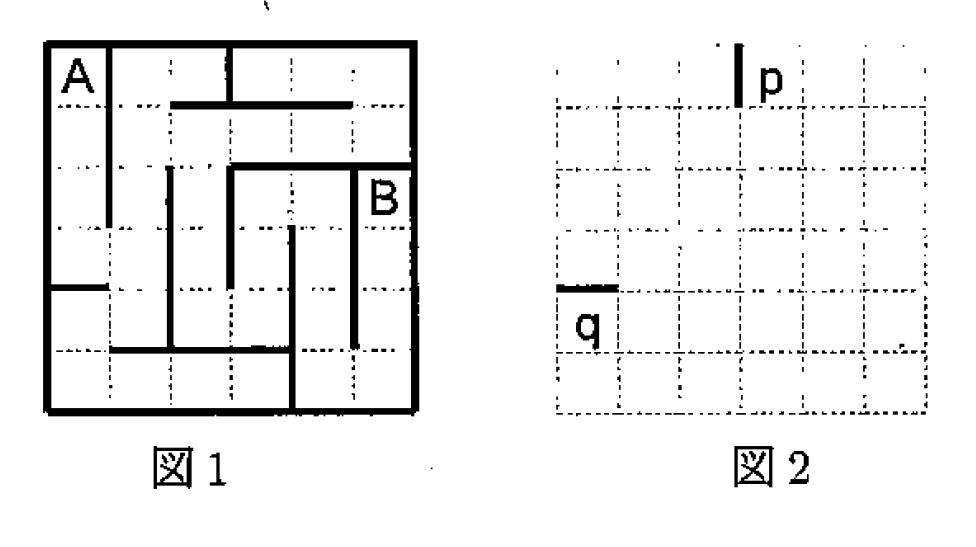
Suppose that we have a maze on a square board with cells. The cell in the -th row and the -th column is denoted by , where and . For example, Figure 1 shows a maze on cells. The cell A is and the cell B is .
The walls composing a maze are denoted as follows. The upper wall of the cell is denoted by , the lower wall is , the left wall is , and the right wall is . For example, the wall p in Figure 2 is and the wall q is .
The layout of walls composing a maze is stored as a character string such as:
0,1,1,0,13,6,8,1
This represents that there are four walls , , , and .
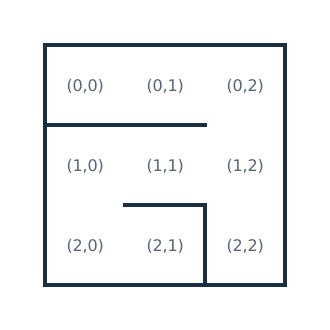
(1) We have a maze on cells. The layout of the walls is stored in file maze1.txt. Draw this maze on the answer sheet so that the layout of the walls will be clearly depicted.
(2) We have a maze on cells. The layout of the walls is stored in file maze2.txt. Count the number of the dead-end cells, which are surrounded with three walls. Write down that number on the answer sheet.
(3) We have a maze on cells. The layout of the walls is stored in file maze3.txt. The start is the cell and the goal is the cell .
Count the number of the cells that will be visited when we move from the start to the goal along the shortest path. Write down that number on the answer sheet. Count the start and the goal for one, respectively. Assume that there exists exactly one path between any pair of two cells in the maze.
(4) We have ten mazes on cells. The layout of the walls for each maze is stored in a file from maze10.txt to maze19.txt. Which maze satisfies that there exists exactly one path between any pair of two cells in the maze? Write down the names of all the files in which the layouts of the walls are stored for such a maze.
题目描述
有一个 方格迷宫。第 行第 列格记为 ,其中 。例如图 1 的 迷宫中,A 为 ,B 为 。
格 的上、下、左、右墙分别编号为
例如图 2 的墙 p 为 ,q 为 。迷宫墙布局存成逗号分隔字符串,例如
0,1,1,0,13,6,8,1
表示四堵墙 。
maze1.txt存有 迷宫墙布局。在答题纸上画出迷宫,清楚标示墙。maze2.txt存有 迷宫。统计恰被三堵墙包围的死路格数量,写在答题纸上。maze3.txt存有 迷宫,起点 ,终点 。沿最短路前进时会访问多少格?起、终点各计 1。题设保证迷宫任意两格间恰有一条路径。maze10.txt~maze19.txt分别存有十个 迷宫。找出满足“任意两格之间恰有一条路径”的所有迷宫,并写出相应文件名。
Kai
The sample data files are here.
(1)
Read consecutive pairs of integers as wall coordinates and draw each corresponding unit segment. The maze in the linked maze1.txt is:
(2)
For each cell , test membership of its four wall coordinates in a set. Count the cell exactly when three of these four coordinates are present. A shared wall is stored only once, but is included when examining either adjacent cell. The result is
(3)
Make an unweighted graph with one vertex per cell and an edge between adjacent cells exactly when their shared wall is absent. Breadth-first search from gives distance 120 edges to . Including both endpoints, the answer is
(4)
An undirected graph has exactly one simple path between every two vertices if and only if it is a tree. Check both connectivity and an edge count of . Each open internal passage is counted once; alternatively, sum all vertex degrees and divide by two. The qualifying files are
maze10.txt
maze11.txt
maze14.txt
maze15.txt
maze17.txt
maze19.txt
Complete program
Save the following as maze_answers.py and run python maze_answers.py DATA_FOLDER. It writes the drawing to maze1.svg and prints the remaining answers. Graph construction, BFS, and the tree test each take time and space for one maze.
from collections import deque
from pathlib import Path
import sys


def read_walls(filename):
    numbers = [int(x) for x in Path(filename).read_text().strip().split(',')]
    if len(numbers) % 2:
        raise ValueError('wall coordinates must occur in pairs')
    return set(zip(numbers[::2], numbers[1::2]))


def walls_of(i, j):
    # Upper, lower, left, right.
    return [(2*i, 2*j+1), (2*i+2, 2*j+1),
            (2*i+1, 2*j), (2*i+1, 2*j+2)]


def neighbors(m, walls, cell):
    i, j = cell
    for (di, dj), wall in zip([(-1,0), (1,0), (0,-1), (0,1)], walls_of(i,j)):
        next_cell = (i+di, j+dj)
        if 0 <= next_cell[0] < m and 0 <= next_cell[1] < m and wall not in walls:
            yield next_cell


def distances(m, walls, start=(0,0)):
    distance = {start: 0}
    queue = deque([start])
    while queue:
        cell = queue.popleft()
        for nxt in neighbors(m, walls, cell):
            if nxt not in distance:
                distance[nxt] = distance[cell] + 1
                queue.append(nxt)
    return distance


def is_tree(m, walls):
    vertices = m*m
    edges = sum(sum(1 for _ in neighbors(m,walls,(i,j)))
                for i in range(m) for j in range(m)) // 2
    return edges == vertices-1 and len(distances(m,walls)) == vertices


def draw_maze(m, walls, filename):
    scale, margin = 80, 45
    size = m*scale + 2*margin
    elements = [f'<svg xmlns="http://www.w3.org/2000/svg" viewBox="0 0 {size} {size}">',
                '<rect width="100%" height="100%" fill="white"/>']
    for i in range(m):
        for j in range(m):
            x, y = margin+(j+.5)*scale, margin+(i+.5)*scale
            elements.append(f'<text x="{x}" y="{y+6}" text-anchor="middle" '
                            f'font-family="sans-serif" font-size="16" fill="#526477">({i},{j})</text>')
    for r, c in sorted(walls):
        if r % 2 == 0:
            x1,x2 = margin+(c-1)*scale/2, margin+(c+1)*scale/2
            y1=y2=margin+r*scale/2
        else:
            x1=x2=margin+c*scale/2
            y1,y2=margin+(r-1)*scale/2, margin+(r+1)*scale/2
        elements.append(f'<path d="M{x1},{y1} L{x2},{y2}" stroke="#182e42" '
                        'stroke-width="4" stroke-linecap="square" fill="none"/>')
    Path(filename).write_text(''.join(elements)+'</svg>')


def main(folder):
    draw_maze(3, read_walls(folder/'maze1.txt'), 'maze1.svg')
    walls = read_walls(folder/'maze2.txt')
    dead_ends = sum(sum(w in walls for w in walls_of(i,j)) == 3
                    for i in range(40) for j in range(40))
    print('Dead ends:', dead_ends)
    distance = distances(40, read_walls(folder/'maze3.txt'))
    print('Shortest-path cells:', distance[(39,29)]+1)
    print('Trees:', ', '.join(f'maze{k}.txt' for k in range(10,20)
                            if is_tree(40,read_walls(folder/f'maze{k}.txt'))))


if __name__ == '__main__':
    main(Path(sys.argv[1]) if len(sys.argv)>1 else Path('.'))