東京大学 情報理工学系研究科 創造情報学専攻 2016年8月実施 筆記試験 第2問
Author
tomfluff, 祭音Myyura
Description
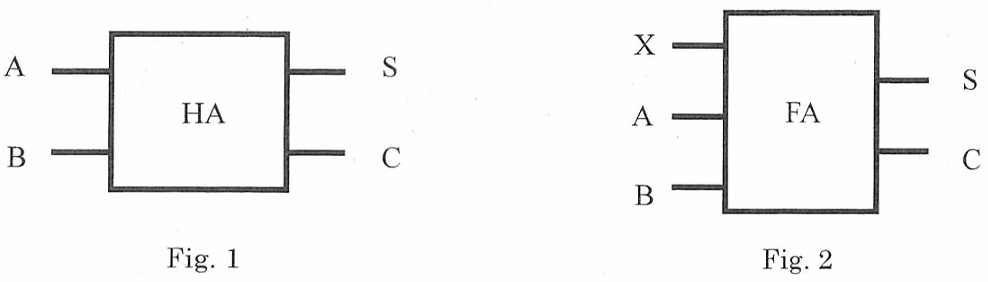
Official examination, archived Japanese PDF. (1) Show the truth table of a half-adder HA (Fig. 1) which outputs 1-bit sum and 1-bit carry from two 1-bit binary inputs and .
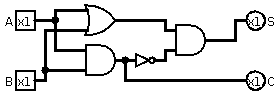
(2) Draw a diagram of the half-adder circuit HA with devices of AND, OR, and NOT.
(3) Show the truth table of a full-adder FA (Fig. 2) which outputs 1-bit sum and 1-bit carry from two 1-bit binary inputs , , and 1-bit carry input .
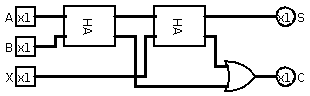
(4) Draw a diagram of the full-adder circuit FA using two half-adder HA devices. If necessary, you can use AND, OR, and NOT devices.
(5) Explain a method to build an n-bit adder for unsigned integers using full-adder FA devices.
(6) Explain a method to build a faster n-bit adder.
(7) Explain a method to execute a subtract operation with an n-bit adder through generating negative number in two's complement, and draw its circuit.
(8) Explain a method to build an n-bit adder-subtractor for unsigned integers with a single n-bit adder and an input signal to select addition or subtraction, and draw its circuit.
(9) Explain how to build a multiplier to generate a 2n-bit product from two n-bit unsigned integers and .
题目描述
- 写出半加器 HA 的真值表:输入为两个 1 位二进制数 ,输出为 1 位和 与 1 位进位 (见图 1)。
- 仅用 AND、OR、NOT 元件画出 HA 电路。
- 写出全加器 FA 的真值表:输入为 和 1 位输入进位 ,输出为和 与进位 (见图 2)。
- 用两个 HA 构成 FA;必要时可增加 AND、OR、NOT 元件,画出电路。
- 说明如何用 FA 构造无符号整数的 位加法器。
- 说明如何构造速度更快的 位加法器。
- 说明如何用二进制补码生成负数,并借助 位加法器执行减法;画出电路。
- 只使用一个 位加法器,再增加选择加、减的输入信号 ,构造无符号整数 位加减器;说明方法并画图。
- 说明如何构造乘法器,把两个 位无符号整数 相乘并输出 位乘积 。
Kai
(1)
| A | B | S | C |
|---|---|---|---|
| 0 | 0 | 0 | 0 |
| 0 | 1 | 1 | 0 |
| 1 | 0 | 1 | 0 |
| 1 | 1 | 0 | 1 |
(2)
Use and , where denotes OR. This uses two AND gates, one OR gate and one NOT gate.
(3)
| A | B | X | S | C |
|---|---|---|---|---|
| 0 | 0 | 0 | 0 | 0 |
| 0 | 0 | 1 | 1 | 0 |
| 0 | 1 | 0 | 1 | 0 |
| 0 | 1 | 1 | 0 | 1 |
| 1 | 0 | 0 | 1 | 0 |
| 1 | 0 | 1 | 0 | 1 |
| 1 | 1 | 0 | 0 | 1 |
| 1 | 1 | 1 | 1 | 1 |
(4)
The first HA produces and . The second adds and , producing and . Set using an OR gate.
(5)
A method would be to do a bitwise addition for and , two unsigned -bit integers. The carry of each addition is connected to the X input of the following FA. Thus has as inputs, has as inputs, and so on; the last carry is the -st output bit.
(6)
Use carry lookahead. Let and . Then
For example, . Instead of waiting for each preceding full adder, combine blocks with group propagate/generate pairs. For a lower block followed by an upper block , their combined pair is
This composition is associative, so a parallel prefix tree computes all carries in gate depth with bounded-fan-in gates, compared with for ripple carry. It uses more wiring and logic; the carries are computed in parallel, not omitted.
(7)
Subtraction would be an addition with the negative value. So let's assume we would like to calculate A-B, it is the same as computing A+(-B). This means that for subtraction all we need to do is compute the 2's-complement of B and add the two numbers together. This can be acomplished by inverting B and adding 1 to the X (carry) input of the n-bit adder.
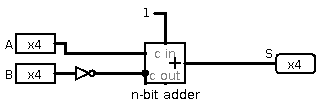
The drawing uses 4-bit buses; the same connections apply to bits. The low sum bits give . For unsigned operands, the final carry is 1 exactly when ; a borrow is its complement.
(8)
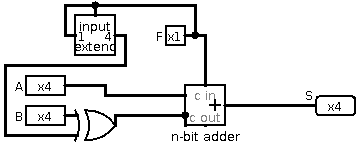
A method could be to use F as the input to the carry of the n-bit adder. As well as XOR F and every bit of B. This way, If F=1 meaning subtraction, B will be inverted and 2's complement will be implemented with the adder carry. Otherwise B will stay the same and addition will be implemented.
(9)
Generate partial products with AND gates. Their weighted sum is
Zero-extend the shifted rows to bits and add them with full-adder chains or a carry-save reduction tree followed by a final carry-propagate adder. The maximum product is , so output bits suffice. A method to compute multiplication would be using full adders and half adders in the following way:
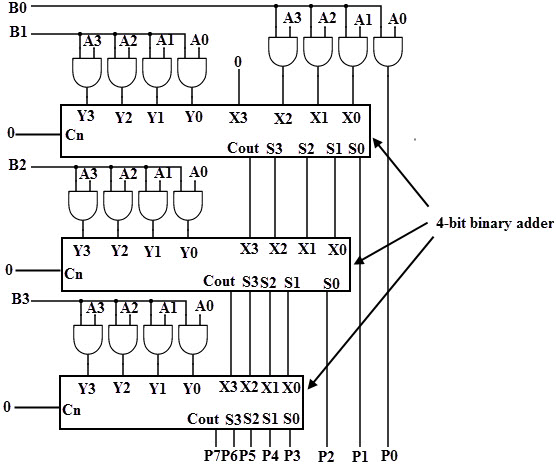
Notice that the Truth Table of bits a*b is the same as a&b. Each b_i selects either a zero row or A; the row for bit i is shifted left by i bit positions before addition.
This method is very similar to the multiplication algorithm that is being taught in schools.