東京大学 情報理工学系研究科 創造情報学専攻 2015年8月実施 筆記試験 第3問
Author
Description
Official examination, archived Japanese PDF.
日本語
写実的な画像をコンピュータグラフィックスで生成する場合、輝度の計算を幾何光学に基づいた積分で行なうことが多い。今、ある平面上の点において角度 から(図 1 を参照)入射する光の放射輝度を とするとき、その点における放射照度 は、
と定義されることが知られている。以下の設問に答えよ。
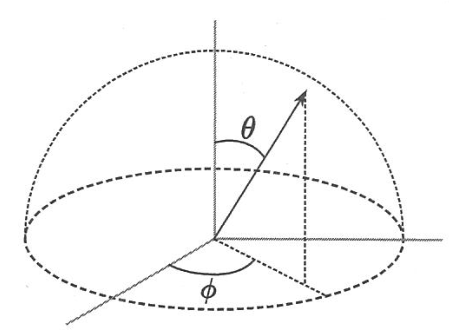
(1) 放射輝度 の分布が に依存しない状況を考える。この場合、放射照度 が
という一次元の定積分で表せることを示せ。なお、以下のすべての設問でこの状況を考える。
(2) と定義される 個の値を考える。図 2 は 間に定義される長方形の面積が で与えられることを示している。この事を利用し放射照度 の近似値の式を総和記号 を用いて書け。この手法は一般に長方形近似と呼ばれる。
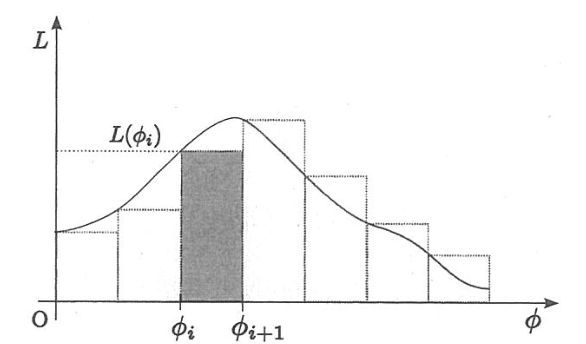
(3) 一般に、で定義される確率密度関数 (ただし とする) に従って分布する確率変数 が与えられたとき、あるスカラー関数 の期待値 は
と定義される。今 を に従って生成した 個の乱数の値であるとする ()。このとき、上記の期待値 の近似が
と与えられることを利用して、放射照度 の近似値を総和記号 を用いて書け。この手法は一般にモンテカルロ積分と呼ばれる。
(4) 長方形近似の誤差と、モンテカルロ積分の誤差の期待値を考える。被積分関数 (ただし とする) がどのような場合に、それぞれの手法の誤差がゼロとなるか答えよ。設問(2)および設問(3)の解を踏まえて説明すること。なお、長方形近似については が図 2 のような階段状の関数となる自明な場合は除く。
(5) 長方形近似もしくはモンテカルロ積分を 32 ビットの浮動小数点数を用いて実装したところ、 がある大きな数を超えた時点で、結果がゼロに向かって下がり始めた。この現象について考えられる原因を一つ説明せよ。 は常に正確にカウントされていると仮定すること。
English (AI translated)
When generating photorealistic images in computer graphics, radiance calculations are often performed using integrals based on geometric optics. Now, let be the radiance of light incident from an angle (see Figure 1) at a point on a plane. It is known that the irradiance at that point is defined as:
Answer the following questions.
(1) Consider a situation where the distribution of radiance does not depend on . Show that in this case, the irradiance can be expressed as the following one-dimensional definite integral:
Note that this situation is considered in all subsequent questions.
(2) Consider values defined as . Figure 2 shows that the area of the rectangle defined in the interval is given by . Using this fact, write the formula for the approximate value of irradiance using the summation symbol . This method is generally called rectangular approximation.
(3) In general, given a random variable distributed according to a probability density function (where ) defined on , the expected value of a scalar function is defined as:
Now, assume that are random values generated according to (). At this time, using the fact that the approximation of the above expected value is given as
write the approximate value of irradiance using the summation symbol . This method is generally called Monte Carlo integration.
(4) Consider the error of the rectangular approximation and the expected value of the error of the Monte Carlo integration. Answer in what cases the error of each method becomes zero for the integrand (assuming ). Explain based on the solutions to question (2) and question (3). Note that for the rectangular approximation, trivial cases where becomes a step-like function as in Figure 2 are excluded.
(5) When the rectangular approximation or Monte Carlo integration was implemented using 32-bit floating-point numbers, the result started to drop towards zero at the point when exceeded a certain large number. Explain one possible cause for this phenomenon. Assume that is always counted correctly.
题目描述
写实计算机图形学常按几何光学积分计算亮度。设某平面上一点从方向角 入射的辐亮度为 (方向定义见图 1),该点辐照度为
-
假设 与 无关,证明
后续各问均采用此假设。
-
定义 个等分点
图 2 中区间 的矩形面积为 。利用这一矩形近似,用求和符号写出 的近似式。
-
对定义在 且处处为正的概率密度 ,有
若独立生成 个样本 ,使用
推导用蒙特卡洛积分近似 的求和式。
-
设 。分别说明在何种 情况下,矩形近似的误差与蒙特卡洛积分误差的期望为零,并依据第 2、3 问解释。矩形近似中排除 恰好为图 2 那类阶梯函数的平凡情况。
-
用 32 位浮点数实现矩形近似或蒙特卡洛积分时,发现 超过某个很大的数后结果开始趋近于零。假设 始终被精确计数,说明一种可能原因。
Kai
(1)
Since is independent of ,
because .
(2)
There are intervals of width . Using each left endpoint gives
The endpoint does not start another interval and is not included in the sum.
(3)
Choose . Then , so
For uniform sampling, and the estimator becomes . Positivity of permits the division throughout the domain.
(4)
For the rectangle rule, the exact necessary and sufficient condition at the given is
The individual interval errors may cancel. A nonconstant, non-step example is , with . Its integral is , while the equally spaced sample values have average , since their sine values sum to zero. Thus . Constancy on every interval is sufficient but is not necessary.
For the Monte Carlo estimator, the expected signed error is zero for every integrable :
This is unbiasedness; an individual realization can still have nonzero error. For independent samples with finite second moment,
The mean squared error, or expected absolute error, is zero precisely when is constant almost everywhere. Since , this is the importance-sampling choice
Every sample then contributes the same exact value. Under uniform sampling, this stronger zero-error condition requires to be constant almost everywhere. See importance sampling.
(5)
A single-precision running sum can stop increasing even while the integer sample count continues to increase. For example, take with uniform sampling and compute by summing copies of 1 into an IEEE 754 binary32 variable . Binary32 has 24 significant binary digits. At , the next representable larger number is ; rounding to nearest with ties to even leaves the sum at . Every subsequent addition of 1 is lost too.
Consequently, for larger exactly counted , the computed result is approximately and decreases toward zero. Pairwise or compensated summation, or a higher-precision accumulator, delays this loss of small increments.