東京大学 情報理工学系研究科 創造情報学専攻 2013年8月実施 プログラミング
Author
Description
-points とは (ここで は負の値を含む整数の集合)と表される点の集合である。 は領域 に含まれる -points の点の個数である。今、領域 に含まれる点 は以下の不等式を満たすとする。
このとき図 1 に示すように は 121 である。
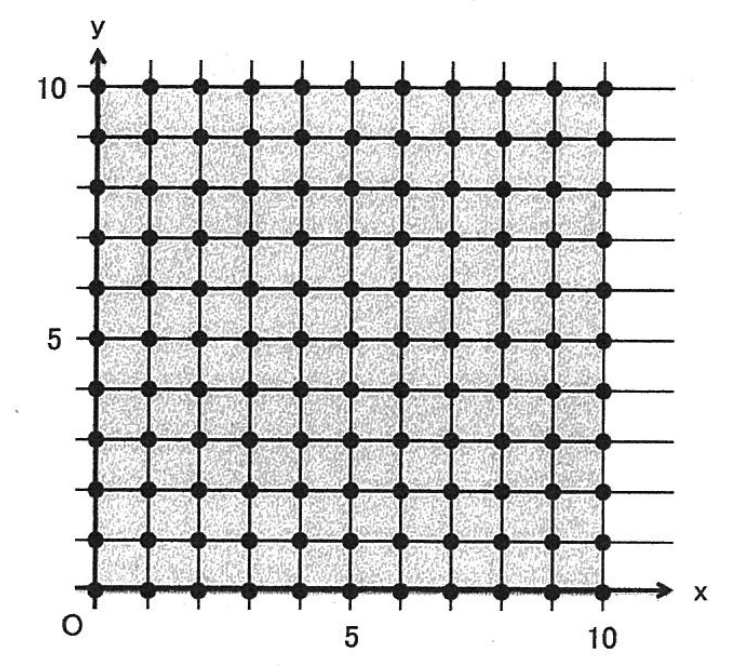
図 1:領域 と に含まれる 1-points の点
(1) 与えられた浮動小数点数 について、 を計算するプログラムを書け。
(2) 領域 に含まれる点 は以下の不等式を満たすとする。
与えられた浮動小数点数 について、以下を計算するプログラムを書け。
(3) コッホ雪片(図 2)は正三角形から始め、再帰的に各線分を次のように変更することで作成できる。
- 線分を三等分する。
- 三等分して得られた中央の線分を一辺とする正三角形を外向きに描く。
- ステップ 2 で描いた正三角形の底辺(三等分して得られた中央の線分)を除去する。
(Wikipedia より,http://en.wikipedia.org/wiki/Koch_snowflake)
領域 は、頂点 、、 を結んだ正三角形から始め、上の手順を 回繰り返して得られる図形の内側である。ただし境界を含むとする。
の面積を表示するプログラムを書け。答は浮動小数点数にせよ。
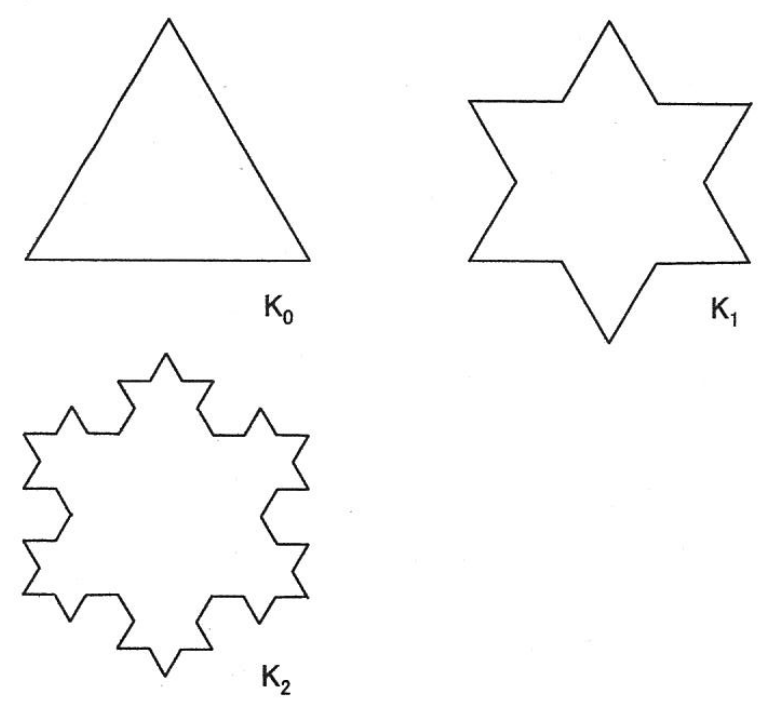
図 2:コッホ雪片
(4) 与えられた正の整数 について の面積を計算するプログラムを書け。答は浮動小数点数にせよ。
(5) 与えられた浮動小数点数 について を計算するプログラムを書け。
(6) 与えられた浮動小数点数 と正の整数 について を計算するプログラムを書け。
题目描述
-points 表示点集 ,其中 为包含负数在内的整数集合。 是区域 内的 -points 的点数。设区域 内的点 满足
此时如图 1 所示,。图 1 表示区域 及其中的 1-points 的点。
(1) 编写程序,对给定浮点数 计算 。
(2) 设区域 内的点 满足
编写程序,对给定浮点数 计算
(3) 科赫雪花(图 2)由正三角形出发,递归地对每条线段进行下述操作而生成:
- 将线段三等分。
- 以中间一段为一边,向外画一个正三角形。
- 删除步骤 2 中所画正三角形的底边,即三等分后中间的那条线段。
(引自 Wikipedia,http://en.wikipedia.org/wiki/Koch_snowflake。)
区域 是从顶点为 、、 的正三角形开始,将上述步骤重复 次所得图形的内部,并包括边界。图 2 示出 、、。
编写程序,输出 的面积。答案采用浮点数。
(4) 编写程序,对给定正整数 计算 的面积。答案采用浮点数。
(5) 编写程序,对给定浮点数 计算 。
(6) 编写程序,对给定浮点数 和正整数 计算 。
Kai
(1) Square count
For , each coordinate has permitted values, including zero and the upper boundary when it is a lattice coordinate. Hence
A negative spacing gives the same lattice as . For , the lattice set has just one distinct point, the origin, so . Counting integer pairs instead would incorrectly count that same point infinitely many times.
(2) Disk count
For each permitted horizontal coordinate , count integer satisfying
For decimal input , use the exact integer comparison
For fixed , take the integer square root and count
within the square's coordinate range. This is columns rather than an two-dimensional scan, apart from integer arithmetic cost. At the disk has 81 points and the requested value is .
As , the disk-to-square count ratio tends to , so the quantity in (2) tends to .
(3) and (4) Snowflake area
The initial area is . At iteration , there are new equilateral triangles, each with side . Their total area is
Summing this geometric series gives
In particular,
This formula needs constant storage and avoids generating all sides just to obtain the area.
(5) and (6) Lattice points in a snowflake
Generate the polygon in counterclockwise order. Replace each oriented side by the four edges through
The negative 60-degree turn puts the new triangle outside a counterclockwise polygon. Enumerate lattice points in the polygon's bounding box, and test membership by a winding-number algorithm that explicitly includes points on any edge. Negative lattice indices must be included: the snowflake extends below the original triangle.
Floating-point orientation tests can misclassify boundary points. The implementation below stores a polygon vertex as representing the physical point , with rational. Every construction step preserves that representation. A cross product between a rational lattice point and a polygon edge has the form ; its sign is decided exactly by signs and a comparison of with , without a tolerance. The bounding box uses exact integer square roots too.
There are sides. If the bounding box contains candidate lattice points, this direct method uses storage and arithmetic operations. It is a simple complete solution for finite input sizes; finer grids and larger may require spatial indexing or scan-line acceleration.
Complete Python program
The program uses the standard library. Decimal input is interpreted as its exact rational value, so values such as 0.1 do not acquire binary floating-point rounding before boundary tests. Parts (3) and (4) return the required floating-point areas. Save the code as koch.py; for example, python koch.py 6 --d 1 --n 2 prints 65.
from fractions import Fraction as F
from math import floor, ceil, isqrt, sqrt


def spacing(text):
    # Decimal input is interpreted exactly, including scientific notation.
    return abs(F(str(text)))


def count_square(d):
    if d == 0:
        return 1  # The set {(dp,dq)} then contains only the origin.
    return (floor(F(10) / d) + 1) ** 2


def count_disk(d):
    if d == 0:
        return 0
    a, b = d.numerator, d.denominator
    limit = (10 * b) // a
    total = 0
    for i in range(limit + 1):
        remaining = 25*b*b - (a*i - 5*b)**2
        if remaining < 0:
            continue
        r = isqrt(remaining)
        # |a*j-5*b| <= sqrt(remaining), with integer a*j-5*b.
        lo = max(0, -(-(5*b-r) // a))
        hi = min(limit, (5*b+r) // a)
        total += max(0, hi-lo+1)
    return total


def koch_vertices(n):
    if n < 0:
        raise ValueError('n must be nonnegative')
    # Store (x,Y), meaning the physical point (x,sqrt(3)*Y).
    points = [(F(0), F(0)), (F(10), F(0)), (F(5), F(5))]
    for _ in range(n):
        new = []
        for a, b in zip(points, points[1:] + points[:1]):
            dx, dy = (b[0]-a[0])/3, (b[1]-a[1])/3
            first = (a[0]+dx, a[1]+dy)
            # Outward = right of a counterclockwise edge: rotate by -60 deg.
            tip = (first[0]+(dx+3*dy)/2, first[1]+(-dx+dy)/2)
            second = (a[0]+2*dx, a[1]+2*dy)
            new.extend((a, first, tip, second))
        points = new
    return points


def sign(v):
    return (v > 0) - (v < 0)


def sign_surd(a, b):
    """Exact sign of a+b*sqrt(3), for rational a and b."""
    if a == 0:
        return sign(b)
    if b == 0 or sign(a) == sign(b):
        return sign(a)
    return sign(a) * sign(a*a - 3*b*b)


def inside_closed(x, y, points):
    # x,y are rational physical coordinates. Winding number includes edges.
    winding = 0
    for a, b in zip(points, points[1:] + points[:1]):
        dx, dy = b[0]-a[0], b[1]-a[1]
        cross = sign_surd(dx*y, -dx*a[1]-dy*(x-a[0]))
        ya = sign_surd(y, -a[1])  # sign(y - physical a.y)
        yb = sign_surd(y, -b[1])
        if cross == 0 and min(a[0], b[0]) <= x <= max(a[0], b[0]) and ya*yb <= 0:
            return True
        if ya >= 0 and yb < 0 and cross > 0:
            winding += 1
        elif ya < 0 and yb >= 0 and cross < 0:
            winding -= 1
    return winding != 0


def floor_sqrt3(v):
    """Exact floor of sqrt(3)*v, for rational v."""
    if v == 0:
        return 0
    if v < 0:
        return -floor_sqrt3(-v)-1  # Nonzero rational times sqrt(3) is irrational.
    return isqrt(3*v.numerator*v.numerator) // v.denominator


def count_koch(d, n):
    points = koch_vertices(n)
    if d == 0:
        return int(inside_closed(F(0), F(0), points))
    ilo = ceil(min(p[0] for p in points)/d)
    ihi = floor(max(p[0] for p in points)/d)
    jlo = -floor_sqrt3(-min(p[1] for p in points)/d)
    jhi = floor_sqrt3(max(p[1] for p in points)/d)
    return sum(inside_closed(d*i, d*j, points)
               for i in range(ilo, ihi+1) for j in range(jlo, jhi+1))


def area_koch(n):
    if n < 0:
        raise ValueError('n must be nonnegative')
    return 25*sqrt(3)*(8/5 - (3/5)*(4/9)**n)


def solve(part, d_text='1', n=2):
    d = spacing(d_text)
    if part == 1:
        return count_square(d)
    if part == 2:
        return F(count_disk(d), 4*count_square(d))
    if part == 3:
        return area_koch(2)
    if part == 4:
        return area_koch(n)
    if part == 5:
        return count_koch(d, 2)
    if part == 6:
        return count_koch(d, n)
    raise ValueError('part must be 1,...,6')


if __name__ == '__main__':
    import argparse
    parser = argparse.ArgumentParser()
    parser.add_argument('part', type=int)
    parser.add_argument('--d', default='1')
    parser.add_argument('--n', type=int, default=2)
    args = parser.parse_args()
    result = solve(args.part, args.d, args.n)
    print(result)
    if isinstance(result, F):
        print(float(result))
Examples from the program:
| Quantity | Value |
|---|---|
| 121 | |
| 81 | |
| Part (2), | |
| 49 | |
| 59 | |
| 65 | |
| 67 |
The lattice counts include the boundaries.