Official examination, archived Japanese PDF.
In kinematic calculations and visual computations in robotics, vector operations are expressed with matrices sometimes. Answer the following questions on inner-product, outer-product, projection and rotation of three dimensional vectors. I is the 3×3 identity matrix. The three-dimensional vectors x, a, b and n are 3×1 column vectors:
xT, which is a 1×3 row vector, shows the transpose of x.
(1) On the inner product (a,b) between vectors a and b, describe i) the value of (a,b), ii) a 3×3 matrix A which satisfies (a,b)a=Ab, and iii)A with vector a and its transpose aT.
(2) On the outer product a×b from a to b, describe i)3×1 expression of a×b, ii)3×3 expression of the matrix A which satisfies a×b=Ab, iii) the 3×3 matrix Q which satisfies A=a×Q where x×Q between a vector x and a 3×3 matrix Q means a 3×3 matrix whose column vectors are three outer products from the vector x to each column vector in the matrix Q respectively.
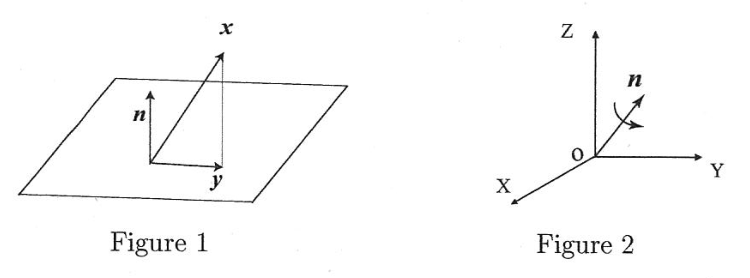
(3) As Figure 1 shows, a vector x is vertically projected to a vector y on a plane whose normal vector is a unit vector n. If the vector y is described as y=Px, show that the matrix P becomes P=I−nnT.
(4) Three rotational matrices Rx(θx), Ry(θy) and Rz(θz) are rotational matrices which rotate a vector x around the X-axis, Y-axis and Z-axis with θx, θy and θz respectively, where the direction of the rotation for plus is clock-wise around the axis from the origin to infinity.
i) Describe 3×3 expression of the matrix Rx(θx), ii) As Figure 2 shows, the 3×3 matrix Rn(θn) is defined as the rotation matrix around a unit orientation vector n with θn. Rn(θn) is described as
Rn(θn)=Rx(−α)Ry(β)Rz(θn)Ry(−β)Rx(α).
Explain what the variables α and β become and explain why the expression is satisfied.
iii) Taking Q=I works: its columns are the coordinate basis vectors, and the columns a×ei are exactly those of [a]×. This choice is not unique for a fixed nonzero a: the general solution is Q=I+avT for any vector v, because each column may be changed by a multiple of a. If a=0, every Q works.
The plane of vectors is nTy=0, through the origin. Decompose x into its normal component (nTx)n and its component in the plane. Because nTn=1,
y=x−(nTx)n=(I−nnT)x.
Thus P=I−nnT. Indeed nTP=0, so the result lies in the plane, and x−Px is parallel to its normal. Also PT=P and P2=P. For an affine plane not through the origin, an additional translation term would be necessary.
i) “Clockwise looking from the origin toward the positive axis” is the right-hand rotation convention; looking back toward the origin would reverse the apparent direction. In particular a positive rotation about X sends ey toward ez. Therefore
Rx(θ)=1000cosθsinθ0−sinθcosθ.
For clarity the other matrices in the factorization use the same active-rotation convention:
Thus cosα=nz/r, sinα=ny/r, cosβ=r and sinβ=nx, using the unit length of n. These choices successively give
Rx(α)n=(nx,0,r)T,Ry(−β)(nx,0,r)T=(0,0,1)T.
Define C=Ry(−β)Rx(α). First C aligns the rotation axis with Z, then Rz(θn) rotates around that aligned axis, and finally C−1 restores the original coordinates. Reading matrix actions from right to left,
If r=0, then n=(±1,0,0)T; choose α=0 and β=±π/2. This avoids an undefined atan2(0,0) and yields the same factorization. An independent equivalent formula is Rodrigues' expression
Rn(θ)=cosθI+(1−cosθ)nnT+sinθ[n]×,
which also makes the fixed axis and rotation sign explicit.