東京大学 情報理工学系研究科 創造情報学専攻 2011年8月実施 筆記試験 第3問
Author
Description
Official examination, archived Japanese PDF. As shown in Figure 1, there is a robot arm which has rotational joints at three points , and , and a two-fingered hand at the end on an - two-dimensional plane. The position of the hand is and the orientation of the hand is , the joint angles are and , and the lengths of the links are and . Answer the following questions:
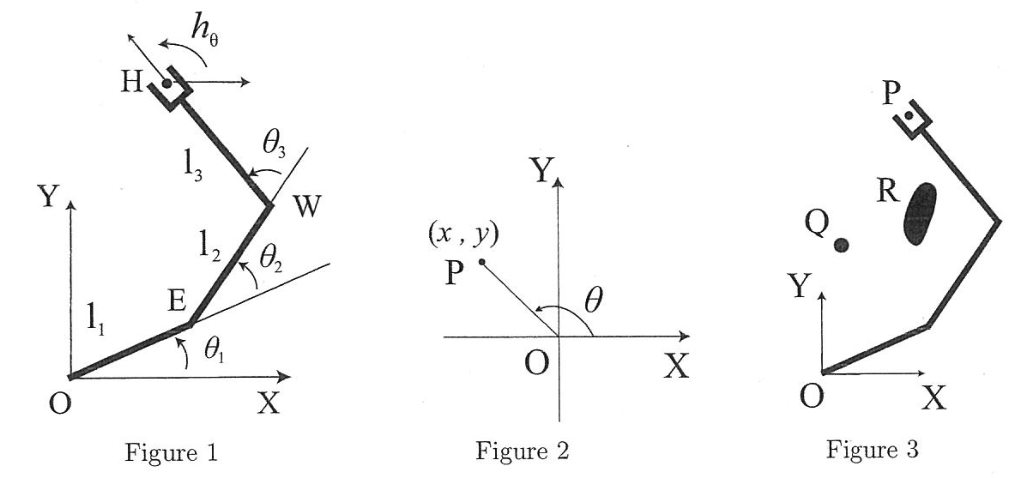
(1) Write equations for the coordinates of the joint in terms of the joint angles and .
(2) As shown in Figure 2, is defined as the angle from the axis to the line , where the point has the coordinates . Describe the definition of the function that calculates from (where ) using .
(3) Describe the procedure which provides the joint angle and from the coordinates of the joint using . The procedure should take account of all the constraints on possible values of the joint angles and .
(4) Write equations for the position and the orientation of the hand in terms of the joint angles and .
(5) Describe the procedure which provides the joint angles and from the position and the orientation of the hand .
(6) As shown in Figure 3, the hand is located at the point and two objects are located at and . Explain a method to generate the trajectory of the joint angles of the robot arm to grasp the object without colliding with the object .
题目描述
如图 1,在二维 - 平面内有一条机械臂,在 三点设转动关节,末端 装有双指手爪。手爪位置为 ,朝向为 ;关节角为 ;连杆长度为
-
用 写出关节 的坐标 。
-
如图 2,对点 ,定义 ()为从 轴到直线 的角。仅使用取值范围为
的反正切函数,分情况定义由 计算 的函数 。
-
使用 ,说明如何由 的坐标求 ,二者均须满足 ,并完整考虑关节角所有可能取值约束。
-
用 写出手爪 的位置 与朝向 。
-
说明如何由给定的 和 求三关节角 ,每个角均限制在 。
-
如图 3,手爪起始位于 ,目标物体位于 ,障碍物位于 。说明如何生成机械臂的关节角轨迹,使其不与 碰撞并最终抓取 。
Kai
The three joint angles in Figure 1 are relative, counterclockwise angles. Assume . Write for the unique representative of modulo in ; in particular is represented by .
(1) Position of
The absolute directions of the first and second links are and , respectively. Therefore
(2) Two-argument arctangent
For , define
In particular the negative axis has angle , and no division by zero is used on the axis. The function is undefined at the origin.
(3) Inverse kinematics of the first two links
Let . By taking the squared norm in (1),
A solution exists exactly when
For a reachable point with , compute
For each sign, set
These follow from . Normally the two signs give the two elbow configurations. At or , the branches coincide modulo , so retain just one distinct solution; use when .
The excluded exceptional case is reachable only when . Then and every is a solution. One must handle this separately instead of calling . Unreachable targets yield no solution. In floating-point implementation, clamp to only for a small roundoff error after the reachability check, not for a genuinely unreachable target.
(4) Hand pose
Let . The final link points along the hand's orientation, so
(5) Inverse kinematics of the full hand pose
First subtract the final link, whose absolute orientation is specified:
Apply all reachability, branch and degenerate-case rules from (3) to obtain . For each resulting pair choose
With no further mechanical joint limits stated, this gives every solution in the required principal-angle intervals. When and , there is a one-parameter family: arbitrary , , and as above. If the wrist point is unreachable, the requested pose is unreachable even when the hand position alone might be reachable with another orientation.
(6) Collision-free joint trajectory
Work in configuration space , with periodic angular coordinates. For each configuration compute all link segments and the two-finger geometry from forward kinematics. A configuration is forbidden if any link or part of the hand intersects , or if self-collision or an actual joint limit occurs. Include a clearance margin for the arm's finite thickness and uncertainty. Checking only the hand position would allow an intermediate link to strike .
Choose a grasp pose at with an appropriate approach orientation and finger opening. Solve (5) to obtain all possible goal configurations; choose an accessible branch, not merely the one closest in end-effector position. Model contact with separately: it is allowed at the intended grasp surfaces during the final approach, while unintended contact earlier in the motion remains forbidden.
Construct a collision-free configuration-space path from the given initial configuration at to one of these goals, for example using a discretized search, a probabilistic roadmap or an RRT. Test the entire interpolating segment for each proposed edge, with continuous collision checking or conservative subdivision; collision-free endpoints alone do not suffice. Then shorten or smooth the path only while preserving clearance, and time-parameterize it to satisfy velocity and acceleration limits. Use continuous, unwrapped angle values during motion so that crossing the representation boundary does not introduce a spurious jump. Follow the path, approach , and close the fingers. A failed finite-resolution or finite-sample search is not itself proof that no feasible path exists.