東京大学 情報理工学系研究科 創造情報学専攻 2010年8月実施 筆記試験 第3問
Author
Description
出典:大学公式問題冊子の保存版。 (1) As shown in figure 1, four periodical signals with a period of are denoted as a sequence of digital signals . Each element takes on values or . Calculate a matrix which consists of each element;
by using shown in figure 1. T denotes transpose.
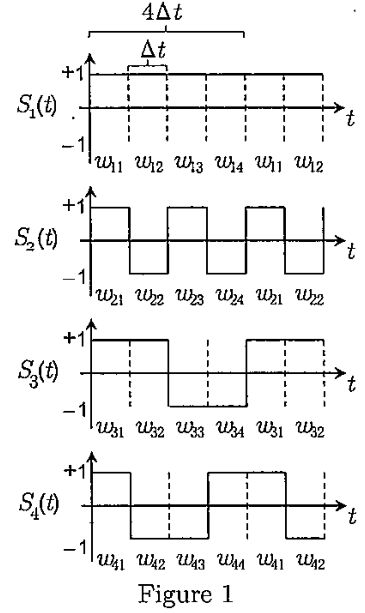
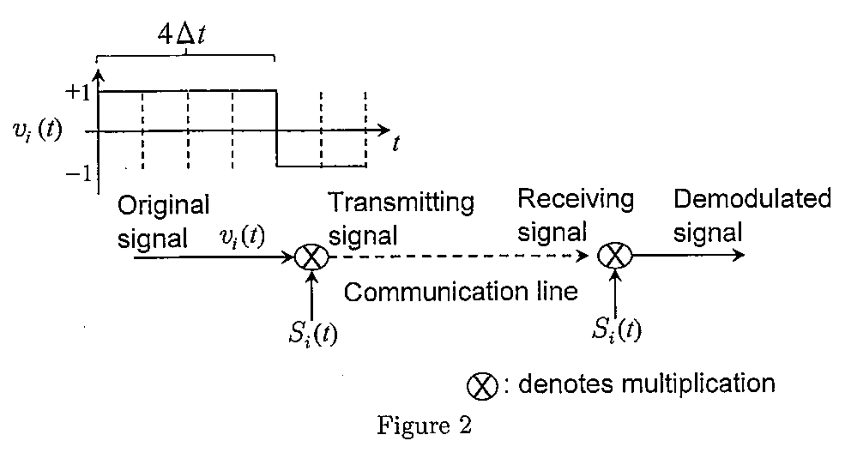
(2) Consider a method of communication shown in figure 2, where a signal period for 1 bit is . The original signal takes the values and and is constant within each bit interval. The transmitting signal is generated by multiplying the original signal by the signal defined in (1). The demodulated signal is generated by multiplying the receiving signal by the signal . Suppose that the synchronization between the original signal and the signal and the synchronization between the receiving signal and the signal are realized by using an appropriate method. In addition, suppose that there is no delay in the communication line and no effect of noise and attenuation of signals. Answer the following problems.
- Show that the demodulated signal matches to the original signal.
- When the transmitting signal generated by multiplying the original signal by the signal is received by the method, write the signal obtained by multiplying the receiving signal by the signal .
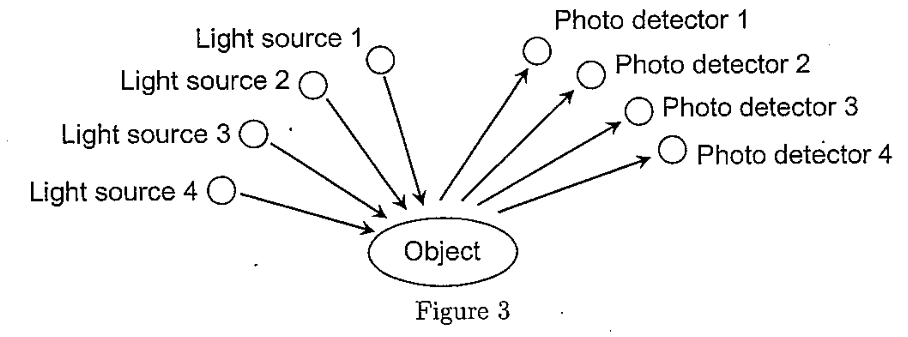
(3) Consider an optical sensing system using concurrently four light sources shown in figure 3. If the same constant lighting levels are used for the light sources, it is difficult to separate the light sources at the photo detectors, so that concurrent sensing cannot be realized. Therefore consider a method for using concurrently four light sources by separating only the signal of the -th light source at the -th photo detector by using an appropriate signal for the -th light source .
- Show a detailed method for separating the signal of -th light source at the -th photo detector from the signal of other light sources. Suppose that the synchronizations at the modulation and the demodulation are realized by using an appropriate method. In addition, suppose that there is no delay in the communication line and no effect of noise and attenuation of signals.
- If there is attenuation of the signals in the above situation, show a detailed method for separating the signal of each light source.
题目描述
-
如图 1,四个周期信号 ()的周期均为 ,分别用数字序列
表示,每个 。根据图 1 给出的各 ,计算 矩阵 ,其中
上标 表示转置。
-
考虑图 2 的通信方法,每比特信号周期为 。发送端将原信号 与第 1 问的 相乘生成发送信号;接收端再把接收信号与 相乘生成解调信号。假设原信号与 、接收信号与 均已适当同步,信道无延迟、噪声和衰减。
- 证明解调信号与原信号一致。
- 若接收到的是 ,写出改与 ()相乘后得到的信号。
-
图 3 的光学传感系统同时使用四个光源。若光源均以恒定亮度点亮,光电探测器无法区分来源,因而不能并行测量。现为第 个光源选取适当信号,使第 个探测器只分离出该光源的成分。
- 详细说明如何把第 个光源信号与其他光源分离。假设调制、解调已适当同步,传播无延迟、噪声和信号衰减。
- 若存在信号衰减,详细说明如何仍然分离各光源信号。
题目中的序列波形、通信框图和光学系统结构沿用原文图 1~3。
Kai
(1)
図1の最初の4区間から、
を読み取る。各ベクトルの長さの2乗は4で、相異なる2本の内積は0だから、
は常に1であり、他の3系列は1周期内の平均が0である。
(2)
1) 送信信号が なので、同期した同じ符号を掛けると
となり、各時刻で元の信号を得る。
2) 別の符号を掛けた直後の信号は
であり、各時刻で0になるわけではない。 の1ビット区間では が一定なので、その区間の平均は
例えば であり、異なる系列による積は正負が相殺される。従って混信の除去には符号との乗算に加え、同期した1周期の積分・平均が必要である。
(3)
1) 符号による分離。 理想化した符号付き変調成分を扱うなら、光源 の成分を とする。検出器 の受信信号 に を掛けて1周期平均すれば、直交性から だけが残る。
ただし実際の光の強度は負にできない。また は直流であるため、単に全光源へ直流バイアスを加えて同じ相関だけを取ると、第1光源に他の光源のバイアスが混入する。これを含めた実装として、各光源を非負のオン・オフ波形
で駆動する。 なので第1光源は連続点灯となる。受信信号を と書き、4個の相関値
を測定する。 は光源 から検出器 へ届いた強度である。直交性より、
したがって各光源を
として分離できる。検出器 は、このうち対応する を取り出す。光強度を負にすることなく、4チップの同時測定で全成分を復元できる。
2) 減衰がある場合。 光源 から検出器 までの経路利得を とし、少なくとも1符号周期の間は一定で、受信強度が線形に加算されると仮定する。このとき と置くだけで上の相関と分離式はそのまま使え、他の光源からの成分を除いた を得る。送出強度 を復元したいなら、校正または既知のパイロットから求めた で割る。一方、対象物の反射・透過を計測する目的なら、 が既知であることを用いて を推定する。
未知の一定な背景光は第1の直流成分と区別できないので、必要なら全光源を消した基準測定で差し引く。符号周期内で減衰が大きく変動する場合や遅延・多重反射によって波形が変形する場合は、単純な直交相関だけでは分離が保証されず、その応答を校正するモデルが必要である。