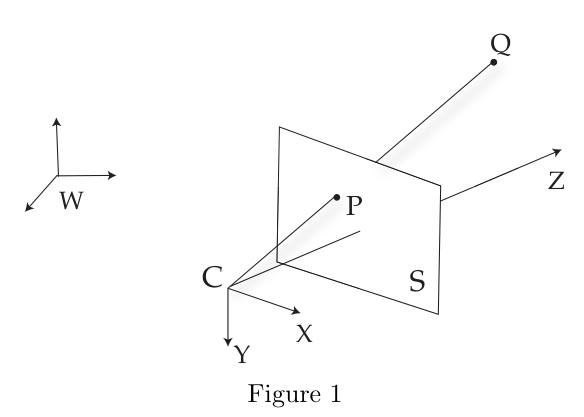
(1) As Figure 1 shows, an orthogonal coordinate frame ΣC of a camera with the lens axis CZ and the projection plane S is placed at the point C. The plane S is orthogonal to the lens axis CZ and has the distance f from C. The point Q is projected to the point P on the plane S with the coordinates PC=(PX,PY,f)t in ΣC. The coordinates of three orientation vectors CX,CY,CZ are described as XW=(XX,XY,XZ)t, YW=(YX,YY,YZ)t and ZW=(ZX,ZY,ZZ)t, and the position vector of C is CW=(CX,CY,CZ)t in the coordinate frame ΣW. The superscript t indicates transpose.
Assume the distance from C to Q is d, show the vector QC from the point C to the point Q with PC and d. When the vector QW is the position vector of Q and the rotation matrix of ΣC is RC in ΣW, we have QW=RCQC+CW. Show the elements of the rotation matrix RC.
(2) When we observe the point Q from the camera placed at a point A, the projection point is PA=(aX,aY,f)t in the camera coordinate frame ΣA. Then, we translate the camera with the distance ℓ along the axis X to a point B and rotate it around the axis Y of the translated coordinate frame with the angle α. The rotated camera coordinate frame is ΣB. The projection point becomes PB=(bX,bY,f)t in ΣB. Show the method to get the distance dA from A to Q and the distance dB from B to Q, when PA=PB is obtained. Assume there is no error in the translation and rotation, and the XZ planes of ΣA and ΣB are aligned in the same plane.
(3) Two cameras are placed at the points M and N, respectively. Let the position vectors of M and N be MW and NW and the rotation matrices be RM and RN. The projection points of Q on these two cameras become PM and PN. As the position vectors QM and QN of the point Q are the same in the coordinate frame ΣW. Denote the condition which the projection points PM and PN should satisfy.
(4) Assume the projection points are described in an array and the condition in (3) is not satisfied. Let the evaluation function be J=∣(RMQM+MW)−(RNQN+NW)∣2, and consider minimizing J to get QW. Let dM and dN be the distances from M and N to Q, respectively, when J is minimized. Denote dM and dN. Then explain the method to get QW in ΣW with dM, dN.
(5) Explain the best arrangement to minimize errors when we measure a three dimensional position by two cameras such as (3).