東京大学 情報理工学系研究科 創造情報学専攻 2007年8月実施 筆記試験 第3問
Author
Description
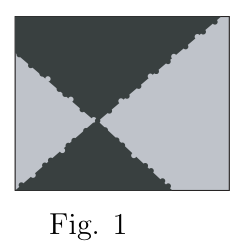
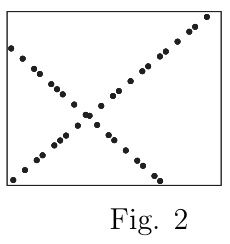
Consider a method to find equations of two straight boundary lines of the two-colored regions like Fig. 1. Suppose the points in Fig. 2 are derived through processing the image of Fig. 1 and answer the following questions.
(1) The line that passes the point as in Fig. 3 is described as
The point of the - parameter coordinates (Fig. 4) shows the line . Explain what the parameters of mean in the - coordinates.
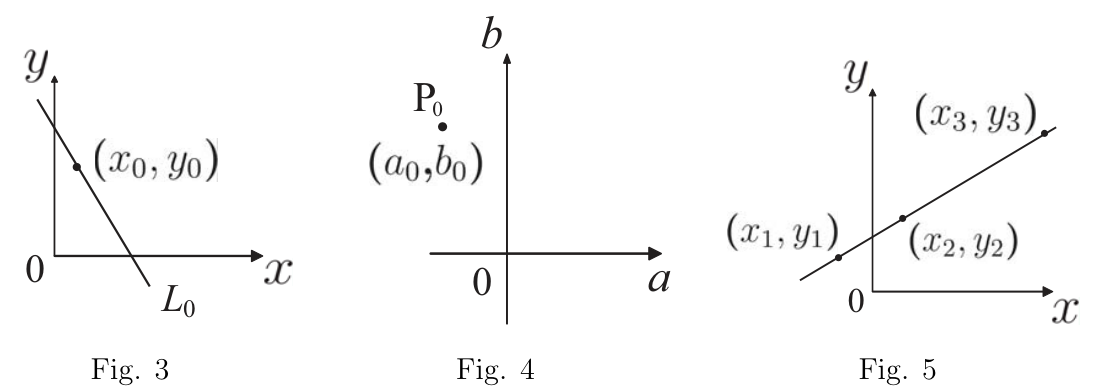
(2) Rotate the line in Fig. 3 at the point . Illustrate the trajectory of the point in the - coordinates.
(3) Consider the three points on a line as in Fig. 5. Let be a line that passes . Rotate each line at . Illustrate the corresponding trajectories of the point in the - coordinates.
(4) Considering the methods described above, explain how to get the equations of the two straight boundary lines from the points of Fig. 2.
题目描述
考虑如何求出图 1 所示双色区域的两条直线边界方程。假设已通过图像处理得到图 2 中的一组点,回答下列问题;各图沿用原文图片。
-
如图 3,经过 的直线 写成
参数空间 - 中的点 表示该直线。说明参数 在原 - 坐标系中的含义。
-
让直线 绕固定点 旋转,在 - 参数空间中画出对应点 的轨迹。
-
如图 5,三点 ()位于同一直线上。令 为经过 的直线,并让每条 绕各自固定点旋转;在参数空间中画出相应点 的轨迹。
-
根据上述方法,说明如何由图 2 的点求出两条直线边界的方程。
Kai
(1)
は直線の傾き 、 は 軸との交点の 座標である。直線の 軸に対する角を とすると 。ただし垂直線 は有限の では表せない。
(2)
点 を通る条件は だから、パラメータ平面での軌跡は
これは傾き 、 切片 の直線である。 なら水平線となる。元の直線が垂直になる方向では が発散するため、この座標表示ではその方向を有限点として含められない。
(3)
三つの軌跡はそれぞれ
となる。元の3点を通る直線を とすれば、各式に を代入して が得られる。したがって3本のパラメータ直線は共通点 をもつ。元の点が相異なり、共通の直線が垂直でなければ、この共通点は一意である。
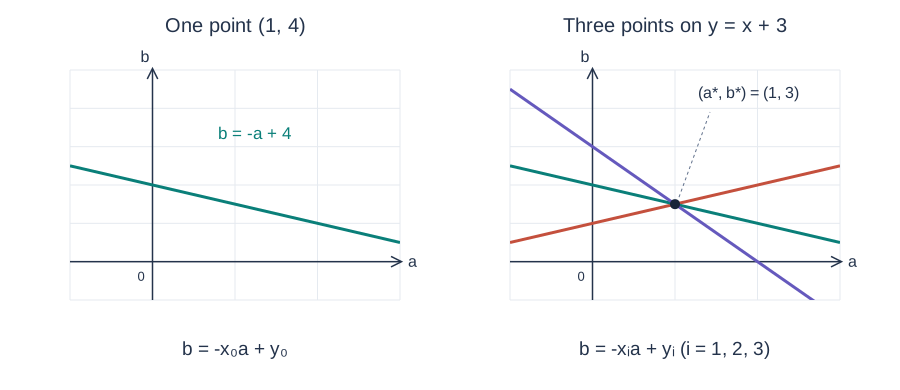
解答用の作図例。左は 、右は同一直線 上の を使っている。これらの数値は作図用に選んだもので、原図の測定値ではない。
(4)
まず 空間を格子に区切り、投票数を0にする。図2の各点 について、許容する各傾き に対する を計算し、対応する格子へ1票を加える。同一直線上の点は同じパラメータ付近へ投票するため、2本の境界線に対応する2個のピークが生じる。近接ピークの重複を除いて大きなピーク を選び、
を得る。量子化誤差や点の雑音があるため、ピークに近い直線を支持する点を集め、直交距離を最小にする直線当てはめで精密化してもよい。図には座標付きの実測点が与えられていないので、数値的な傾き・切片を一意には計算できない。
垂直線も統一的に扱うなら、法線形式 を使い、 空間へ投票する。これは有限の角度範囲で全方向を表す標準的な Hough 変換である。OpenCV の説明も、この形式と投票による直線検出を示している。