東京大学 情報理工学系研究科 創造情報学専攻 2006年8月実施 筆記試験 第2問
Author
Description
出典:大学公式問題冊子の保存版。
日本語
センサからデータを入力し,演算を行うコンピュータシステムについて,以下の問いに答えよ.
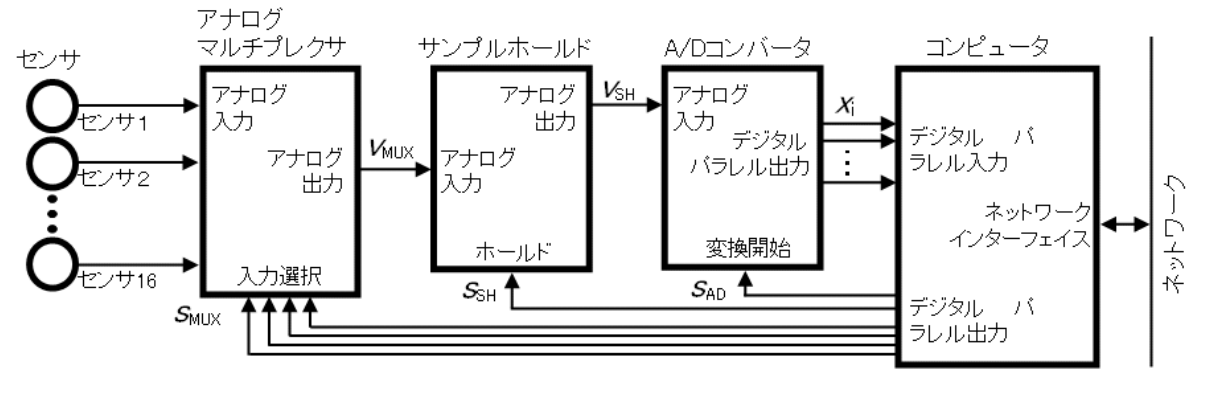
(1) このようなコンピュータシステムの例を図 に示す.このコンピュータシステムを用いて, 個のセンサからのデータ () を入力し,演算 () を一度だけ行う場合,この処理を最小時間で実行するプログラムの時間ダイアグラムを示し,その動作の概略を説明せよ.また,この処理に必要となる時間 を求めよ.ただし,ここで用いられている回路ブロックの遅延特性 は,それぞれ,
:アナログマルチプレクサにおける入力選択信号 の確定からアナログ出力 の確定までの遅延時間 :サンプルホールドにおけるホールド信号 の確定からアナログ出力 の確定までの遅延時間 :AD コンバータにおける変換開始信号 の確定からデジタルパラレル出力 の確定までの遅延時間 :コンピュータ上で,デジタルパラレル入力 の確定から演算 の終了までの演算時間
を表し,これら以外の遅延はすべて無視できるものとする.また,便宜上,これらの遅延は一定で, であると仮定する.なお,図に示されている回路以外の回路は適切に処理されているものとして解答では考慮しなくてよい.
(2) 個のセンサからのデータを入力し,得られたデータ に対して所定の演算 () を行う処理を繰り返し実行することを考える.ただし,図 で回路ブロックとして用いられているアナログマルチプレクサ,サンプルホールド,AD コンバータ,コンピュータはいくつでも使えるものとし,コンピュータのデジタルパラレル入力並びにデジタルパラレル出力は必要なビット数を使えるものとして,以下の問いに答えよ.なお,コンピュータシステムの概略を示す際には,これらの回路ブロックのみを用いて解答するものとし,簡単のため,,コンピュータ間の通信にかかる時間は無視できるものとする.
(2-1) の場合,この繰り返しのサイクルタイムを最小とする回路のなかで,用いる AD コンバータの数が最小となるコンピュータシステムの概略を示し,実行するプログラムの時間ダイアグラムを示せ.また,必要となる AD コンバータの数を と の関係から導け.ただし,コンピュータは処理内容にかかわらず,任意の時刻で入出力命令の実行が可能であると仮定してよい.
(2-2) の場合,この繰り返しのサイクルタイムを最小とする回路のなかで,用いるコンピュータの数が最小となるコンピュータシステムの概略を示し,実行するプログラムの時間ダイアグラムを示せ.また,必要となるコンピュータの数を と の関係から導け.
(3) センサからのデータの入力を伴う並列処理システムを実際に設計する際,一般的に留意すべき事項を 字以内で述べよ.
English
Answer the following questions about computer systems which carry out some operations on sensor data.
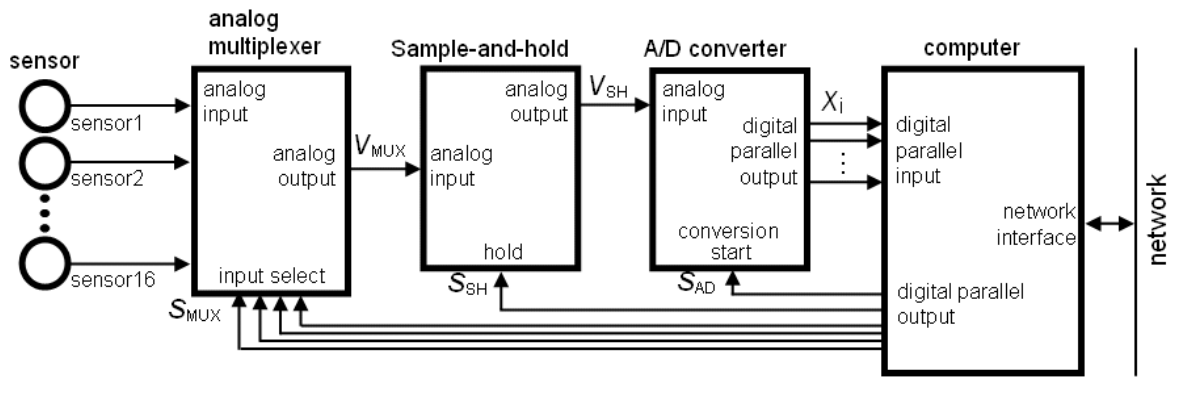
(1) Figure 1 shows a sample configuration of such a computer system. In the case that the system inputs sensor data () and computes () for each sensor data only once, show the time diagram for the program which minimizes the time for the whole operation, and describe the outline of the program. In addition, calculate the time needed for the whole operation. Delay times of the circuit blocks used in Figure 1 are defined as:
: Delay time of the analog multiplexer from the settled time of the input select signal to the settled time of analog output , : Delay time of the sample-and-hold from the settled time of hold signal to the settled time of analog output , : Delay time of the A/D converter from the settled time of conversion start signal to the settled time of signal parallel output , : Computation time for after the digital parallel input is settled.
Ignore other delays except the above defined delay times. Suppose that these delay times are constant and . Since you may suppose that the circuits other than those shown in Figure 1 are designed appropriately, you may not consider those in your answer.
(2) Consider iterative operations in which sensor data () are input and () for each sensor data are computed periodically. Suppose that you can use any number of analog multiplexers, sample-and-holds, A/D converters, and computers used in Figure 1, but no other circuits. Also, suppose that you can use any number of bits of the digital parallel input and the digital parallel output. Answer the following questions. To simplify the condition, suppose , and assume that the time for communication between computers is zero.
(2-1) In case of , show the configuration of a computer system which minimizes the cycle time of the iterative operations with the minimum number of A/D converters. In addition, show the time diagram of the program for the computer system and describe the number of necessary A/D converters as a function of and . In your answer, you may suppose that a computer can carry out input/output operation at any time even if the computer runs any other programs.
(2-2) In case of , show the configuration of a computer system which minimizes the cycle time of the iterative operations with the minimum number of computers. In addition, show the time diagram of the program for the computer system and describe the number of necessary computers as a function of and .
(3) Describe general important points, within about 100 words, for the design of actual parallel processing systems which manipulate sensor data inputs.
题目描述
回答关于从传感器采集数据并进行计算的计算机系统的问题,系统结构见原文图 1。
-
系统从 16 个传感器各读取一次数据 (),并各执行一次 。画出使总处理时间最短的程序时序图,概述其运行方式,并求总时间 。各模块延迟定义如下:
- :模拟多路选择器的输入选择信号 稳定至模拟输出 稳定的时间;
- :采样保持器的保持信号 稳定至模拟输出 稳定的时间;
- :A/D 转换器的启动信号 稳定至数字并行输出 稳定的时间;
- :计算机的数字并行输入 稳定后,完成 所需的时间。
除上述延迟外均可忽略;各延迟恒定且满足
图中未画出的电路可视为已妥善处理,无须在答案中考虑。
-
现要周期性重复读取 16 个传感器数据并计算对应的 。可使用任意数量的图 1 所示模拟多路选择器、采样保持器、A/D 转换器和计算机,计算机的数字并行输入、输出位数也不限;系统框图只能使用这些模块。为简化,令 ,并忽略计算机间通信时间。
- 当 时,在所有能使重复处理周期最短的电路中,选择 A/D 转换器数最少的系统:画出系统概略和程序时序图,并由 与 的关系推导所需 A/D 转换器数量。可假设计算机无论正在执行何种处理,都能在任意时刻执行输入输出指令。
- 当 时,在所有能使周期最短的电路中,选择计算机数最少的系统:画出系统概略和程序时序图,并由 与 的关系推导所需计算机数量。
-
用不超过 300 个日文字符(英文版表述为约 100 词)的篇幅,说明实际设计带传感器输入的并行处理系统时通常应注意的事项。
Kai
以下では , , , と略す。
モデル上の注意。 公式問題冊子の保存版にも、(2)について同一センサの異なる回の処理を何組でも並行してよいかを制限する記述はない。文字通り台数を無制限に増やせるなら、正の最短周期は存在しない。この点を最後に示す。まず、各センサの遅い段を1台ずつ用い、その16系列を流水線化するモデルで、構成と時刻表を与える。また(1)では、外部サンプルホールドがAD変換の終了まで入力を保持する通常の構成を仮定する。
(1)
最初にセンサ1を選択し、 待ってからホールドを指示し、さらに 後にAD変換を始める。最初のデータが利用可能になる時刻は である。変換中にMUXを次のセンサへ切り替えておけば、 より次のMUX出力は間に合う。ただし、同じSHの出力は現在の変換が終わるまで変更できないので、連続するAD完了の間隔は少なくとも となる。
とおき、センサ のAD完了を にそろえる。次の表は各処理の占有区間を与える時間ダイアグラムである(区間は左端を含み右端を含まない)。
| 処理 | センサ に対する時間区間 |
|---|---|
| MUXの切替え | は 、 は |
| SHの新しい値の確定 | |
| AD変換(SHは値を保持) | |
| 計算 |
により、次のSH更新は前のAD完了より前には始まらない。 により計算も重ならない。制御命令・データの取り込みは題意どおり時間を無視し、必要な時刻で実行する。
最初の取得に必要な時間、SHとADの直列資源制約、単一コンピュータの計算量から、このスケジュールは上のモデルで最短であり、
特に が成立する場合 は である。与えられた だけでは は導けない。ADコンバータが開始時に内部へ入力を取り込み、外部SHを直ちに解放できる別のモデルなら各段を独立に流水線化でき、 となる。入力を保持すべき期間の仕様を区別する必要がある。
(2-1) 16台の計算機を使い、各センサの計算を周期 で行う構成
各コンピュータを1センサに対応させる。各ADの前に全16センサを選べるMUXとSHを置き、変換結果を担当コンピュータへ渡す。コンピュータ間通信・入出力の時間は0である。AD台数を とすれば、1周期に必要な変換時間の総和が なので、
この下界を達成するには、取得位相をずらしてADの割当てを巡回させる。 に対して、 とし、次の時刻表を定常状態で繰り返す。
| 処理 | センサ番号 | 使用装置 | 時間区間 |
|---|---|---|---|
| AD変換 | AD | ||
| 計算 | 同上 | そのセンサ専用のCOMP |
同じADへの割当て間隔は であり、同じコンピュータへの間隔は なので、資源競合は起こらない。開始時の負の時刻は全時刻を だけ平行移動すればよい。これはセンサごとのサンプリング位相が異なる構成であり、16個の同時標本化を要求する場合とは異なる。
MUXは各ADが必要なセンサを選べるように接続し、ADのデジタル出力は担当計算機が入力する。
(2-2) 16台のADを使い、各センサの変換を周期 で行う構成
今度は各センサにSHとADを1組ずつ置き、複数のAD結果を共用コンピュータへ巡回して渡す。1周期あたりの計算量から、
とした次の時間表がこの台数で実行できる。
| 処理 | センサ番号 | 使用装置 | 時間区間 |
|---|---|---|---|
| AD変換 | そのセンサ専用のAD | ||
| 計算 | 同上 | COMP |
各ADは周期 、各コンピュータは間隔 で使われる。したがって競合せず、取得結果をメモリに読み込んだ後で対応する を実行できる。
台数を文字通り無制限にした場合。 各センサにAD1台とCOMP1台を用いた16路の装置全体を 組複製し、各組の位相を ずつずらす。このとき16センサ分の結果を得る定常周期は となり、任意に短くできる。従って原文の条件のみでは有限台数で達成される最短周期と、そのときの最少台数は定まらない。上の二つの台数式は、それぞれ16台の遅い側の装置に限定したモデルでの解答である。
(3)
センサの帯域に応じて標本化周期とアンチエイリアスフィルタを選び、ADの分解能・雑音・飽和を確認する。複数センサの時刻同期と取得時刻の記録を行い、遅延やジッタが演算結果に与える影響を評価する。通信帯域、バッファ容量、処理の最悪実行時間、負荷分散を見積もり、取りこぼしや資源競合を防ぐ。故障検出、期限超過時の処理、制御信号の安全性にも配慮する。