東京大学 情報理工学系研究科 創造情報学専攻 2006年8月実施 プログラミング
Author
itsuitsuki, 祭音Myyura
Description
日本語
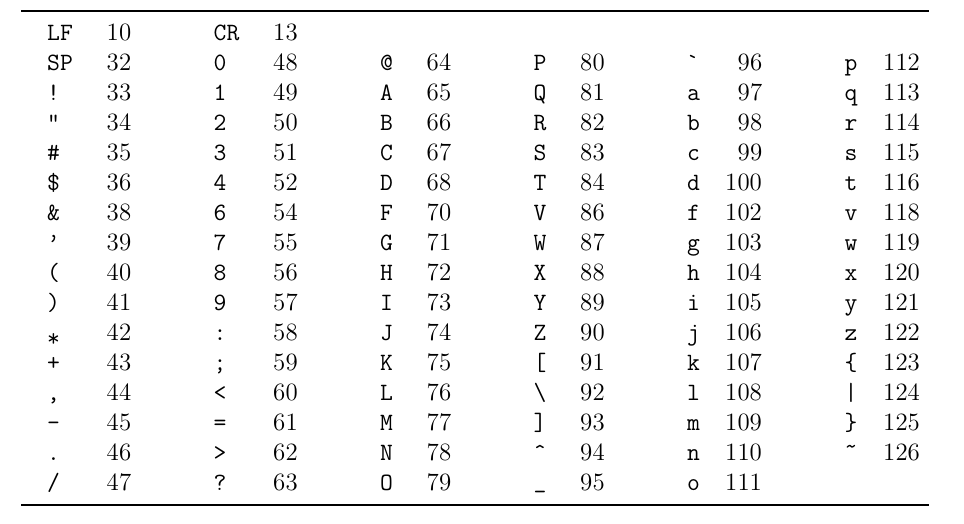
必要なら最後の ASCII コード表を使いなさい. この問題で扱う文字コードは 32~126 と改行に関するコードの計 96 種類のみである. また, 以下で使うファイルはすべて ASCII 文字で, 1 行 76 文字以内である.
問 1 鍵として指定した数だけ, アルファベットの英字を循環的に後ろへシフトする非常に単純な暗号 (シーザー暗号) がある. 鍵は 1~25 の整数である. 例えば, 鍵が 4 の場合, Japan は Neter と暗号化され, 鍵が 25 の場合, IBM は HAL と暗号化される. なお, 簡単のため, ここでは, 英字の大文字は大文字に, 小文字は小文字に変換されるとし, 空白や改行, 数字, 句読点などの記号は暗号化しない.
ファイル q1.txt を入力して解読しなさい. すなわち, 暗号化に使われた鍵を推測し, 元の英語の文章を復元しなさい.
問 2 問 1 のシーザー暗号はあまりにも単純すぎるので, 英字を別の英字に 1 対 1 変換する表 (換字表) を鍵とする暗号化もよく使われた.
2-1 ファイル q21.txt に数万文字の英語の文章がある. 出典は以下の通り.
The 1980 ACM Turing Award Lecture by Charles Antony Richard Hoare The Emperor’s Old Clothes, Communications of the ACM, Volume 24, Number 2, 1981. Copyright 1981, Association for Computing Machinery, Inc.
www.braithwaite-lee.com/opinions/p75-hoare.pdf
このファイルに含まれる英字の出現頻度 (出現回数) を求めなさい. ただし, 英字の大文字は小文字に含めて数える. その結果を出現頻度の大きい順に並べたものを表示するプログラムを書きなさい. 表示は英字 (大文字は小文字で代表) と出現頻度が対になっていればどんな形式でもよい.
2-2 ファイル q22.txt に, ある換字表を使って暗号化された文章が入っている. ここでは簡単のため, 英字以外は変換せず, 英字の大小はそのままになっている. 換字表による文字変換プログラムと, 英語の知識にもとづく試行錯誤を行なって, この暗号文の解読を試み, 得られた平文をファイル a22.txt に出力しなさい.
(出典 www.cs.utexas.edu/users/EWD/transcriptions/EWD03xx/EWD340.html)
問 3 換字表による暗号化は, 平文の文字出現頻度分布がヒントになるので, 解読されやすい. しかし, 暗号化する前の文のどの文字もほぼ同じ出現頻度になっていれば, 解読は困難になる. 出現頻度の高い文字には短い 2 進列, 出現頻度の低い文字には長い 2 進列を割り当てる符号化を行なうと, 2 進列のパターンの出現頻度がほぼ同じになる. すなわち, テキストの圧縮を行なってから暗号化すると, 解読は難しくなる.
3-1 q21.txt における 96 種類すべての文字の出現頻度を求め, すべての文字を出現頻度の高いものほど短い 2 進列で表わす符号化を考えよう. 以下にそのような符号化の考え方 (ハフマン符号化) を示す. これをプログラムしなさい. 文字と対応する 2 進列がわかるように出力されていれば, 出力形式はなんでもよい. 空白は SP, 改行は NL と表示しなさい.
符号化の考え方: まず, 図 1(4) のように, すべての文字が葉であるような順序付き 2 進木を構成する. 文字に対する符号を求めるには, 根から葉へ木をたどり, 左側の分岐をたどったら 0,右側の分岐をたどったら 1 と順に 0, 1 を振っていく. 葉に到達するまでに得られた 0, 1 の列がその文字に対する符号である. 例えば, 図 1(4) では B は 100 と 2 進符号化される.
ハフマン符号を得るための順序付き 2 進木の作り方: 次のようにボトムアップに構成する.
- 出現頻度表のすべての文字を節点とし, それぞれの節点に, 頻度表に書かれた出現頻度を値として与える. ここでは, 頻度 0 の文字は存在しない.
- まだ親をもたない節点の中で最も小さな値をもつ節点と, 次に小さな値をもつ節点をそれぞれ右の子, 左の子とする節点を生成し, その節点には 2 つの子の値の和を値として与える. これを 2 進木が完成するまで繰り返す. 値が等しいものがあった場合は, 文字同士なら, ASCII コードの小さいほうが右, また, 節点は新しくつくられたもののほうが右という規則にする.
図 1 に A, B, C, D, E の頻度がそれぞれ 50, 20, 33, 15, 40 だった場合の組み立て方を示した.
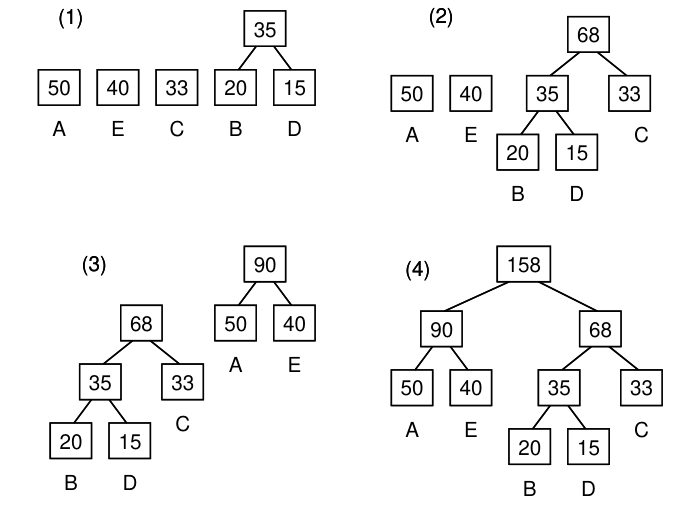
図 1. ハフマン符号化のための順序付き 2 進木のつくりかた (例)
3-2 これまで扱ってきた NL (改行) を含めた 96 種類の文字に対して, 頻度を考えずに 2 進数に符号化すると, 1 文字あたり平均 6.5 ビットを要する. 上で求めたハフマン符号化の 2 進数のビット数は 1 文字当たり平均何ビットになるか, 少なくとも小数点以下 2 桁まで計算するプログラムを書きなさい. ただし, このときの平均は文字の出現頻度の重みをつけること.
English
Refer to the ASCII code table on the last page, if necessary. The number of character codes dealt with in this examination will be 96; that is, from 32 to 126 and that for newline. Files consist of ASCII characters. Every line has no more than 76 characters.
Q1 Caesar cipher is one of the simplest cipher which shifts alphabet letter by -place in a cyclic manner, where is the cipher key ranging from 1 to 25. For example, if the key is 4, Japan is enciphered into Neter, and if the key is 25, IBM is enciphered into HAL. Here we preserve uppercase and lowercase of alphabet letters, and do not substitute any other characters such as space, digits, and punctuation marks. Decipher the Caesar cipher text in the file q1.txt. Namely, infer the key and recover the original English sentences.
Q2 Caesar cipher is too simple to defense against cipher breaking. A little complicated cipher uses a substitution table which substitutes each letter by another letter. The substitution table gives a one-to-one mapping within the alphabet.
2-1 The file q21.txt is an article consisting of about ten thousand words. The text is cited from:
The 1980 ACM Turing Award Lecture by Charles Antony Richard Hoare The Emperor’s Old Clothes, Communications of the ACM, Volume 24, Number 2, 1981. Copyright 1981, Association for Computing Machinery, Inc.
www.braithwaite-lee.com/opinions/p75-hoare.pdf
Compute the frequencies (or occurrence counts) of all alphabet letters in this text, counting uppercase alphabet letters as their corresponding lowercase letters. Make a program that outputs the result in the descending order of frequency. You can choose arbitrary output format under the condition that each alphabet letter in lowercase is paired with its occurrence count.
2-2 The file q22.txt is a cipher text made by using a certain substitution table, where characters other than alphabet letters are unchanged for simplicity. Break the cipher by using an appropriate character substitution program and some trial and error inference. Output the full deciphered text on a file named a22.txt.
This article is cited from: www.cs.utexas.edu/users/EWD/transcriptions/EWD03xx/EWD340.html.
Q3 As you can see, ciphers based on a simple substitution table are easily broken with a hint of alphabet letter frequency distribution. If the frequency distribution of the characters of the original text becomes flat, it would be more difficult to break. For the preparation, let us consider an encoding scheme in which a short binary code is assigned for a frequently occurring character and a long binary code for an infrequently occurring character. In such an encoding, every binary pattern tends to appear in the same probability. We can readily imagine the code breaking would be much more difficult if we compress the original text before enciphering.
3-1 Compute the frequencies of all 96 characters in q21.txt and program the Huffman coding in which more frequent characters have shorter binary codes, as shown below. Output the encoding table in which each character is paired with the corresponding binary code, namely, sequence of 0 and 1. You can choose your convenient output format, but space character and newline character should be denoted SP and NL, respectively.
Code assignment: First, you have to make an ordered binary tree as shown in Figure 1(4), each of whose leaves represents a character. To assign a code to a character, start from the root toward the corresponding leaf. In the course, you get 0 if you choose the left branch, and 1 if the right branch. The 0-1 sequence from the root up to the leaf is the code for the character. For example, the Huffman code for the character B in Figure 1(4) is 100.
Construction of an ordered binary tree for Huffman code: Make a tree in a bottom-up manner as described below.
- Create a node for each character in the frequency table, and give the frequency as its value. Note that there is no character of zero occurrence in this problem.
- Until a complete binary tree is constructed, create a parent node of the two nodes that have not yet a parent, each of which is one that has the least value, and the other that has the second least value. The node of the least value will be the right child of the new node, and the node with the second least value will be the left child. If the least value equals to the second least value, newer node will be the right child, and character node with smaller ASCII code will be the right child if both are character nodes. Figure 1 illustrates the tree construction, where five characters A, B, C, D, and E have frequencies 50, 20, 33, 15, and 40, respectively.
Figure 1. Construction of an ordered binary tree for Huffman coding (example)
3-2 You can see that we need 6.5 bits on an average for 96 characters if we do not consider their frequencies. Compute the average number of bits for binary code for 96 characters you made in the Question 3-1, at least up to 2 places of decimals. Note that the average should be weighted by each character frequency.
题目描述
必要时可使用文末的 ASCII 码表。本题只处理 ASCII 码 32~126 以及换行符,共 96 种字符;所用文件均仅含 ASCII 字符,每行不超过 76 个字符。
第 1 题:凯撒密码。 这种密码把英文字母按密钥指定的位数循环后移,密钥为 1~25 的整数。例如密钥为 4 时,Japan 加密为 Neter;密钥为 25 时,IBM 加密为 HAL。大写字母仍映射为大写,小写仍映射为小写;空格、换行、数字、标点等非字母字符不加密。读入 q1.txt,推断加密密钥并恢复原英文文本。
第 2 题:单表替换密码。 该密码用一张英文字母间的一一映射表作为密钥。
- 文件
q21.txt含数万字符的英文文章,来源为 C. A. R. Hoare 的 1980 年 ACM 图灵奖演讲论文 The Emperor’s Old Clothes(Communications of the ACM, 24(2), 1981;原文所列链接为www.braithwaite-lee.com/opinions/p75-hoare.pdf)。编写程序统计其中各英文字母的出现次数,统计时将大写并入对应小写,并按频数从高到低输出字母—频数对,输出格式不限。 q22.txt含一段用某张替换表加密的文本;非字母不变,字母大小写保持不变。编写按替换表转换字符的程序,并结合英语知识反复尝试解密,将得到的明文输出到a22.txt。文本来源为原文所列的 Dijkstra EWD340 链接。
第 3 题:哈夫曼编码。 单表替换密码会保留明文字符频率,因而容易受到频率分析;若先以高频字符分配短二进制串、低频字符分配长二进制串的方式压缩文本,再加密,则二进制模式的频率更趋均匀。
- 统计
q21.txt中上述 96 种字符各自的频数,并实现题目规定的哈夫曼编码。构造一棵所有字符均为叶子的有序二叉树;从根走向叶子时,走左支记 0、走右支记 1,沿途比特串即为该字符的编码。自底向上建树时,先将每个字符作为权值等于其频数的结点(题设保证频数均非零);反复从尚无父结点的结点中选权值最小和次小者,分别作为新结点的右、左孩子,新结点权值为二者之和,直至形成整棵树。权值相同时,字符结点中 ASCII 码较小者置于右侧;涉及已合并结点时,较新建立者置于右侧。图 1 给出了 的频数分别为 时的构造示例。输出须能看出每个字符与其二进制串的对应关系,空格显示为SP,换行显示为NL,其余格式不限。 - 题设指出,不考虑频率时对含换行在内的 96 种字符进行二进制编码,平均每字符需要 6.5 位。编写程序计算第 3-1 问所得哈夫曼编码的加权平均码长,权重为各字符出现频率,结果至少保留小数点后两位。
题目所需的哈夫曼树示意图与 ASCII 码表沿用原文图片。
Kai
The sample data file of q1.txt are here.
Sxx, jzf dppx ez slgp qzfyo esp qzwwzhtyr dpypepynpd.
Zyp zq esp dtxawpde pilxawpd zq l dfmdetefetzy ntaspc td esp Nlpdlc
ntaspc, hstns td dlto ez slgp mppy fdpo mj Ufwtfd Nlpdlc ez
nzxxfytnlep htes std lcxj. Nlpdlc td nzydtopcpo ez mp zyp zq esp qtcde
apcdzyd ez slgp pgpc pxawzjpo pyncjaetzy qzc esp dlvp zq dpnfctyr
xpddlrpd. Nlpdlc opntopo esle dstqetyr plns wpeepc ty esp xpddlrp
hzfwo mp std delyolco lwrzctesx, lyo dz sp tyqzcxpo lww zq std
rpypclwd zq std opntdtzy, lyo hld es
We currently do not have OTHER corresponding sample data files. If you have them and are willing to share, please submit a PR.
(1)
def _transform(ch:str, offset):
    diff = ord(ch) - ord('a' if ch.islower() else 'A')
    newdiff = (diff + offset)%26
    newch = chr(ord('a' if ch.islower() else 'A') + newdiff)
    return newch

def transform(s:str, offset):
    new = ''
    for c in s:
        if c.isalpha():
            new += _transform(c, offset)
        else:
            new += c
    return new

with open('q1.txt') as f:
    q1 = f.read()
print(transform(q1, -11), end='')
The encryption key is ; equivalently, decryption shifts each letter by .
(2-1)
with open('q21.txt') as q21:
    q21r = q21.read()
from collections import Counter
q21_counter = Counter(q21r.lower())
c = 'abcdefghijklmnopqrstuvwxyz'
# q21_counter = dict(q21_counter)
by_order = ''
for ch in sorted(list(c), key=lambda x:q21_counter[x] if x in q21_counter else 0, reverse=True):
    print(ch, q21_counter[ch] if ch in q21_counter else 0)
    by_order += ch
# print('by order:', by_order)
(2-2)
def sub_cipher(s:str, cmap:dict):
    new = ''
    for c in s:
        if c.isalpha():
            lower = c.islower()
            base = 'a' if lower else 'A'
            newc = cmap[c.lower()]
            if not lower:
                newc = newc.upper()
            new += newc
        else:
            new += c
    return new
with open('q22.txt') as q22:
    q22r = q22.read()
q22_counter = Counter(q22r.lower())
initial_guess = {}
for i, ch in enumerate(sorted(list(c), key=lambda x:q22_counter[x] if x in q22_counter else 0, reverse=True)):
    print(ch, q22_counter[ch] if ch in q22_counter else 0)
    initial_guess[ch] = by_order[i]

# Correct this table by inspecting common words and repeated patterns.
# Every ciphertext letter must occur exactly once as a key, and every
# plaintext letter exactly once as a value.
manual_map = {
    # 'ciphertext letter': 'plaintext letter',
}
decipher = initial_guess | manual_map
if set(decipher) != set(c) or set(decipher.values()) != set(c):
    raise ValueError('the final substitution must be one-to-one')
print('decipher map:', decipher)
with open('a22.txt', 'w') as a22:
    a22.write(sub_cipher(q22r, decipher))
Frequency-rank substitution alone is only an initial guess; it is not generally the decryption key. The entries in manual_map must be refined by the required trial and error until the output is coherent plaintext.
(3-1)
Convention. Use left = 0, right = 1, and place the smaller weight on the right; the example has B = 100. The numerical frequency table, substitution key and final average length require the contents of q21.txt and q22.txt.
from collections import Counter

with open('q21.txt') as q21:
    q21r = q21.read()

alphabet = ['\n'] + [chr(i) for i in range(32, 127)]
q21_counter = Counter(q21r)
if set(q21_counter) != set(alphabet):
    raise ValueError('q21.txt must contain exactly the specified 96 characters')

# A node is [frequency, creation order, character, left, right].  Creating
# leaves in reverse ASCII order makes the smaller ASCII code newer, so the
# prescribed tie rule is uniformly "newer node goes right".
nodes = []
serial = 0
for ch in sorted(alphabet, key=ord, reverse=True):
    nodes.append([q21_counter[ch], serial, ch, None, None])
    serial += 1

def pop_for_right(nodes):
    node = min(nodes, key=lambda x: (x[0], -x[1]))
    nodes.remove(node)
    return node

while len(nodes) > 1:
    right = pop_for_right(nodes)  # least; ties go right
    left = pop_for_right(nodes)   # second least
    nodes.append([left[0] + right[0], serial, None, left, right])
    serial += 1

root = nodes[0]
huffman_code = {}

def traverse(node, code):
    if node[2] is not None:
        huffman_code[node[2]] = code
        return
    traverse(node[3], code + '0')
    traverse(node[4], code + '1')

traverse(root, '')
for ch in sorted(huffman_code, key=ord):
    display_ch = ch
    if ch == ' ':
        display_ch = 'SP'
    elif ch == '\n':
        display_ch = 'NL'
    print(f'{display_ch}: {huffman_code[ch]}')
(3-2)
sum_of_freq = sum(q21_counter.values())
expected_bit_length = sum(
    len(huffman_code[ch]) * freq
    for ch, freq in q21_counter.items()
) / sum_of_freq
print(f'Average bits per character: {expected_bit_length:.2f}')
The quantity computed is
where is the occurrence count and is the Huffman code length. The statement's introductory “6.5 bits” is not the fixed-length cost for 96 symbols: a fixed-length binary code needs bits. For 96 equally likely symbols, the optimal binary prefix code has 32 codewords of length 6 and 64 of length 7, giving bits on average. The entropy is , which also rules out 6.5 as an average uniquely decodable code length for that uniform distribution. This discrepancy does not affect the frequency-weighted calculation requested in (3-2).