跳到主要内容

大阪大学 工学研究科 機械工学専攻 2018年度 力学 問題3

Author​

祭音Myyura (refined with GPT 6 Astra)

Description​

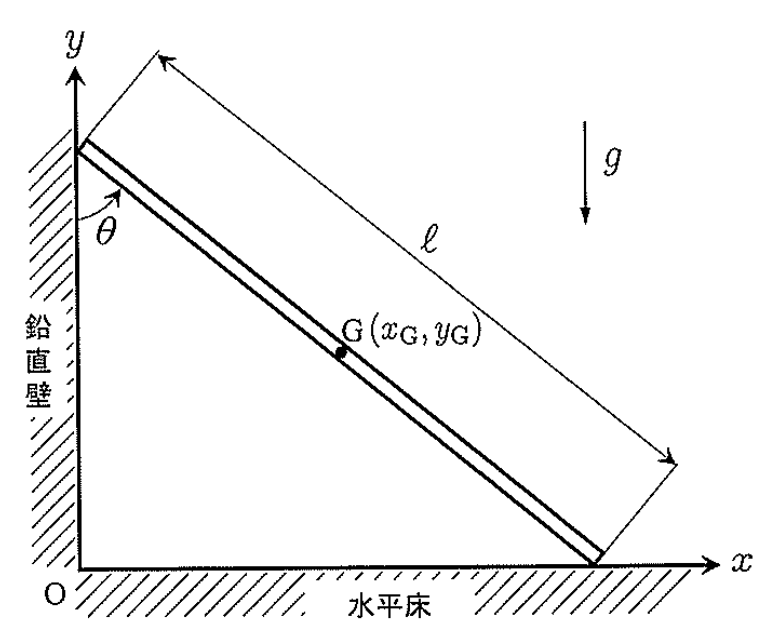
質量 mm、長さ ℓ\ell の一様な棒の両端が、滑らかな鉛直壁と水平床に接している。壁と床の交点を O、床に沿う右向きを xx 軸、壁に沿う上向きを yy 軸とする。壁から棒上端への抗力は +x+x 向きに NxN_x、床から下端への抗力は +y+y 向きに NyN_y である。重心 G の座標を (xG,yG)(x_G,y_G)、棒の角を鉛直下向きから測って θ\theta とする。

時刻 00 に棒は θ=θ0\theta=\theta_0(0<θ0<π/20<\theta_0<\pi/2)で静止しており、そこから静かに放す。棒が動き始めてから上端が壁を離れるまでを考える。棒の太さを無視し、重心まわりの慣性モーメントを IGI_G、重力加速度の大きさを gg とする。

  1. 棒の並進および G まわりの回転の運動方程式を、m,IG,xG,yG,θ,Nx,Nym,I_G,x_G,y_G,\theta,N_x,N_y で表せ。
  2. IGI_G を m,ℓm,\ell で表せ。
  3. (1)、(2) から Nx,NyN_x,N_y を消去し、θ¨\ddot\theta を求めよ。
  4. エネルギー保存則から θ˙\dot\theta を求めよ。
  5. 上端が壁から離れる瞬間の cos⁡θ\cos\theta を求めよ。
  6. 下端が床から離れないことを示せ。

原題の図

题目描述​

质量为 mm、长度为 ℓ\ell 的均匀细杆,两端分别接触光滑竖直墙和水平地面。以墙角为原点,向右为 xx 正方向、向上为 yy 正方向。墙面对上端的支持力为 NxN_x,地面对下端的支持力为 NyN_y。质心坐标为 (xG,yG)(x_G,y_G),杆相对于竖直向下的夹角为 θ\theta。

从静止角度 θ0∈(0,π/2)\theta_0\in(0,\pi/2) 释放,研究开始运动至上端离墙的阶段。忽略杆的粗细,记质心转动惯量为 IGI_G,重力加速度为 gg。

  1. 写出质心平动和绕质心转动的方程。
  2. 求 IGI_G。
  3. 消去支持力,求角加速度。
  4. 用能量守恒求角速度。
  5. 求上端离墙时的 cos⁡θ\cos\theta。
  6. 证明下端不会离开地面。

Kai​

(1)​

並進と重心まわりの回転の運動方程式は

mx¨G=Nx,my¨G=Ny−mg,\boxed{m\ddot x_G=N_x},\qquad \boxed{m\ddot y_G=N_y-mg},
IGθ¨=ℓ2(Nysin⁡θ−Nxcos⁡θ).\boxed{I_G\ddot\theta =\frac\ell2(N_y\sin\theta-N_x\cos\theta)}.

(2)​

線密度 m/ℓm/\ell より

IG=mℓ∫−ℓ/2ℓ/2s2 ds=112mℓ2.\boxed{I_G=\frac m\ell\int_{-\ell/2}^{\ell/2}s^2\,ds =\frac1{12}m\ell^2}.

(3)​

両端が壁と床に接している間は

xG=ℓ2sin⁡θ,yG=ℓ2cos⁡θ.x_G=\frac\ell2\sin\theta,\qquad y_G=\frac\ell2\cos\theta.

従って

x¨G=ℓ2(θ¨cos⁡θ−θ˙2sin⁡θ),y¨G=−ℓ2(θ¨sin⁡θ+θ˙2cos⁡θ).\ddot x_G=\frac\ell2(\ddot\theta\cos\theta-\dot\theta^2\sin\theta), \qquad \ddot y_G=-\frac\ell2(\ddot\theta\sin\theta+\dot\theta^2\cos\theta).

これらと Nx=mx¨G,Ny=m(y¨G+g)N_x=m\ddot x_G,N_y=m(\ddot y_G+g) を回転の式に代入すると

112mℓ2θ¨=−14mℓ2θ¨+12mgℓsin⁡θ.\frac1{12}m\ell^2\ddot\theta =-\frac14m\ell^2\ddot\theta+\frac12mg\ell\sin\theta.

よって

θ¨=3g2ℓsin⁡θ.\boxed{\ddot\theta=\frac{3g}{2\ell}\sin\theta}.

(4)​

抗力は仕事をしない。x˙G2+y˙G2=ℓ2θ˙2/4\dot x_G^2+\dot y_G^2=\ell^2\dot\theta^2/4 とエネルギー保存から

mgℓ2cos⁡θ0=mgℓ2cos⁡θ+12mℓ24θ˙2+12mℓ212θ˙2.\frac{mg\ell}{2}\cos\theta_0 =\frac{mg\ell}{2}\cos\theta +\frac12m\frac{\ell^2}{4}\dot\theta^2 +\frac12\frac{m\ell^2}{12}\dot\theta^2.

θ\theta は増加するので

θ˙=3gℓ(cos⁡θ0−cos⁡θ).\boxed{\dot\theta=\sqrt{\frac{3g}{\ell}(\cos\theta_0-\cos\theta)}}.

(5)​

(3)、(4) を水平抗力の式に入れると

Nx=3mg4sin⁡θ(3cos⁡θ−2cos⁡θ0).N_x=\frac{3mg}{4}\sin\theta(3\cos\theta-2\cos\theta_0).

sin⁡θ>0\sin\theta>0 であり、上端が壁を離れるとき Nx=0N_x=0 だから

cos⁡θ=23cos⁡θ0.\boxed{\cos\theta=\frac23\cos\theta_0}.

(6)​

鉛直抗力は

Ny=mg−mℓ2(θ¨sin⁡θ+θ˙2cos⁡θ)=mg[94cos⁡2θ−32cos⁡θ0cos⁡θ+14]=mg4[9(cos⁡θ−13cos⁡θ0)2+sin⁡2θ0]>0.\begin{aligned} N_y&=mg-\frac{m\ell}{2} (\ddot\theta\sin\theta+\dot\theta^2\cos\theta)\\ &=mg\left[\frac94\cos^2\theta -\frac32\cos\theta_0\cos\theta+\frac14\right]\\ &=\frac{mg}{4}\left[ 9\left(\cos\theta-\frac13\cos\theta_0\right)^2 +\sin^2\theta_0\right]>0. \end{aligned}

0<θ0<π/20<\theta_0<\pi/2 より右辺は正であり、対象としている運動中に下端は床から離れない。