大阪大学 工学研究科 電気電子情報工学専攻 2019年8月実施 基礎科目 数学1
Author
Miyake
Description
t を実変数とし、(x,y) 平面におけるベクトル
v(t)=(x(t)y(t))=exp(tA)v(0)(1)
に関し、A を2次元正方行列
A=(0110)
として、以下の設問 (a)〜(c) に答えよ。
(a) A の固有値および固有ベクトルをすべて求めよ。
(b) 行列 X の指数関数は
exp(X)=n→∞lim(E+nX)n
で与えられる。E+(t/n)A を対角化し、exp(tA) を求めよ。ただし、n は正の整数、E は単位行列である。
(c) 式 (1) で表される曲線群の概略を、(x,y) 平面上に図示せよ。
题目描述
实变量 t 下,平面向量满足 v(t)=(x(t),y(t))T=etAv(0),其中 A=(0110)。
(a) 求 A 的所有特征值和特征向量。
(b) 利用矩阵指数的极限定义 eX=limn→∞(E+X/n)n,将 E+(t/n)A 对角化并求 etA;E 为单位矩阵,n 为正整数。
(c) 在 xy 平面画出该向量方程给出的曲线族概形。
Kai
(a)
A の固有値を λ とすると、
0=det(−λ11−λ)=λ2−1=(λ+1)(λ−1)∴λ=±1
固有値 λ=1 に属する固有ベクトルは、例えば、
21(11)
固有値 λ=−1 に属する固有ベクトルは、例えば、
21(1−1)
(b)
(a)で求めた固有ベクトルを使って、次のように定義する:
P=21(111−1)
このとき、次が成り立つ:
PPPAP=E=(100−1)
よって、
P(E+ntA)P=E+nt(100−1)=(1+nt001−nt)
なので、
exp(tA)=n→∞lim(E+ntA)n=n→∞limP(1+nt001−nt)nP=n→∞limP((1+nt)n00(1−nt)n)P=P(et00e−t)P=21(et+e−tet−e−tet−e−tet+e−t)=(coshtsinhtsinhtcosht)
(c)
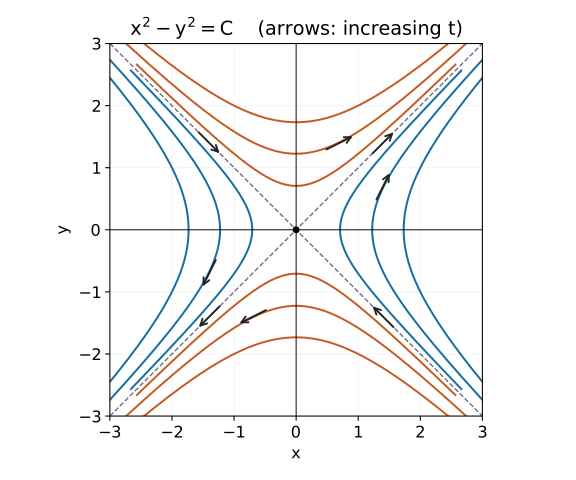
以下は本稿で補った解答である。u=x+y、v=x−y とおくと、v˙=Av より
u˙=u,v˙=−v.
従って u(t)=u(0)et、v(t)=v(0)e−t であり、
x2−y2=uv=u(0)v(0)=C
が軌道を与える。C>0 は左右に開く双曲線、C<0 は上下に開く双曲線である。各初期値はその一方の枝を選ぶ。
C=0 では y=x または y=−x の半直線となる。時間が増すと y=x 上では原点から遠ざかり、y=−x 上では原点に近づく。原点自体は静止解である。
Reference