九州大学 工学府 機械系専攻 2019年8月実施 機械力学 問3 Author 祭音Myyura (co-authored with GPT 6 Astra)
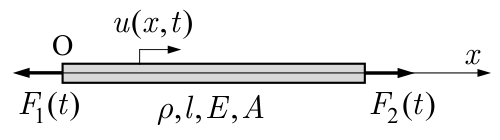
Description 図のように、左端および右端にそれぞれ長手方向の外力 F 1 ( t ) F_1(t) F 1 ( t ) F 2 ( t ) F_2(t) F 2 ( t ) l l l ρ \rho ρ E E E A A A x x x t t t u ( x , t ) u(x,t) u ( x , t )
(1) 棒の縦振動を表す運動方程式(波動方程式)を導出せよ。
(2) F 1 ( t ) = 0 , F 2 ( t ) = F cos Ω t F_1(t)=0,\ F_2(t)=F\cos\Omega t F 1 ( t ) = 0 , F 2 ( t ) = F cos Ω t u ( x , t ) = U ( x ) cos Ω t u(x,t)=U(x)\cos\Omega t u ( x , t ) = U ( x ) cos Ω t U ( x ) U(x) U ( x )
(3) F 1 ( t ) = F sin Ω t , F 2 ( t ) = F cos Ω t F_1(t)=F\sin\Omega t,\ F_2(t)=F\cos\Omega t F 1 ( t ) = F sin Ω t , F 2 ( t ) = F cos Ω t
(4) F 1 ( t ) = F sin Ω t , F 2 ( t ) = F cos Ω t F_1(t)=F\sin\Omega t,\ F_2(t)=F\cos\Omega t F 1 ( t ) = F sin Ω t , F 2 ( t ) = F cos Ω t F 1 ( t ) F_1(t) F 1 ( t ) F 2 ( t ) F_2(t) F 2 ( t )
题目描述
如图,长度为 l l l ρ \rho ρ E E E A A A F 1 ( t ) , F 2 ( t ) F_1(t),F_2(t) F 1 ( t ) , F 2 ( t ) x x x u ( x , t ) u(x,t) u ( x , t ) t t t
(1) 推导描述杆纵向振动的运动方程(波动方程)。
(2) 当 F 1 ( t ) = 0 , F 2 ( t ) = F cos Ω t F_1(t)=0,\ F_2(t)=F\cos\Omega t F 1 ( t ) = 0 , F 2 ( t ) = F cos Ω t u ( x , t ) = U ( x ) cos Ω t u(x,t)=U(x)\cos\Omega t u ( x , t ) = U ( x ) cos Ω t U ( x ) U(x) U ( x )
(3) 当 F 1 ( t ) = F sin Ω t , F 2 ( t ) = F cos Ω t F_1(t)=F\sin\Omega t,\ F_2(t)=F\cos\Omega t F 1 ( t ) = F sin Ω t , F 2 ( t ) = F cos Ω t
(4) 对 F 1 ( t ) = F sin Ω t , F 2 ( t ) = F cos Ω t F_1(t)=F\sin\Omega t,\ F_2(t)=F\cos\Omega t F 1 ( t ) = F sin Ω t , F 2 ( t ) = F cos Ω t F 1 ( t ) F_1(t) F 1 ( t ) F 2 ( t ) F_2(t) F 2 ( t )
Kai (1)
軸力 N = E A u x N=EAu_x N = E A u x d x dx d x
ρ A d x u t t = N ( x + d x , t ) − N ( x , t ) = E A u x x d x . \begin{gathered}
\rho A\,dx\,u_{tt}=N(x+dx,t)-N(x,t)\\
=EAu_{xx}\,dx.
\end{gathered} ρ A d x u tt = N ( x + d x , t ) − N ( x , t ) = E A u xx d x . したがって
u t t = c 2 u x x , c = E / ρ . \boxed{u_{tt}=c^2u_{xx}},\qquad c=\sqrt{E/\rho}. u tt = c 2 u xx , c = E / ρ . 端面の法線の向きを考慮すると境界条件は E A u x ( 0 , t ) = F 1 ( t ) EAu_x(0,t)=F_1(t) E A u x ( 0 , t ) = F 1 ( t ) E A u x ( l , t ) = F 2 ( t ) EAu_x(l,t)=F_2(t) E A u x ( l , t ) = F 2 ( t )
(2)
β = Ω / c \beta=\Omega/c β = Ω/ c U ′ ′ + β 2 U = 0 U''+\beta^2U=0 U ′′ + β 2 U = 0 U = C cos β x + D sin β x U=C\cos\beta x+D\sin\beta x U = C cos β x + D sin β x E A U ′ ( 0 ) = 0 EAU'(0)=0 E A U ′ ( 0 ) = 0 D = 0 D=0 D = 0 E A U ′ ( l ) = F EAU'(l)=F E A U ′ ( l ) = F
U ( x ) = − F cos β x E A β sin β l . \boxed{U(x)=-\frac{F\cos\beta x}{EA\beta\sin\beta l}}. U ( x ) = − E A β sin βl F cos β x . 以下は Ω > 0 \Omega>0 Ω > 0 sin β l ≠ 0 \sin\beta l\ne0 sin βl = 0
(3)
左端の正弦加振に対する解を (2) に重ね合わせると
u ( x , t ) = F E A β sin β l { cos β ( l − x ) sin Ω t − cos β x cos Ω t } . \boxed{u(x,t)=\frac{F}{EA\beta\sin\beta l}
\{\cos\beta(l-x)\sin\Omega t-\cos\beta x\cos\Omega t\}}. u ( x , t ) = E A β sin βl F { cos β ( l − x ) sin Ω t − cos β x cos Ω t } . 微分すれば両端の境界条件を満たす。
(4)
K = F / ( E A β sin β l ) K=F/(EA\beta\sin\beta l) K = F / ( E A β sin βl ) − x -x − x
W 1 = ∫ 0 2 π / Ω [ − F sin Ω t ] u t ( 0 , t ) d t = − π F K , \begin{gathered}
W_1=\int_0^{2\pi/\Omega}[-F\sin\Omega t]u_t(0,t)\,dt\\
=-\pi FK,
\end{gathered} W 1 = ∫ 0 2 π /Ω [ − F sin Ω t ] u t ( 0 , t ) d t = − π F K , W 2 = ∫ 0 2 π / Ω [ F cos Ω t ] u t ( l , t ) d t = π F K . W_2=\int_0^{2\pi/\Omega}[F\cos\Omega t]u_t(l,t)\,dt
=\pi FK. W 2 = ∫ 0 2 π /Ω [ F cos Ω t ] u t ( l , t ) d t = π F K . よって
W 1 = − π F 2 E A β sin β l , W 2 = π F 2 E A β sin β l . \boxed{\begin{gathered}
W_1=-\frac{\pi F^2}{EA\beta\sin\beta l},\\
W_2=\frac{\pi F^2}{EA\beta\sin\beta l}
\end{gathered}}. W 1 = − E A β sin βl π F 2 , W 2 = E A β sin βl π F 2 . W 1 + W 2 = 0 W_1+W_2=0 W 1 + W 2 = 0
Reference