京都大学 情報学研究科 システム科学専攻 2016年8月実施 専門科目 確率統計
Author
uogxtc, 祭音Myyura
Description
問題1
下記の確率密度関数にしたがう確率変数 X について、以下の設問に答えよ。
ただし、α>0, β>0 はパラメータ(母数)である。
f(x)={βααxα−1exp(−(βx)α)0(x>0)(x≤0)
(1) 確率変数 X の平均を、以下のガンマ関数とパラメータを用いて表せ。
Γ(θ)=∫0∞xθ−1e−xdx(θ>0)
(2) 確率密度関数 f(x) が規定する確率分布から、大きさ n の無作為標本
{X1,X2,…,Xn}
が得られたとする。このとき、パラメータ α=α0 を既知として、パラメータ β の最尤推定量を求めよ。
問題2
以下の設問に答えよ。
(1) X1,X2,…,Xn を、独立かつ同一の確率分布(確率密度関数を f(x)、累積分布関数を F(x) とする)にしたがう確率変数とする。
このとき、X1,X2,…,Xn の最小値
Z=min(X1,X2,…,Xn)
もまた確率変数となるが、その確率密度関数 g(z) を f と F を用いて表せ。
(2) 設問 (1) の X1,X2,…,Xn の確率分布が区間 [0,b] の一様分布 (b>0) であるとき、
Z=min(X1,X2,…,Xn)
の期待値を求めよ。
問題3
以下の設問に答えよ。
(1) 半径 a の円 C 内に、2 点 A,B を独立かつそれぞれ円 C 内の一様分布にしたがうようにとる。
AB 間の距離を R としたとき、R2 の期待値を求めよ。
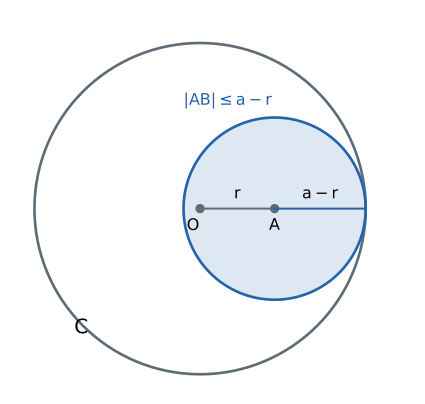
(2) 設問 (1) において、点 A を中心とし AB 間の距離 R を半径とする円が、円 C 内に全て含まれる確率を求めよ。
题目描述
- 随机变量 X 的概率密度函数为
f(x)=⎩⎨⎧βααxα−1exp[−(βx)α]0(x>0),(x≤0),
其中 α>0,β>0 为参数。
(1)使用 Gamma 函数
Γ(θ)=∫0∞xθ−1e−xdx(θ>0)
和上述参数表示 X 的均值。
(2)从该密度所规定的分布中得到容量为 n 的随机样本
{X1,X2,…,Xn}.
已知 α=α0,求参数 β 的最大似然估计量。
-
回答下列问题。
(1)设 X1,…,Xn 独立同分布,其密度函数和累积分布函数分别为 f(x),F(x)。令
Z=min(X1,X2,…,Xn).
用 f,F 表示 Z 的概率密度函数 g(z)。
(2)若第(1)问中的 X1,…,Xn 均服从区间 [0,b] 上的均匀分布,其中 b>0,求 Z 的期望。
-
回答下列问题。
(1)在半径为 a 的圆盘 C 内,独立地按圆盘上的均匀分布选取两点 A,B。令两点距离为 R,求 E[R2]。
(2)在第(1)问中,以 A 为圆心、以 R=AB 为半径的圆完全包含在圆盘 C 内的概率是多少?
Kai
問題1
(1) u=(x/β)α とおくと
E[X]=β∫0∞u1/αe−udu=βΓ(1+1/α).
(2) β に関係する対数尤度は −nα0logβ−β−α0∑iXiα0 である。微分して
dβdℓ=βα0(−n+β−α0i∑Xiα0).
符号が正から負に変わる点で最大となり、
β=(n1i=1∑nXiα0)1/α0.
問題2
(1) 独立性から P(Z>z)={1−F(z)}n。微分して
g(z)=n{1−F(z)}n−1f(z).
(2) 0<z<b では P(Z>z)=(1−z/b)n なので
E[Z]=∫0b(1−z/b)ndz=n+1b.
問題3
(1) O を円の中心とする。円盤上一様分布の半径の密度は 2r/a2 だから
E[∣OA∣2]=∫0ar2a22rdr=2a2,E[OA]=0.
A,B の独立性より
E[R2]=E[∣OA∣2]+E[∣OB∣2]−2E[OA]⋅E[OB]=a2.
(2) ∣OA∣=r を固定すると、求める条件は B が A を中心とする半径 a−r の円盤内にあることと同値。この円盤は元の円盤内に含まれるので条件付き確率は (a−r)2/a2。したがって
P=∫0aa2(a−r)2a22rdr=61.