京都大学 情報学研究科 知能情報学専攻 2024年8月実施 専門科目 S-4 Author itsuitsuki
Description 大学公表の原題
Let us define the Fourier transform F [ x ( t ) ] \mathcal{F}[x(t)] F [ x ( t )] x ( t ) x(t) x ( t ) F − 1 [ X ( ω ) ] \mathcal{F}^{-1}[X(\omega)] F − 1 [ X ( ω )] X ( ω ) X(\omega) X ( ω ) t t t ω \omega ω j = − 1 j = \sqrt{-1} j = − 1
F [ x ( t ) ] = ∫ − ∞ ∞ x ( t ) e − j ω t d t F − 1 [ X ( ω ) ] = 1 2 π ∫ − ∞ ∞ X ( ω ) e j ω t d ω \mathcal{F}[x(t)] = \int_{-\infty}^{\infty} x(t)e^{-j\omega t} \mathrm d t \\
\mathcal{F}^{-1}[X(\omega)] = \frac{1}{2\pi} \int_{-\infty}^{\infty} X(\omega)e^{j\omega t} \mathrm d\omega F [ x ( t )] = ∫ − ∞ ∞ x ( t ) e − jω t d t F − 1 [ X ( ω )] = 2 π 1 ∫ − ∞ ∞ X ( ω ) e jω t d ω Answer the following questions, where T 0 , ω 0 T_0, \omega_0 T 0 , ω 0 T T T
Q.1
Prove that the following equation holds for real functions f ( t ) f(t) f ( t ) g ( t ) g(t) g ( t ) ∗ * ∗
F [ f ( t ) g ( t ) ] = 1 2 π F [ f ( t ) ] ∗ F [ g ( t ) ] \mathcal{F}[f(t)g(t)] = \frac{1}{2\pi} \mathcal{F}[f(t)] * \mathcal{F}[g(t)] F [ f ( t ) g ( t )] = 2 π 1 F [ f ( t )] ∗ F [ g ( t )] Q.2
Compute the Fourier transform of the functions given below.
(1) x 1 ( t ) = 1 2 ( sgn ( T 0 − t ) + sgn ( T 0 + t ) ) x_1(t) = \frac{1}{2}(\text{sgn}(T_0 - t) + \text{sgn}(T_0 + t)) x 1 ( t ) = 2 1 ( sgn ( T 0 − t ) + sgn ( T 0 + t ))
where sgn ( t ) = { − 1 ( t < 0 ) 0 ( t = 0 ) 1 ( t > 0 ) \text{where } \text{sgn}(t) = \begin{cases} -1 & (t < 0) \\ 0 & (t = 0) \\ 1 & (t > 0) \end{cases} where sgn ( t ) = ⎩ ⎨ ⎧ − 1 0 1 ( t < 0 ) ( t = 0 ) ( t > 0 ) (2) x 2 ( t ) = { sin ω 0 t π t ( t ≠ 0 ) ω 0 π ( t = 0 ) x_2(t) = \begin{cases} \frac{\sin \omega_0 t}{\pi t} & (t \neq 0) \\ \frac{\omega_0}{\pi} & (t = 0) \end{cases} x 2 ( t ) = { π t s i n ω 0 t π ω 0 ( t = 0 ) ( t = 0 )
Q.3
Let x s ( t , T ) = x 2 ( t ) δ T ( t ) x_s(t, T) = x_2(t)\delta_T(t) x s ( t , T ) = x 2 ( t ) δ T ( t ) x 2 ( t ) x_2(t) x 2 ( t ) δ T ( t ) = ∑ k = − ∞ ∞ δ ( t − k T ) \delta_T(t) = \sum_{k=-\infty}^{\infty} \delta(t - kT) δ T ( t ) = ∑ k = − ∞ ∞ δ ( t − k T ) δ ( t ) \delta(t) δ ( t ) F [ δ T ( t ) ] = 1 T ∑ k = − ∞ ∞ δ ( ω − k T ) \mathcal{F}[\delta_T(t)] = \frac{1}{T} \sum_{k=-\infty}^{\infty} \delta(\omega - \frac{k}{T}) F [ δ T ( t )] = T 1 ∑ k = − ∞ ∞ δ ( ω − T k )
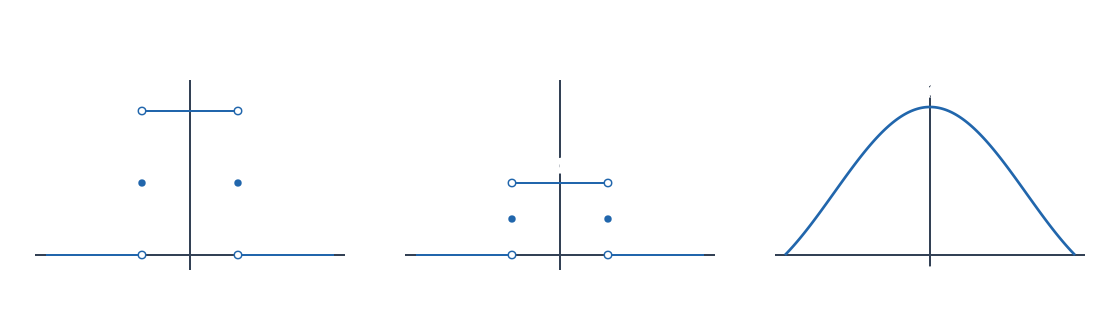
(1) Draw the graph of F [ x s ( t , 1 3 ω 0 ) ] \mathcal{F}[x_s(t, \frac{1}{3\omega_0})] F [ x s ( t , 3 ω 0 1 )] ∣ ω ∣ ≤ 3 ω 0 |\omega| \leq 3\omega_0 ∣ ω ∣ ≤ 3 ω 0
(2) Show the condition for T T T F [ x 2 ( t ) ] = F [ x s ( t , T ) ] \mathcal{F}[x_2(t)] = \mathcal{F}[x_s(t, T)] F [ x 2 ( t )] = F [ x s ( t , T )] ∣ ω ∣ ≤ ω 0 |\omega| \leq \omega_0 ∣ ω ∣ ≤ ω 0
(3) Draw the graph of F [ x s ( t , 2 3 ω 0 ) ] \mathcal{F}[x_s(t, \frac{2}{3\omega_0})] F [ x s ( t , 3 ω 0 2 )] ∣ ω ∣ ≤ 3 ω 0 |\omega| \leq 3\omega_0 ∣ ω ∣ ≤ 3 ω 0
(4) Draw the graph of F − 1 [ X s ( ω ) ] \mathcal{F}^{-1}[X_s(\omega)] F − 1 [ X s ( ω )] ∣ t ∣ ≤ π ω 0 |t| \leq \frac{\pi}{\omega_0} ∣ t ∣ ≤ ω 0 π X s ( ω ) X_s(\omega) X s ( ω )
X s ( ω ) = { F [ x s ( t , 2 3 ω 0 ) ] ( ∣ ω ∣ ≤ ω 0 ) 0 ( ∣ ω ∣ > ω 0 ) X_s(\omega) = \begin{cases} \mathcal{F}[x_s(t, \frac{2}{3\omega_0})] & (|\omega| \leq \omega_0) \\ 0 & (|\omega| > \omega_0) \end{cases} X s ( ω ) = { F [ x s ( t , 3 ω 0 2 )] 0 ( ∣ ω ∣ ≤ ω 0 ) ( ∣ ω ∣ > ω 0 ) 题目描述
连续时间 Fourier 变换及其逆变换定义为
F [ x ( t ) ] = ∫ − ∞ ∞ x ( t ) e − j ω t d t , F − 1 [ X ( ω ) ] = 1 2 π ∫ − ∞ ∞ X ( ω ) e j ω t d ω . \mathcal{F}[x(t)]=\int_{-\infty}^{\infty}x(t)e^{-j\omega t}\,dt,\qquad
\mathcal{F}^{-1}[X(\omega)]=\frac{1}{2\pi}\int_{-\infty}^{\infty}X(\omega)e^{j\omega t}\,d\omega. F [ x ( t )] = ∫ − ∞ ∞ x ( t ) e − jω t d t , F − 1 [ X ( ω )] = 2 π 1 ∫ − ∞ ∞ X ( ω ) e jω t d ω .
证明时域乘积的 Fourier 变换满足
F [ f ( t ) g ( t ) ] = 1 2 π ( F [ f ( t ) ] ∗ F [ g ( t ) ] ) , \mathcal{F}[f(t)g(t)]
=\frac{1}{2\pi}\bigl(\mathcal{F}[f(t)]*\mathcal{F}[g(t)]\bigr), F [ f ( t ) g ( t )] = 2 π 1 ( F [ f ( t )] ∗ F [ g ( t )] ) , 其中 ∗ * ∗
求下列两个信号的 Fourier 变换:
x 1 ( t ) = 1 2 { sgn ( T 0 − t ) + sgn ( T 0 + t ) } , x_1(t)=\frac12\{\operatorname{sgn}(T_0-t)+\operatorname{sgn}(T_0+t)\}, x 1 ( t ) = 2 1 { sgn ( T 0 − t ) + sgn ( T 0 + t )} , 其中符号函数 sgn ( ⋅ ) \operatorname{sgn}(\cdot) sgn ( ⋅ )
x 2 ( t ) = { sin ω 0 t π t ( t ≠ 0 ) , ω 0 π ( t = 0 ) . x_2(t)=
\begin{cases}
\dfrac{\sin\omega_0t}{\pi t} & (t\ne0),\\[4pt]
\dfrac{\omega_0}{\pi} & (t=0).
\end{cases} x 2 ( t ) = ⎩ ⎨ ⎧ π t sin ω 0 t π ω 0 ( t = 0 ) , ( t = 0 ) .
用冲激梳
δ T ( t ) = ∑ k = − ∞ ∞ δ ( t − k T ) \delta_T(t)=\sum_{k=-\infty}^{\infty}\delta(t-kT) δ T ( t ) = k = − ∞ ∑ ∞ δ ( t − k T ) 对 x 2 ( t ) x_2(t) x 2 ( t ) x s ( t , T ) = x 2 ( t ) δ T ( t ) x_s(t,T)=x_2(t)\delta_T(t) x s ( t , T ) = x 2 ( t ) δ T ( t )
F [ δ T ( t ) ] = 1 T ∑ k = − ∞ ∞ δ ( ω − k T ) . \mathcal{F}[\delta_T(t)]
=\frac1T\sum_{k=-\infty}^{\infty}\delta\left(\omega-\frac{k}{T}\right). F [ δ T ( t )] = T 1 k = − ∞ ∑ ∞ δ ( ω − T k ) . (1)在 ∣ ω ∣ ≤ 3 ω 0 |\omega|\leq3\omega_0 ∣ ω ∣ ≤ 3 ω 0 F [ x s ( t , 1 3 ω 0 ) ] \mathcal{F}[x_s(t,\frac{1}{3\omega_0})] F [ x s ( t , 3 ω 0 1 )] ∣ ω ∣ ≤ ω 0 |\omega|\leq\omega_0 ∣ ω ∣ ≤ ω 0 F [ x 2 ( t ) ] = F [ x s ( t , T ) ] \mathcal{F}[x_2(t)]=\mathcal{F}[x_s(t,T)] F [ x 2 ( t )] = F [ x s ( t , T )] T T T ∣ ω ∣ ≤ 3 ω 0 |\omega|\leq3\omega_0 ∣ ω ∣ ≤ 3 ω 0 F [ x s ( t , 2 3 ω 0 ) ] \mathcal{F}[x_s(t,\frac{2}{3\omega_0})] F [ x s ( t , 3 ω 0 2 )]
X s ( ω ) = { F [ x s ( t , 2 3 ω 0 ) ] ( ∣ ω ∣ ≤ ω 0 ) , 0 ( ∣ ω ∣ > ω 0 ) , X_s(\omega)=
\begin{cases}
\mathcal{F}[x_s(t,\frac{2}{3\omega_0})] & (|\omega|\leq\omega_0),\\
0 & (|\omega|>\omega_0),
\end{cases} X s ( ω ) = { F [ x s ( t , 3 ω 0 2 )] 0 ( ∣ ω ∣ ≤ ω 0 ) , ( ∣ ω ∣ > ω 0 ) , 在 ∣ t ∣ ≤ π ω 0 |t|\leq\frac{\pi}{\omega_0} ∣ t ∣ ≤ ω 0 π F − 1 [ X s ( ω ) ] \mathcal{F}^{-1}[X_s(\omega)] F − 1 [ X s ( ω )]
Kai Q.1
Assume, for example, that f , g f,g f , g g g g
F [ f g ] ( ω ) = ∫ R f ( t ) e − j ω t ( 1 2 π ∫ R G ( ν ) e j ν t d ν ) d t = 1 2 π ∫ R G ( ν ) F ( ω − ν ) d ν = 1 2 π ( F ∗ G ) ( ω ) . \begin{aligned}
\mathcal F[fg](\omega)
&=\int_{\mathbb R}f(t)e^{-j\omega t}
\left(\frac1{2\pi}\int_{\mathbb R}G(\nu)e^{j\nu t}\,d\nu\right)dt\\
&=\frac1{2\pi}\int_{\mathbb R}G(\nu)F(\omega-\nu)\,d\nu
=\frac1{2\pi}(F*G)(\omega).
\end{aligned} F [ f g ] ( ω ) = ∫ R f ( t ) e − jω t ( 2 π 1 ∫ R G ( ν ) e j ν t d ν ) d t = 2 π 1 ∫ R G ( ν ) F ( ω − ν ) d ν = 2 π 1 ( F ∗ G ) ( ω ) . Q.2
(1)
The function is 1 1 1 ∣ t ∣ < T 0 |t|<T_0 ∣ t ∣ < T 0 0 0 0 ∣ t ∣ > T 0 |t|>T_0 ∣ t ∣ > T 0 1 / 2 1/2 1/2
X 1 ( ω ) = ∫ − T 0 T 0 e − j ω t d t = { 2 sin ( ω T 0 ) / ω , ω ≠ 0 , 2 T 0 , ω = 0. X_1(\omega)=\int_{-T_0}^{T_0}e^{-j\omega t}\,dt
=\begin{cases}2\sin(\omega T_0)/\omega,&\omega\ne0,\\2T_0,&\omega=0.\end{cases} X 1 ( ω ) = ∫ − T 0 T 0 e − jω t d t = { 2 sin ( ω T 0 ) / ω , 2 T 0 , ω = 0 , ω = 0. (2)
The inverse transform of the frequency rectangle is
1 2 π ∫ − ω 0 ω 0 e j ω t d ω = sin ( ω 0 t ) π t , \frac1{2\pi}\int_{-\omega_0}^{\omega_0}e^{j\omega t}\,d\omega
=\frac{\sin(\omega_0t)}{\pi t}, 2 π 1 ∫ − ω 0 ω 0 e jω t d ω = π t sin ( ω 0 t ) , with the continuous value ω 0 / π \omega_0/\pi ω 0 / π t = 0 t=0 t = 0
X 2 ( ω ) = R ( ω ) : = { 1 , ∣ ω ∣ < ω 0 , 1 / 2 , ∣ ω ∣ = ω 0 , 0 , ∣ ω ∣ > ω 0 . X_2(\omega)=R(\omega):=
\begin{cases}
1,&|\omega|<\omega_0,\\
1/2,&|\omega|=\omega_0,\\
0,&|\omega|>\omega_0.
\end{cases} X 2 ( ω ) = R ( ω ) := ⎩ ⎨ ⎧ 1 , 1/2 , 0 , ∣ ω ∣ < ω 0 , ∣ ω ∣ = ω 0 , ∣ ω ∣ > ω 0 . Q.3
For the angular-frequency convention e − j ω t e^{-j\omega t} e − jω t
δ T ( t ) = 1 T ∑ m ∈ Z e j 2 π m t / T , F [ δ T ] ( ω ) = 2 π T ∑ m ∈ Z δ ( ω − 2 π m T ) . \delta_T(t)=\frac1T\sum_{m\in\mathbb Z}e^{j2\pi mt/T},
\qquad
\mathcal F[\delta_T](\omega)
=\frac{2\pi}{T}\sum_{m\in\mathbb Z}\delta\left(\omega-\frac{2\pi m}{T}\right). δ T ( t ) = T 1 m ∈ Z ∑ e j 2 πm t / T , F [ δ T ] ( ω ) = T 2 π m ∈ Z ∑ δ ( ω − T 2 πm ) . Using Q.1, the sampled spectrum is therefore
F [ x s ] ( ω ) = 1 T ∑ m ∈ Z R ( ω − 2 π m T ) . (*) \mathcal F[x_s](\omega)=\frac1T\sum_{m\in\mathbb Z}
R\left(\omega-\frac{2\pi m}{T}\right).
\tag{*} F [ x s ] ( ω ) = T 1 m ∈ Z ∑ R ( ω − T 2 πm ) . ( * ) The following answers use this transform convention and the half-height values of R R R
(1)
For T = 1 / ( 3 ω 0 ) T=1/(3\omega_0) T = 1/ ( 3 ω 0 ) 6 π ω 0 6\pi\omega_0 6 π ω 0 ∣ ω ∣ ≤ 3 ω 0 |\omega|\le3\omega_0 ∣ ω ∣ ≤ 3 ω 0
F [ x s ] ( ω ) = 3 ω 0 R ( ω ) ( ∣ ω ∣ ≤ 3 ω 0 ) . \mathcal F[x_s](\omega)=3\omega_0 R(\omega)
\qquad(|\omega|\le3\omega_0). F [ x s ] ( ω ) = 3 ω 0 R ( ω ) ( ∣ ω ∣ ≤ 3 ω 0 ) . (2)
In the absence of spectral overlap, 2 π / T > 2 ω 0 2\pi/T>2\omega_0 2 π / T > 2 ω 0 X 2 / T X_2/T X 2 / T ∣ ω ∣ ≤ ω 0 |\omega|\le\omega_0 ∣ ω ∣ ≤ ω 0
T = 1 and 0 < ω 0 < π . \boxed{T=1\quad\text{and}\quad0<\omega_0<\pi}. T = 1 and 0 < ω 0 < π . To see that overlap cannot provide another solution with these endpoint values, note that (*) is periodic with period a = 2 π / T a=2\pi/T a = 2 π / T a < 2 ω 0 a<2\omega_0 a < 2 ω 0 − ω 0 -\omega_0 − ω 0 − ω 0 + a -\omega_0+a − ω 0 + a R R R 1 / 2 1/2 1/2 1 1 1 a = 2 ω 0 a=2\omega_0 a = 2 ω 0 R R R
For amplitude-normalized sampling, the usual no-aliasing identity is instead
T F [ x s ] ( ω ) = X 2 ( ω ) , T < π ω 0 , ∣ ω ∣ ≤ ω 0 . T\mathcal F[x_s](\omega)=X_2(\omega),
\qquad T<\frac{\pi}{\omega_0},\quad |\omega|\le\omega_0. T F [ x s ] ( ω ) = X 2 ( ω ) , T < ω 0 π , ∣ ω ∣ ≤ ω 0 . The non-strict bound T ≤ π / ω 0 T\le\pi/\omega_0 T ≤ π / ω 0
(3)
For T = 2 / ( 3 ω 0 ) T=2/(3\omega_0) T = 2/ ( 3 ω 0 ) 3 π ω 0 3\pi\omega_0 3 π ω 0
F [ x s ] ( ω ) = 3 ω 0 2 R ( ω ) ( ∣ ω ∣ ≤ 3 ω 0 ) . \mathcal F[x_s](\omega)=\frac{3\omega_0}{2}R(\omega)
\qquad(|\omega|\le3\omega_0). F [ x s ] ( ω ) = 2 3 ω 0 R ( ω ) ( ∣ ω ∣ ≤ 3 ω 0 ) . (4)
The baseband restriction keeps this central rectangle. Consequently
F − 1 [ X s ] ( t ) = 3 ω 0 2 x 2 ( t ) = { 3 ω 0 sin ( ω 0 t ) 2 π t , t ≠ 0 , 3 ω 0 2 2 π , t = 0. \mathcal F^{-1}[X_s](t)
=\frac{3\omega_0}{2}\,x_2(t)
=\begin{cases}
\dfrac{3\omega_0\sin(\omega_0t)}{2\pi t},&t\ne0,\\[4pt]
\dfrac{3\omega_0^2}{2\pi},&t=0.
\end{cases} F − 1 [ X s ] ( t ) = 2 3 ω 0 x 2 ( t ) = ⎩ ⎨ ⎧ 2 π t 3 ω 0 sin ( ω 0 t ) , 2 π 3 ω 0 2 , t = 0 , t = 0. It is even, nonnegative on the requested interval, maximal at zero, and zero at t = ± π / ω 0 t=\pm\pi/\omega_0 t = ± π / ω 0