京都大学 情報学研究科 知能情報学専攻 2022年8月実施 専門科目 S-4
Author
Isidore, Passed, 祭音Myyura
Description
大学公表の原題 Let be an alphabet for information sources. Assume that irreducible and aperiodic Markov information sources and consisting of finite numbers of states satisfy:
- [C1] neither nor outputs any sequence including , and
- [C2] does not output any sequence including .
Answer all of the following subquestions from (1) to (5).
(1) Let be the states of . Draw the transition diagram of . Assume that should output with probability () when it is at state . You must make the number of the states minimum.
(2) Let be the states of . Draw the transition diagram of . Assume that should output with probability () when it is at state and with probability () when it is at state . You must make the number of the states minimum. Also explain the reason why your answer satisfies [C1] and [C2].
(3) Give the transition matrix of .
(4) Let a probability distribution be on the states . When the distribution is stationary and , represent each of with .
(5) Show the entropy of with when the initial distribution is equal to the stationary distribution given in (4).
题目描述
信息源字母表为 。有限状态、不可约且非周期的 Markov 信息源 满足:
- C1:二者都不会输出含
11的序列; - C2: 还不会输出含
0000的序列。
回答:
- 设 状态为 。画最少状态的转移图,并使在 时以概率 ()输出 0。
- 设 状态为 。画最少状态的转移图,使在 时以概率 输出 0、在 时以概率 输出 0();说明为何满足 C1、C2。
- 写出 的转移矩阵。
- 状态分布为 。当其为平稳分布且 时,用 表示全部 。
- 初始分布取第 4 问平稳分布时,用 表示 的熵率。
Kai
(1)
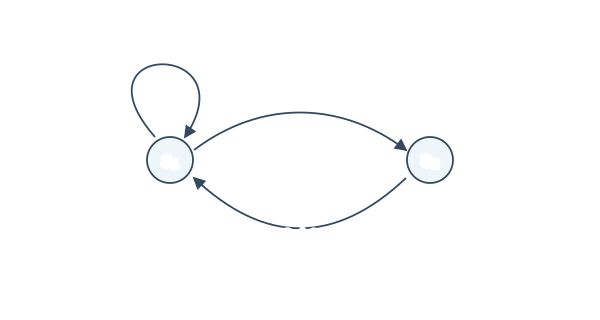
After output , the next output must be forced to . Since is stochastic for , this requires a distinct state, so two states are minimal.
(2)
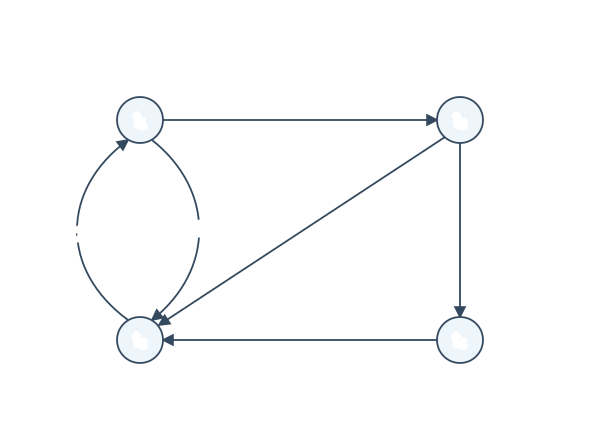
After an output , the diagram enters , whose next output is forced to be , so [C1] holds. After three consecutive outputs , it enters , whose next output is forced to be , so [C2] holds. Moreover, are stochastic because , while a forced- state and a distinct forced- state are necessary; hence at least four states are required.
All four states communicate for . The return cycles and have lengths and , so the chain is aperiodic.
(3)
(4)
(5)
Let denote the entropy function
hence