京都大学 情報学研究科 知能情報学専攻 2021年7月実施 専門科目 S-5
Author
祭音Myyura
Description
大学公表の原題
Let n∈Z be a discrete-time index.
The unit impulse signal δ[n] and the unit step signal u[n] are defined as follows:
δ[n]={01(n=0)(n=0)
u[n]={01(n<0)(n≥0)
Q.1 Compute the z-transform X(z) of a discrete-time signal x[n] given below.
- (1) x[n]=3δ[n]−2δ[n−2]+5δ[n−4]
- (2) x[n]=nu[n]
Q.2 Judge the stability of a system whose transfer function H(z) is given below and draw the correponding circuit.
In addition, compute the inverse z-transform h[n].
- (1) H(z)=1+2z−1+3z−2
- (2) H(z)=2−z−11+2z−1
Q.3 Compute the discrete-time Fourier transform F(ω) of a discrete-time signal x[n] given below, where ω represents a normalized angular frequency.
- (1) x[n]=3δ[n]−2δ[n−2]+5δ[n−4]
- (2) x[n]=u[n]−u[n−6]
题目描述
对离散时间 n∈Z,单位冲激和单位阶跃定义为
δ[n]={1,0,n=0n=0,u[n]={0,1,n<0n≥0.
- 求下列信号的 z 变换 X(z):
- x[n]=3δ[n]−2δ[n−2]+5δ[n−4];
- x[n]=nu[n]。
- 对下列传递函数,判断系统稳定性、画出对应电路,并求逆 z 变换 h[n]:
- H(z)=1+2z−1+3z−2;
- H(z)=2−z−11+2z−1。
- 求下列信号的离散时间 Fourier 变换 F(ω),其中 ω 为归一化角频率:
- x[n]=3δ[n]−2δ[n−2]+5δ[n−4];
- x[n]=u[n]−u[n−6]。
Kai
Q.1
The bilateral z-transform is used.
(1)
X(z)=3−2z−2+5z−4,∣z∣>0
(2)
Note that
n=−∞∑∞u[n]z−n=n=0∑∞z−n=1−z−11
hence
n=0∑∞(−n)z−n−1=(1−z−1)2−z−2
n=0∑∞nz−n=X(z)=(1−z−1)2z−1
The series in (2) converges for ∣z∣>1.
Q.2
For the circuit realizations below, assume a causal system initially at rest.
(1)
The finite impulse response is absolutely summable, so the system is BIBO stable.
The corresponding circuit diagram is as follows:
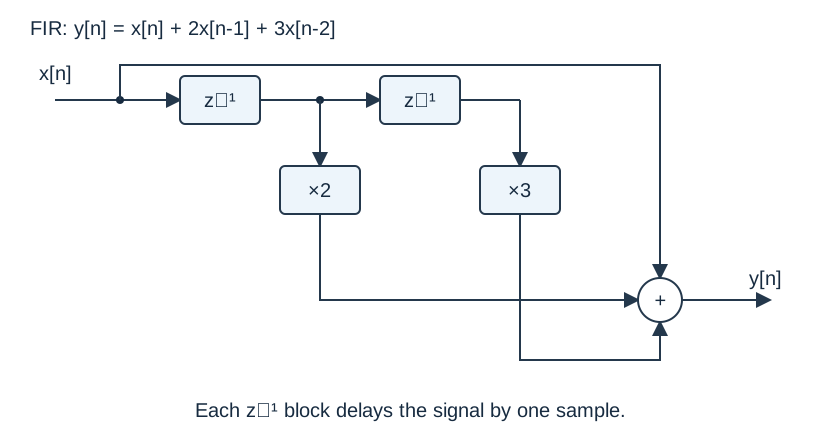
and
h[n]=δ[n]+2δ[n−1]+3δ[n−2]
(2)
For the causal realization, the region of convergence is ∣z∣>1/2, containing the unit circle, so the system is BIBO stable.
The corresponding circuit diagram is as follows:
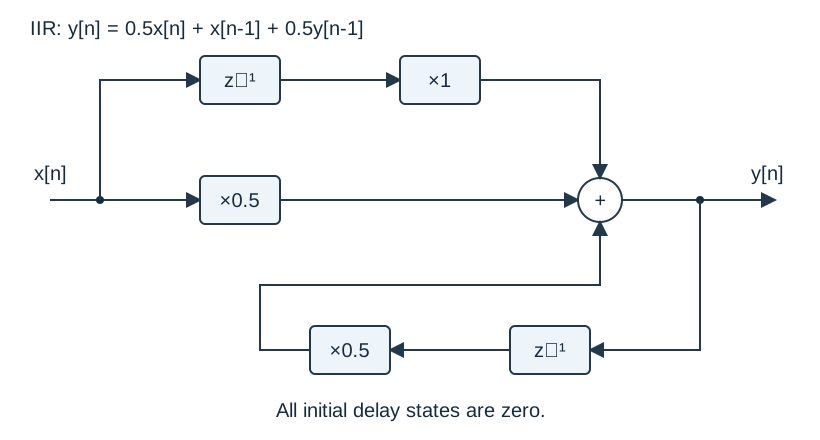
Note that
n=−∞∑∞anu[n]z−n=n=−∞∑∞u[n](az−1)n=n=0∑∞(az−1)n=1−az−11
hence
H(z)=−2+2−z−15=−2+251−2−1⋅z−11
⇒h[n]=−2δ[n]+5⋅2−n−1u[n]
Without the causal assumption, the same rational expression also permits the region ∣z∣<1/2, whose inverse is
h[n]=−2δ[n]−(5/2)(1/2)nu[−n−1]. This left-sided response is not absolutely summable and is unstable.
Q.3
Note that
n=−∞∑∞δ[n−a]e−iωn=e−iωa(*)
and
n=−∞∑∞(u[n]−u[n−a])e−iωn=k=0∑a−1e−iωk=1−e−iω1−e−iωa=e−iω/2(eiω/2−e−iω/2)e−iωa/2(eiωa/2−e−iωa/2)=e−iω(a−1)/2sinω/2sinaω/2(**)
(1)
By (*) we have
F(ω)=3−2e−i2ω+5e−i4ω
(2)
By (**) we have
F(ω)=e−i5ω/2sinω/2sin3ω
At ω=2πk (k∈Z), the value is F(ω)=6, obtained directly from the six-sample sum or by continuity.