京都大学 情報学研究科 通信情報システム専攻 2024年8月実施 専門基礎A [A-2]
Author
SUN, 祭音Myyura (co-authored with ChatGPT 5.4 Thinking)
Description
大学公表の原題 Answer all the following questions. Note that operators , , , and denote logical negation, logical and, logical or, and exclusive or, respectively.
(1)
Answer the following questions on the logic function defined below.
(a) Give all minimum sum-of-products expressions of .
(b) Derive a logic circuit that realizes with the minimum number of 3-input NAND gates only. Assume and their complements are available as inputs.
(c) Give all minimum product-of-sums expressions of .
(d) Assume logic functions
Among all the logic functions that satisfy
derive a minimum sum-of-products expression of a logic function that has the minimum number of product terms with the minimum number of literals in its sum-of-products form. If there is no logic function that satisfies , state that does not exist.
(2)
We design a Moore-type synchronous sequential circuit that has a 1-bit input and a 1-bit output using D flip-flop(s). Every time two or more 0s are given consecutively or two or more 1s are given consecutively, the output is inverted in the next clock cycle. The initial state is the state where 0 has been previously inputted to and the output is 0. Table 1 shows an operation example of this sequential circuit. The initial value of D flip-flop is 0. Answer the following questions.
Table 1
| clock cycle | 0 | 1 | 2 | 3 | 4 | 5 | 6 | 7 | 8 | 9 |
|---|---|---|---|---|---|---|---|---|---|---|
| input | 0 | 0 | 0 | 1 | 0 | 0 | 1 | 1 | 1 | 1 |
| output | 0 | 1 | 0 | 1 | 1 | 1 | 0 | 0 | 1 | 0 |
(a) Derive a state transition diagram of this sequential circuit.
(b) Regarding the state transition diagram derived in Question (a), minimize the number of states and show the state transition table and the output table after state assignment. Explain how you verified that the number of states is minimal. Use the minimum number of D flip-flop(s) for state assignment and show the state assignment result.
(c) We implement a sequential circuit corresponding to the state transition table and the output table derived in Question (b). Derive the excitation function(s) of the D flip-flop(s) and the output function of in a minimal sum-of-products form. The logic variables of the input and the output of a D flip-flop are and , respectively. If multiple flip-flops are used, distinguish them by subscripts.
题目描述
回答全部问题。、、、 分别表示逻辑非、与、或、异或。
-
对
回答:
-
给出 的所有最简与或式。
-
仅用三输入 NAND 门实现 ,使门数最少;可直接使用各变量及其反变量。
-
给出 的所有最简或与式。
-
设
在所有满足 的 中,求一种最简与或式,使乘积项数最少,并在此基础上文字数最少;若不存在则说明。
-
-
设计一个用 D 触发器实现、输入 、输出 均为 1 位的 Moore 同步时序电路。每当连续输入至少两个 ,或连续输入至少两个 时,输出 在下一时钟周期翻转。初态为此前输入是 且 ,D 触发器初值均为 。示例:
时钟周期 0 1 2 3 4 5 6 7 8 9 输入 0 0 0 1 0 0 1 1 1 1 输出 0 1 0 1 1 1 0 0 1 0 - 画状态转移图。
- 最小化状态数,用最少 D 触发器完成状态编码,并写出编码后的状态转移表、输出表;说明如何验证状态数最少,并给出状态分配。
- 求各 D 触发器激励函数及输出 的最简与或式;D 输入、Q 输出分别记作 ,多个时用下标。
Kai
(1)
(a)
By simplifying on a 4-variable Karnaugh map, the 1-cells can be grouped as follows:
- a group of 4 cells with and , giving the implicant ,
- a group of 4 cells with and , giving the implicant ,
- a group of 2 cells with , , and , giving the implicant .
Therefore, the minimum sum-of-products expression of is
This minimum SOP expression is unique.
(b)
Using
a minimum 3-input-NAND realization is:
and
So the minimum number of 3-input NAND gates is 4.
The 1-inputs cannot be covered pairwise by one implicant, so at least three product terms are required. To justify minimality, note that no literal is true on every 1-input and no entire literal half-space has output 1. The last NAND therefore cannot receive a primary literal. With at most three gates, its inputs must come from the preceding one or two gates. Parallel preceding gates give at most two product terms. If the first gate is and the second is , feeding both into the last gate gives , again at most two terms. Feeding only the second gives : nonconstant forces a common literal on all 1-inputs, while constant gives the complement of one product, contrary to the half-space property. Thus three gates cannot suffice.
(c)
To obtain the minimum product-of-sums form, group the 0-cells of the Karnaugh map:
- a group of 4 zeros with and , giving the maxterm ,
- a group of 4 zeros with and , giving the maxterm ,
- a group of 2 zeros with , , and , giving the maxterm .
Hence, the minimum product-of-sums expression of is
This minimum POS expression is unique.
(d)
We are given
and we need a logic function such that
First, consider the cases where .
In those cases, is uniquely determined by
For the cases where , since
the value of does not affect the equality as long as .
Thus, those cells can be treated as don't-care conditions in the Karnaugh map for .
Using the determined values together with the don't-care cells, the minimum sum-of-products expression is
This expression has the minimum number of product terms, and among them, the minimum number of literals.
(2)
(a)
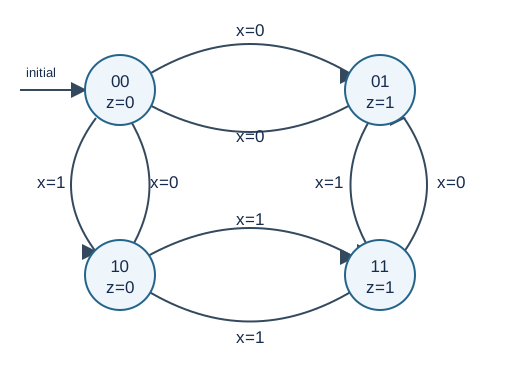
(b)
Assign to the previous input and to the current output . The initial state is . The minimized Moore machine has the following four states:
- :
- :
- :
- :
The state transition table is:
| Current State () | Next State for | Next State for | Output |
|---|---|---|---|
| (00) | (01) | (10) | 0 |
| (01) | (00) | (11) | 1 |
| (10) | (00) | (11) | 0 |
| (11) | (01) | (10) | 1 |
The number of states is minimal because no two states are equivalent:
- and have the same output, but with input , they go to states with different outputs.
- and have the same output, but with input , they go to states with different outputs.
- Any pair of states with different outputs are immediately distinguishable.
Therefore, all four states are necessary.
Since 4 states are required, the minimum number of D flip-flops is 2.
(c)
Two D flip-flops are required. Let their present-state outputs be , and their inputs be , respectively.
Using the state assignment
the excitation functions are
and
The output function is