(1) Consider a general communication system model, which consists of a source, destination, channel encoder, channel decoder, source encoder, source decoder, and communication channel. Draw this model as a block diagram.
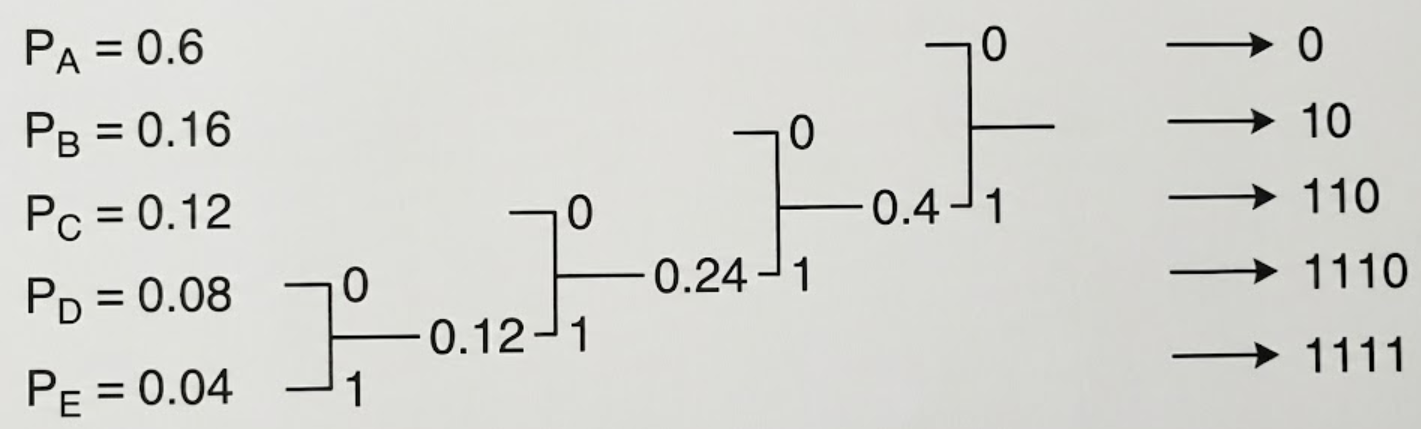
(2) A stationary memoryless information source S generates information symbols A,B,C,D, and E with probabilities 0.6,0.16,0.12,0.08, and 0.04 respectively. Answer the following questions. log23=1.6 and log25=2.3 may be used.
(a) Describe the definitions of “memoryless” and “stationary”.
(b) Find a binary Huffman code of S.
(c) Find the expected codeword length per symbol of the code in Question (b).
(d) Find the entropy of S.
(3) Let C be a memoryless binary symmetric channel (BSC) with crossover probability p. Answer the following questions.
(a) Show the channel matrix of C.
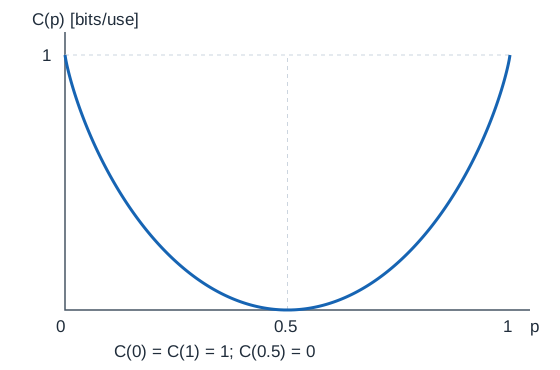
(b) Show that the channel capacity of C is given by 1+plog2p+(1−p)log2(1−p). In addition, graph it as a function of p.
(c) Consider communications with (7,4) Hamming code through C. Evaluate the probability of decoding failure assuming that any correctable errors are corrected.
(d) Find the channel capacity of a cascade of two BSCs with crossover probabilities p and q.
C=maxI(x;y)=maxH(y)−H(y∣x) H(y∣x)=H(1−p,p)=−[plog2p+(1−p)log2(1−p)]
A uniform input makes the output uniform for every p∈[0,1], so the upper bound H(y)≤1 is attainable.
maxH(y)=H(21)=1. So that C=1+plog2p+(1−p)log2(1−p).
 Source source encoder channel encoder Communication channel channel decoder source decoder destination