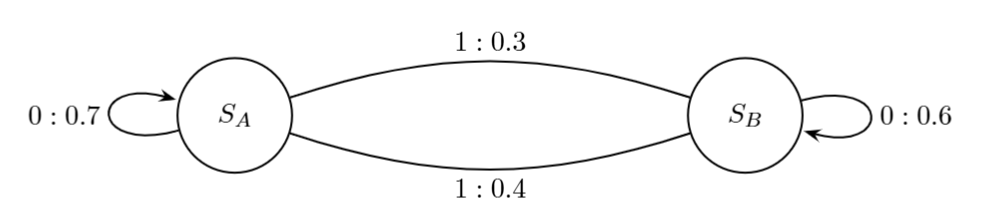
SA and SB are independent and stationary memoryless information sources. SA generates information symbols 0 and 1 with probabilities 0.7 and 0.3, respectively, while SB generates 0 and 1 with probabilities 0.6 and 0.4, respectively.
Answer the following questions. log23=1.6, log25=2.3, and log27=2.8 may be used.
(a) Find the value of the entropy of SA.
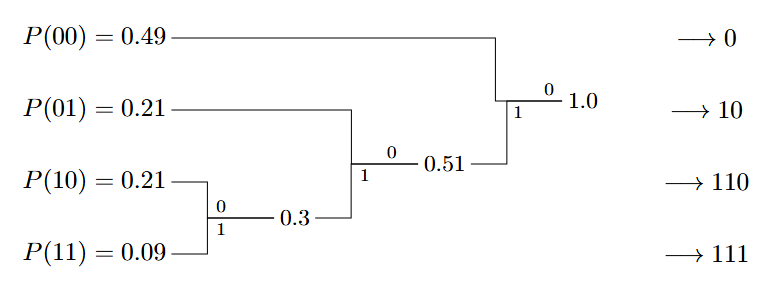
(b) Consider the nth extension of SA. Find a binary Huffman code for the second extension (n=2) of SA and the expected codeword length per symbol.
(c) Compare the entropy in Question (a) and the expected codeword length per symbol in Question (b). Explain which should be larger and the reason.
(d) Explain whether the expected codeword length per symbol in Question (b) increases or decreases as n in Question (b) increases and the reason.
(e) An information source SX has two states and generates information symbols by following SA and SB when its state is sA and sB, respectively. SX transits from a state to the other state when it generates 1. Draw the state diagram of SX.
(f) Find the stationary distribution of SX in Question (e).
(g) Find the value of the entropy of SX in Question (e). Round down to one decimal place.
Answer the following questions related to channel coding. Let C be the binary cyclic code of length 15 that has generator polynomial
G(x)=x4+x+1.
(a) Determine whether x10+x7+x4+x3+x2+x+1 is a codeword polynomial of C or not.
(b) Find the codeword polynomial for the message polynomial x5+x3+x in a systematic form.
(c) Find the minimum distance of C.
(d) Find the maximum number of error bits corrected by C.
(e) Consider communications with C through a memoryless binary symmetric channel with crossover probability p. Evaluate the probability of decoding failure assuming that any correctable errors are corrected.
According to Shannon's source coding theorem, the entropy of a source provides the ultimate lower bound on the average length of any lossless code for that source.
The source SA doesn't meet with dyadic distribution (powers of 1/2), so the Huffman coding will never reach the lower bound exactly.
Rounded down to one decimal place, the answer is 0.9 bits/symbol.
Using only the supplied coarse logarithm approximations instead gives H(SA)=0.86, H(SB)=0.94 and the approximate rate 6.26/7≈0.8943, whose downward rounding is 0.8. This discrepancy is caused by those approximations; 0.9 is the downward rounding of the entropy computed with accurate logarithms.
since g(x)=x4+x+1 is primitive of degree 4, this is the binary cyclic Hamming code.
For completeness, let α be a root of g(x). Its order is 15. A weight-two codeword would have the form xj(1+xℓ) with 1≤ℓ≤14, and divisibility by g would imply αℓ=1, a contradiction. Weight one is also impossible, while g(x) itself is a weight-three codeword. Hence
Achievability: For any data transmission rate R<C (channel capacity), it is possible to design a coding scheme that allows for communication with an arbitrarily low probability of error.
Converse: If R>C, it is impossible to achieve arbitrarily low probability of error.