跳到主要内容

北海道大学 情報科学院 情報科学専攻 情報エレクトロニクスコース 2022年8月実施 専門科目2 [2] 量子力学

Author

Miyake

Description

以下の各問において ii を虚数単位とする。また、\hbar はプランク定数 hh2π2\pi で割った定数とする。

1.

ハミルトニアンが

H=(ε100ε2)H= \begin{pmatrix} \varepsilon_1 & 0 \\ 0 & \varepsilon_2 \end{pmatrix}

で与えられている物理系がある。以下の問いに答えよ。

(1) 状態ベクトルを

φ(t)=c1(t)(10)+c2(t)(01)|\varphi(t)\rangle = c_1(t) \begin{pmatrix} 1 \\ 0 \end{pmatrix} + c_2(t) \begin{pmatrix} 0 \\ 1 \end{pmatrix}

と表したとき、φ(t)|\varphi(t)\rangle が満たすシュレディンガー方程式を考えることにより、 c1(t)c_1(t)c2(t)c_2(t) が初期値 c1(0)c_1(0)c2(0)c_2(0) によって

c1(t)=c1(0)exp(iε1t)c_1(t)=c_1(0)\exp\left(-i\frac{\varepsilon_1 t}{\hbar}\right)
c2(t)=c2(0)exp(iε2t)c_2(t)=c_2(0)\exp\left(-i\frac{\varepsilon_2 t}{\hbar}\right)

で与えられることを示せ。

(2) オブザーバブル

σ^=(cos2θsin2θsin2θcos2θ)\hat{\sigma} = \begin{pmatrix} \cos 2\theta & \sin 2\theta \\ \sin 2\theta & -\cos 2\theta \end{pmatrix}

の固有ベクトルが

λ1=(cosθsinθ)|\lambda_1\rangle = \begin{pmatrix} \cos\theta \\ \sin\theta \end{pmatrix}
λ2=(sinθcosθ)|\lambda_2\rangle = \begin{pmatrix} -\sin\theta \\ \cos\theta \end{pmatrix}

であることを示せ。

(3) 状態ベクトルの初期値が

φ(0)=λ1|\varphi(0)\rangle=|\lambda_1\rangle

であるとき、時刻 t0t\geq 0 でオブザーバブル σ^\hat{\sigma} を測定して結果 λ1\lambda_1 が得られる確率を求めよ。

2.

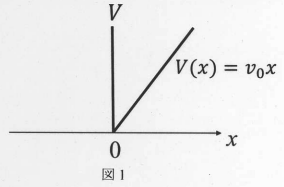
図1のように、x<0x<0V(x)=V(x)=\infty0x0\leq xV(x)=v0xV(x)=v_0x ただし、v0>0v_0>0 とする、と与えられている1次元ポテンシャル中に質量 mm の粒子が閉じ込められている。

以下の問いに答えよ。必要であれば正整数 nn について成立する次の公式を用いてよい。

0xnesxdx=n!sn+1\int_0^\infty x^n e^{-sx}\,dx = \frac{n!}{s^{n+1}}

(1) 波動関数を

ψ(x)={0,<x<0,Cxeαx,0x<\psi(x) = \begin{cases} 0, & -\infty<x<0, \\ Cxe^{-\alpha x}, & 0\leq x<\infty \end{cases}

としたとき、規格化定数 CC を定めよ。ただし、α>0\alpha>0 であるとする。

(2) (1) の波動関数で表される状態のエネルギーの期待値を求めよ。
Kai

1.

(1)

シュレディンガー方程式

iddtφ(t)=H^φ(t)φ(t)=c1(t)(10)+c2(t)(01) \begin{aligned} i \hbar \frac{d}{dt} | \varphi(t) \rangle = \hat{H} | \varphi(t) \rangle \end{aligned} に \begin{aligned} | \varphi(t) \rangle = c_1(t) \begin{pmatrix} 1 \\ 0 \end{pmatrix} + c_2(t) \begin{pmatrix} 0 \\ 1 \end{pmatrix} \end{aligned}

を代入すると、

i(dc1(t)dt(10)+dc2(t)dt(01))=ε1c1(t)(10)+ε2c2(t)(01) \begin{aligned} i \hbar \left( \frac{dc_1(t)}{dt} \begin{pmatrix} 1 \\ 0 \end{pmatrix} + \frac{dc_2(t)}{dt} \begin{pmatrix} 0 \\ 1 \end{pmatrix} \right) = \varepsilon_1 c_1(t) \begin{pmatrix} 1 \\ 0 \end{pmatrix} + \varepsilon_2 c_2(t) \begin{pmatrix} 0 \\ 1 \end{pmatrix} \end{aligned}

となるから、

idc1(t)dt=ε1c1(t),  idc2(t)dt=ε2c2(t) \begin{aligned} i \hbar \frac{dc_1(t)}{dt} = \varepsilon_1 c_1(t) , \ \ i \hbar \frac{dc_2(t)}{dt} = \varepsilon_2 c_2(t) \end{aligned}

であり、

c1(t)=c1(0)exp(iε1t),  c2(t)=c2(0)exp(iε2t) \begin{aligned} c_1(t) = c_1(0) \exp \left( -i \frac{\varepsilon_1 t}{\hbar} \right) , \ \ c_2(t) = c_2(0) \exp \left( -i \frac{\varepsilon_2 t}{\hbar} \right) \end{aligned}

がわかる。

(2)

まず、

σ^λ1=(cos2θcosθ+sin2θsinθsin2θcosθcos2θsinθ)=(cosθsinθ)=λ1\begin{aligned} \hat{\sigma} | \lambda_1 \rangle &= \begin{pmatrix} \cos 2 \theta \cos \theta + \sin 2 \theta \sin \theta \\ \sin 2 \theta \cos \theta - \cos 2 \theta \sin \theta \end{pmatrix} \\ &= \begin{pmatrix} \cos \theta \\ \sin \theta \end{pmatrix} \\ &= | \lambda_1 \rangle \end{aligned}

なので、 λ1| \lambda_1 \rangleσ^\hat{\sigma} の固有値 11 に属する固有ベクトルである。

また、

σ^λ2=(cos2θsinθ+sin2θcosθsin2θsinθcos2θcosθ)=(sinθcosθ)=λ2\begin{aligned} \hat{\sigma} | \lambda_2 \rangle &= \begin{pmatrix} - \cos 2 \theta \sin \theta + \sin 2 \theta \cos \theta \\ - \sin 2 \theta \sin \theta - \cos 2 \theta \cos \theta \end{pmatrix} \\ &= \begin{pmatrix} \sin \theta \\ - \cos \theta \end{pmatrix} \\ &= - | \lambda_2 \rangle \end{aligned}

なので、 λ2| \lambda_2 \rangleσ^\hat{\sigma} の固有値 1-1 に属する固有ベクトルである。

(3)

φ(0)=λ1=cosθ(10)+sinθ(01)\begin{aligned} | \varphi(0) \rangle &= | \lambda_1 \rangle \\ &= \cos \theta \begin{pmatrix} 1 \\ 0 \end{pmatrix} + \sin \theta \begin{pmatrix} 0 \\ 1 \end{pmatrix} \end{aligned}

なので、 (1) から、

φ(t)=cosθexp(iε1t)(10)+sinθexp(iε2t)(01)\begin{aligned} | \varphi(t) \rangle &= \cos \theta \exp \left( -i \frac{\varepsilon_1 t}{\hbar} \right) \begin{pmatrix} 1 \\ 0 \end{pmatrix} + \sin \theta \exp \left( -i \frac{\varepsilon_2 t}{\hbar} \right) \begin{pmatrix} 0 \\ 1 \end{pmatrix} \end{aligned}

がわかる。 よって、

λ1σ^φ(t)=λ1φ(t)=cos2θexp(iε1t)+sin2θexp(iε2t)\begin{aligned} \langle \lambda_1 | \hat{\sigma} | \varphi(t) \rangle &= \langle \lambda_1 | \varphi(t) \rangle \\ &= \cos^2 \theta \exp \left( -i \frac{\varepsilon_1 t}{\hbar} \right) + \sin^2 \theta \exp \left( -i \frac{\varepsilon_2 t}{\hbar} \right) \end{aligned}

となり、求める確率は、

λ1σ^φ(t)2=cos4θ+sin4θ+cos2θsin2θ(exp(i(ε1ε2)t)+exp(i(ε1ε2)t))=1+12sin22θ(cos((ε1ε2)t1))\begin{aligned} \left| \langle \lambda_1 | \hat{\sigma} | \varphi(t) \rangle \right|^2 &= \cos^4 \theta + \sin^4 \theta + \cos^2 \theta \sin^2 \theta \left( \exp \left( i \frac{(\varepsilon_1-\varepsilon_2) t}{\hbar} \right) + \exp \left( -i \frac{(\varepsilon_1-\varepsilon_2) t}{\hbar} \right) \right) \\ &= 1 + \frac{1}{2} \sin^2 2 \theta \left( \cos \left( \frac{(\varepsilon_1-\varepsilon_2)t}{\hbar} - 1 \right) \right) \end{aligned}

である。

2.

(1)

波動関数の規格化条件より、

1=ψ(x)2dx=C20x2eaxdx=C22a3\begin{aligned} 1 &= \int_{-\infty}^\infty \left| \psi(x) \right|^2 dx \\ &= |C|^2 \int_0^\infty x^2 e^{-ax} dx \\ &= |C|^2 \frac{2}{a^3} \end{aligned}

なので、

C=a32\begin{aligned} C &= \sqrt{\frac{a^3}{2}} \end{aligned}

とすればよい。

(2)

ポテンシャルエネルギーの期待値は

ψ(x)V(x)ψ(x)dx=C2v00x3eaxdx=a32v03!a4=3v0a\begin{aligned} \int_{-\infty}^\infty \psi(x)^* V(x) \psi(x) dx &= |C|^2 v_0 \int_0^\infty x^3 e^{-ax} dx \\ &= \frac{a^3}{2} v_0 \frac{3!}{a^4} \\ &= \frac{3v_0}{a} \end{aligned}

であり、運動エネルギーの期待値は

ψ(x)(22md2dx2)ψ(x)dx=22mC20xeax2(a+a24x)eax2dx=2a2ma320(x+a4x2)eaxdx=2a44m(1!a2+a42!a3)=2a28m\begin{aligned} \int_{-\infty}^\infty \psi(x)^* \left( - \frac{\hbar^2}{2m} \frac{d^2}{dx^2} \right) \psi(x) dx &= - \frac{\hbar^2}{2m} |C|^2 \int_0^\infty xe^{-\frac{ax}{2}} \left( -a + \frac{a^2}{4} x \right) e^{-\frac{ax}{2}} dx \\ &= - \frac{\hbar^2 a}{2m} \frac{a^3}{2} \int_0^\infty \left( -x + \frac{a}{4} x^2 \right) e^{-ax} dx \\ &= - \frac{\hbar^2 a^4}{4m} \left( - \frac{1!}{a^2} + \frac{a}{4} \frac{2!}{a^3} \right) \\ &= \frac{\hbar^2 a^2}{8m} \end{aligned}

であるから、エネルギーの期待値は

3v0a+2a28m\begin{aligned} \frac{3v_0}{a} + \frac{\hbar^2 a^2}{8m} \end{aligned}

である。