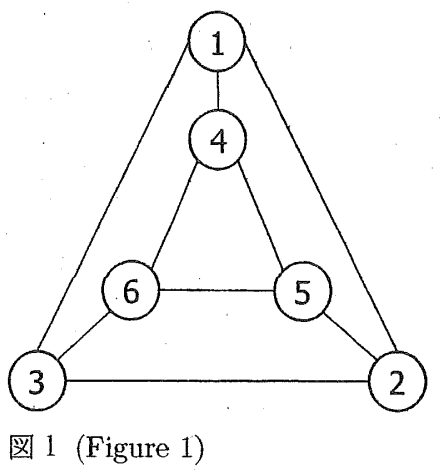
Given graph G=(V,E), a subset of edges A⊆E is called a matching if any two edges e,e′∈A share no end vertex.
A matching A is said to be maximal if any superset of A is not a matching.
(1) Show two maximal matchings of the graph shown in Figure 1.
(2) Prove ∣A−B∣≤2∣B−A∣ holds for any maximal matchings A and B of a given graph G. Here, A−B is defined as A−B={e∈A:e∈/B} and ∣A∣ denotes the cardinality of set A.
(3) Prove ∣A∣≤2∣B∣ by using the above statement and equation ∣A∣=∣A∩B∣+∣A−B∣.
(4) Show an example of graph G to have maximal matchings A and B satisfying ∣A∣=2∣B∣.
Note that each edge in B−A can be adjacent to at most 2 edges in A−B since A is a matching; and each edge in A−B is adjacent to an edge in B−A by maximality of B, hence we have