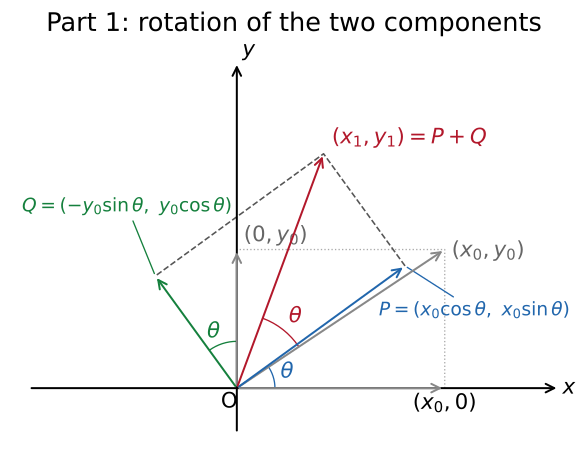
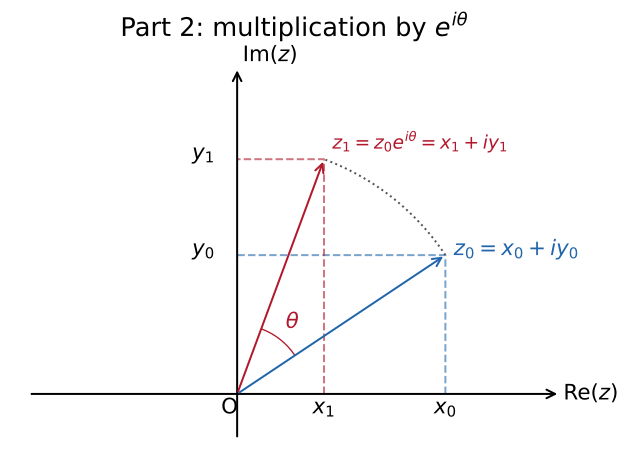
Let's detail the derivation of the 2D vector (x1,y1) obtained by rotating an initial 2D vector (x0,y0) counter-clockwise around the origin by an angle of θ radians.
[Part 1]
First, any 2D vector (x0,y0) can be expressed as the sum of a vector along the x-axis, (x0,0), and a vector along the y-axis, (0,y0), i.e., (x0,y0)=(x0,0)+(0,y0). Leveraging this property, the rotated vector (x1,y1) can be found by adding the vector obtained from rotating (x0,0) by an angle θ and the vector obtained from rotating (0,y0) by an angle θ. Next, let's consider rotating the vector (x0,0), which lies on the x-axis, by an angle θ. When a point at a distance of x0 from the origin rotates by an angle θ, its new x-coordinate becomes x0cosθ and its new y-coordinate becomes x0sinθ. Therefore, the vector obtained by rotating (x0,0) by an angle θ is (x0cosθ,x0sinθ).
Similarly, let's consider rotating the vector (0,y0), which lies on the y-axis, by an angle θ. When a point at a distance of y0 from the origin rotates by an angle θ, its new x-coordinate becomes −y0sinθ and its new y-coordinate becomes y0cosθ. This is because applying the standard rotation matrix to a vector with an x-component of 0 and a y-component of y0 yields these results. Thus, the vector obtained by rotating (0,y0) by an angle θ is (−y0sinθ,y0cosθ).
By summing the results from the previous steps, we can derive (x1,y1):
(x1,y1)=(x0cosθ,x0sinθ)+(−y0sinθ,y0cosθ).
Summing the respective components, we get:
x1=x0cosθ−y0sinθ,andy1=x0sinθ+y0cosθ.
Therefore, the 2D vector (x1,y1) obtained by rotating an initial 2D vector (x0,y0) counter-clockwise around the origin by an angle of θ radians is given by:
In a 2D plane, any point (x,y) can be uniquely represented as a complex number z=x+iy, where i is the imaginary unit (i2=−1). Similarly, our initial vector (x0,y0) can be written as the complex number z0=x0+iy0. The rotated vector (x1,y1) can be represented as z1=x1+iy1.
The key to understanding rotation in the complex plane lies in Euler's formula, which states that for any real number θ:
eiθ=cosθ+isinθ.
This complex exponential, eiθ, acts as a rotation operator. When you multiply a complex number by eiθ, you effectively rotate that complex number (and thus the corresponding vector) counter-clockwise around the origin by an angle θ.
To rotate the initial complex number z0=x0+iy0 by an angle θ, we simply multiply it by eiθ:
z1=z0eiθ.
Now, let's substitute the complex number representations and Euler's formula:
Recall that z1=x1+iy1. By comparing the real and imaginary parts of the equation above, we can directly find x1 and y1:
x1=x0cosθ−y0sinθ,andy1=x0sinθ+y0cosθ.
These are precisely the same rotation formulas we derived earlier using vector decomposition in the Cartesian coordinate system. This demonstrates how representing 2D vectors as complex numbers and using multiplication by eiθ provides an elegant and concise way to perform rotations.
Part 1 及び Part 2 の説明によく適合する図をそれぞれ1枚描け。図には説明で用いている軸名、座標、角度を必ず記すこと。
説明に基づいて行列 A の逆行列を導出する説明文を、日本語、英語の2通りで作成せよ。但し、説明文の内容は日本語、英語で同一にすること。
となる。実際、この行列と A の積は cos2θ+sin2θ=1 により単位行列となるので、逆行列である。
English. Matrix A represents a counter-clockwise rotation through angle θ about the origin. Its inverse transformation is a rotation through angle −θ. Replacing θ with −θ in the rotation matrix in the passage and using cos(−θ)=cosθ and sin(−θ)=−sinθ, we obtain
A−1=(cosθ−sinθsinθcosθ).
Indeed, multiplying this matrix by A gives the identity matrix because cos2θ+sin2θ=1, confirming that it is the inverse.