東京工業大学 情報理工学院 数理・計算科学系 2017年8月実施 午前 問C Author 祭音Myyura
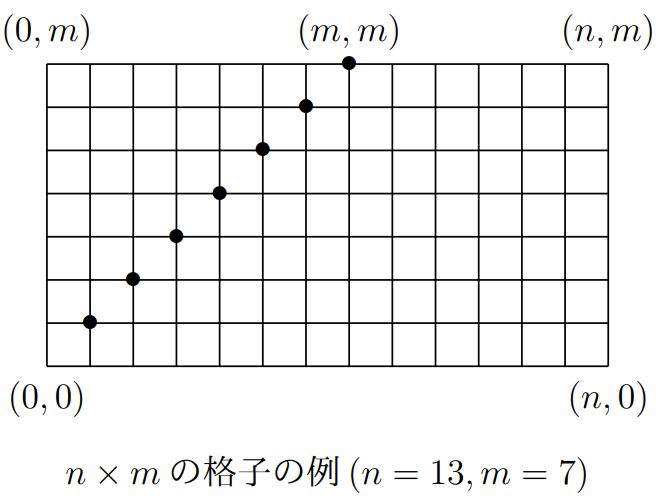
Description 以下の図に示すような n × m n \times m n × m n ≥ m ≥ 1 n \geq m \geq 1 n ≥ m ≥ 1
ここで,点 ( 0 , 0 ) (0, 0) ( 0 , 0 ) ( n , m ) (n, m) ( n , m ) P ( n , m ) \mathcal{P}(n, m) P ( n , m )
条件 1: 経路上の全ての点に関して,その右または上の隣接点へのみ移動可能.
有限集合 A に対して |A| は A の濃度 (要素数) を表すものとする.
(1) ∣ P ( n , m ) ∣ |\mathcal{P}(n,m)| ∣ P ( n , m ) ∣
P ( n , m ) \mathcal{P}(n,m) P ( n , m ) B ( n , m ) ⊆ P ( n , m ) \mathcal{B}(n, m) \subseteq \mathcal{P}(n, m) B ( n , m ) ⊆ P ( n , m )
条件 2: ある a ∈ { 1 , . . . , m } a \in \{1, . . . , m\} a ∈ { 1 , ... , m } ( a , a ) (a, a) ( a , a )
集合 B ( n , m ) \mathcal{B}(n,m) B ( n , m ) B ( 0 , 1 ) ( n , m ) ⊆ B ( n , m ) \mathcal{B}_{(0,1)}(n,m) \subseteq \mathcal{B}(n,m) B ( 0 , 1 ) ( n , m ) ⊆ B ( n , m ) B ( 1 , 0 ) ⊆ B ( n , m ) \mathcal{B}_{(1,0)} \subseteq \mathcal{B}(n,m) B ( 1 , 0 ) ⊆ B ( n , m )
B ( 0 , 1 ) ( n , m ) : B ( n , m ) \mathcal{B}_{(0,1)}(n,m): \mathcal{B}(n,m) B ( 0 , 1 ) ( n , m ) : B ( n , m ) ( 0 , 1 ) (0, 1) ( 0 , 1 ) B ( 1 , 0 ) ( n , m ) : B ( n , m ) \mathcal{B}_{(1,0)}(n,m): \mathcal{B}(n,m) B ( 1 , 0 ) ( n , m ) : B ( n , m ) ( 1 , 0 ) (1, 0) ( 1 , 0 )
(2) ∣ B ( 0 , 1 ) ( n , m ) ∣ |\mathcal{B}_{(0,1)}(n,m)| ∣ B ( 0 , 1 ) ( n , m ) ∣
(3) ∣ B ( 1 , 0 ) ( n , m ) ∣ |\mathcal{B}_{(1,0)}(n,m)| ∣ B ( 1 , 0 ) ( n , m ) ∣
(4) r ( n , m ) = ∣ G ( n , m ) ∣ ∣ P ( n , m ) ∣ r(n,m) = \frac{|\mathcal{G}(n,m)|}{|\mathcal{P}(n,m)|} r ( n , m ) = ∣ P ( n , m ) ∣ ∣ G ( n , m ) ∣ G ( n , m ) = P ( n , m ) ∖ B ( n , m ) \mathcal{G}(n,m) = \mathcal{P}(n,m) \setminus \mathcal{B}(n,m) G ( n , m ) = P ( n , m ) ∖ B ( n , m ) n = 15 , m = 10 n = 15, m = 10 n = 15 , m = 10 r ( 15 , 10 ) r(15, 10) r ( 15 , 10 )
题目描述
考虑题面图示的 n × m n\times m n × m n ≥ m ≥ 1 n\geq m\geq1 n ≥ m ≥ 1 P ( n , m ) \mathcal P(n,m) P ( n , m ) ( 0 , 0 ) (0,0) ( 0 , 0 ) ( n , m ) (n,m) ( n , m )
条件 1: 在路径上的每一点,只能移动到其右侧或上侧的相邻点。
对有限集合 A A A ∣ A ∣ |A| ∣ A ∣
求 ∣ P ( n , m ) ∣ |\mathcal P(n,m)| ∣ P ( n , m ) ∣
在 P ( n , m ) \mathcal P(n,m) P ( n , m ) B ( n , m ) \mathcal B(n,m) B ( n , m )
条件 2: 存在某个 a ∈ { 1 , … , m } a\in\{1,\ldots,m\} a ∈ { 1 , … , m } ( a , a ) (a,a) ( a , a )
再把 B ( n , m ) \mathcal B(n,m) B ( n , m )
B ( 0 , 1 ) ( n , m ) \mathcal B_{(0,1)}(n,m) B ( 0 , 1 ) ( n , m ) B ( n , m ) \mathcal B(n,m) B ( n , m ) ( 0 , 1 ) (0,1) ( 0 , 1 ) B ( 1 , 0 ) ( n , m ) \mathcal B_{(1,0)}(n,m) B ( 1 , 0 ) ( n , m ) B ( n , m ) \mathcal B(n,m) B ( n , m ) ( 1 , 0 ) (1,0) ( 1 , 0 )
求 ∣ B ( 0 , 1 ) ( n , m ) ∣ |\mathcal B_{(0,1)}(n,m)| ∣ B ( 0 , 1 ) ( n , m ) ∣
求 ∣ B ( 1 , 0 ) ( n , m ) ∣ |\mathcal B_{(1,0)}(n,m)| ∣ B ( 1 , 0 ) ( n , m ) ∣
定义
G ( n , m ) = P ( n , m ) ∖ B ( n , m ) , r ( n , m ) = ∣ G ( n , m ) ∣ ∣ P ( n , m ) ∣ . \mathcal G(n,m)=\mathcal P(n,m)\setminus\mathcal B(n,m),
\qquad
r(n,m)=\frac{|\mathcal G(n,m)|}{|\mathcal P(n,m)|}. G ( n , m ) = P ( n , m ) ∖ B ( n , m ) , r ( n , m ) = ∣ P ( n , m ) ∣ ∣ G ( n , m ) ∣ . 求 r ( n , m ) r(n,m) r ( n , m ) n = 15 , m = 10 n=15,m=10 n = 15 , m = 10 r ( 15 , 10 ) r(15,10) r ( 15 , 10 )
Kai (1)
Total number of moves in which we have to move up to reach the last row = m = m = m
Total number of moves in which we have to move right to reach the last column = n = n = n
Total moves = m + n = m + n = m + n
Now think of moves as a string of ‘R’ and ‘U’ characters where ‘R’ at any ith index will tell us to move ‘Right’ and ‘U’ will tell us to move ‘Up’.
Then P ( n , m ) \mathcal{P}(n,m) P ( n , m ) ( n + m ) (n + m) ( n + m ) m m m n n n n n n m m m
Therefore,
∣ P ( n , m ) ∣ = ( n + m m ) |\mathcal{P}(n,m)| = \binom{n+m}{m} ∣ P ( n , m ) ∣ = ( m n + m ) (2)
Note that all paths go through the point ( 0 , 1 ) (0,1) ( 0 , 1 ) y = x y=x y = x
∣ B ( 0 , 1 ) ( n , m ) ∣ = ∣ P ( n , m − 1 ) ∣ = ( n + m − 1 m − 1 ) |\mathcal{B}_{(0,1)} (n,m)| = |\mathcal{P}(n, m-1)| = \binom{n+m-1}{m-1} ∣ B ( 0 , 1 ) ( n , m ) ∣ = ∣ P ( n , m − 1 ) ∣ = ( m − 1 n + m − 1 ) (3)
We take a path from ( 1 , 0 ) (1,0) ( 1 , 0 ) ( n , m ) (n,m) ( n , m ) y = x y=x y = x p p p
If we reflect the portion of the path from ( 1 , 0 ) (1,0) ( 1 , 0 ) p p p y = x y=x y = x ( 0 , 1 ) (0,1) ( 0 , 1 ) ( n , m ) (n,m) ( n , m ) ( 0 , 1 ) (0,1) ( 0 , 1 ) ( n , m ) (n,m) ( n , m ) y = x y=x y = x p ′ p' p ′ ( 0 , 1 ) (0,1) ( 0 , 1 ) p ′ p' p ′ ( 1 , 0 ) (1,0) ( 1 , 0 ) ( n , m ) (n,m) ( n , m )
Since this gives a bijection between the two types of paths, and since the number of paths from ( 0 , 1 ) (0,1) ( 0 , 1 ) ( n , m ) (n,m) ( n , m ) B ( 0 , 1 ) ( n , m ) \mathcal{B}_{(0,1)} (n,m) B ( 0 , 1 ) ( n , m )
∣ B ( 1 , 0 ) ( n , m ) ∣ = ∣ B ( 0 , 1 ) ( n , m ) ∣ = ( n + m − 1 m − 1 ) |\mathcal{B}_{(1,0)} (n,m)| = |\mathcal{B}_{(0,1)} (n,m)| = \binom{n+m-1}{m-1} ∣ B ( 1 , 0 ) ( n , m ) ∣ = ∣ B ( 0 , 1 ) ( n , m ) ∣ = ( m − 1 n + m − 1 ) (4)
By (2) and (3) we have
r ( n , m ) = ∣ G ( n , m ) ∣ ∣ P ( n , m ) ∣ = ( n + m m ) − 2 ( n + m − 1 m − 1 ) ( n + m m ) = 1 − 2 ( n + m − 1 m − 1 ) ( n + m m ) = 1 − 2 ⋅ ( n + m − 1 ) ! ( m − 1 ) ! n ! ⋅ m ! n ! ( m + n ) ! = 1 − 2 m m + n \begin{aligned}
r(n,m) &= \frac{|\mathcal{G}(n,m)|}{|\mathcal{P}(n,m)|} = \frac{\binom{n+m}{m}-2\binom{n+m-1}{m-1}}{\binom{n+m}{m}} \\
&= 1 - \frac{2\binom{n+m-1}{m-1}}{\binom{n+m}{m}} \\
&= 1 - 2 \cdot \frac{(n+m-1)!}{(m-1)!n!} \cdot \frac{m!n!}{(m+n)!} \\
&= 1 - \frac{2m}{m+n}
\end{aligned} r ( n , m ) = ∣ P ( n , m ) ∣ ∣ G ( n , m ) ∣ = ( m n + m ) ( m n + m ) − 2 ( m − 1 n + m − 1 ) = 1 − ( m n + m ) 2 ( m − 1 n + m − 1 ) = 1 − 2 ⋅ ( m − 1 )! n ! ( n + m − 1 )! ⋅ ( m + n )! m ! n ! = 1 − m + n 2 m Then
r ( 15 , 10 ) = 1 − 2 × 10 10 + 15 = 1 5 r(15, 10) = 1 - \frac{2 \times10}{10 + 15} = \frac{1}{5} r ( 15 , 10 ) = 1 − 10 + 15 2 × 10 = 5 1